
16
APR
2026
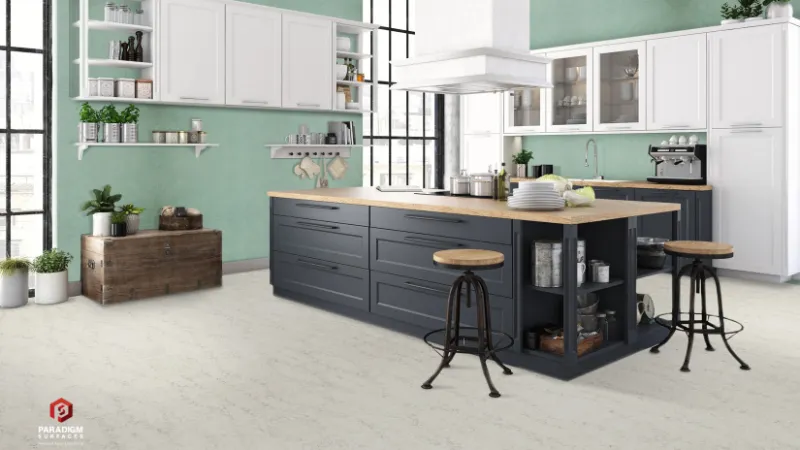
Modern kitchen design is moving towards warmer colour palettes, natural materials, streamlined surfaces, smarter storage, and islands that support cooking, dining, and socialising. Large-format quartz can help create coordinated countertops, statement islands, and full-height backsplashes, while varied colours and finishes offer flexibility for different interiors. The best designs balance visual appeal with practical considerations such as maintenance, heat exposure, storage, available space, and material sourcing. Rather than following every trend, designers should prioritise features that suit the client\'s lifestyle and the project\'s long-term needs.
Kitchens are increasingly expected to function as cooking areas, social spaces, and extensions of the living room. This is changing how designers approach cabinetry, layouts, lighting, and surface materials.
The NKBA\'s 2026 Kitchen Trends Report highlights continuing interest in neutral colours, natural materials, streamlined cabinetry, integrated storage, and multifunctional layouts. These trends point towards kitchens that feel considered but remain practical for everyday living.
For architects, designers, and developers, material selection is becoming an early design decision—not simply the final finish added to a completed layout.
Instead of combining a countertop with a separate tiled backsplash, designers are increasingly extending the surface material up the wall to create a more unified appearance.
Large-format quartz can support this approach through coordinated colours and patterns, fewer joints, and a wide range of finishes. Marble-inspired designs are particularly useful when the backsplash or island needs to become a focal point.
However, a seamless appearance depends on slab dimensions, fabrication, pattern alignment, and installation. Large-format slabs can reduce joints, but they do not guarantee a completely joint-free design.
Cool grey and high-contrast black-and-white schemes are making room for warmer combinations of cream, taupe, greige, sand, muted green, and natural wood.
These palettes create a softer atmosphere and work well across contemporary, transitional, and minimalist interiors. Grey quartz remains versatile, but warmer quartz shades can complement timber cabinetry, brushed metal fittings, and earthy flooring.
According to ELLE Decor\'s 2026 kitchen trend coverage, designers are increasingly introducing natural wood and earth-inspired tones rather than relying exclusively on cool monochromatic schemes.
Practical tip: View countertop samples alongside the actual cabinetry and flooring, ideally under lighting similar to the finished kitchen.
The kitchen island is no longer just an additional preparation surface. Depending on its size and layout, it may also accommodate dining, informal work, storage, and social interaction.
This makes the island\'s dimensions and material specification particularly important. Quartz is a popular option for its design flexibility and relatively low maintenance, but it requires protection from intense or sudden heat.
Designers should plan appliance cutouts, seating overhangs, storage, circulation, and support requirements before confirming the island\'s dimensions.
For compact homes, a well-proportioned peninsula or smaller island may provide more value than an oversized centrepiece.
Kitchen islands are increasingly treated as architectural features. Waterfall edges, curved forms, contrasting materials, and distinctive edge profiles can give the island visual presence without adding decorative clutter.
Quartz offers a range of colours and patterns for these designs, including marble-inspired veining and restrained neutral finishes.
The detail must suit the available space and budget. Waterfall panels require additional material and precise fabrication, while curved or unusual forms may increase production complexity. They also need appropriate structural support.
The objective is to make the island feel intentional rather than adding a feature simply because it is fashionable.
Clean countertops are easier to maintain visually when everyday appliances, accessories, and food-preparation items have designated storage.
Floor-to-ceiling cabinetry, deep drawers, appliance garages, and dedicated pantry areas help keep frequently used items accessible without leaving everything on display.
This trend also changes how surfaces are perceived: with fewer objects on the countertop, the colour, texture, and finish of the material become more prominent.
For multi-unit projects, integrated storage can improve functionality across different kitchen layouts. Designers should still ensure that concealed storage is convenient to access rather than sacrificing everyday usability for a minimal appearance.
Minimalist kitchens do not have to look plain. A dramatic island surface or full-height backsplash can provide visual interest while surrounding cabinetry remains understated.
Marble-inspired quartz designs offer controlled pattern options for clients who want expressive veining with different maintenance characteristics from natural marble.
Natural marble and quartzite remain relevant where authentic geological patterns and material individuality are essential to the design. The right selection depends on the project\'s aesthetic goals, budget, and maintenance expectations.
For strong veining, review the full slab—not just a small sample. Pattern direction and layout determine whether the finished surface looks balanced or fragmented.
Clients and project teams are paying closer attention to how kitchens function, how materials are maintained, and what can be verified about product sourcing.
Practical technology—such as well-planned task lighting, appropriately specified appliances, and useful kitchen-workstation fittings—can improve everyday operation without making the space unnecessarily complicated.
Material selection also deserves greater scrutiny. Engineered quartz should not automatically be described as sustainable simply because it contains natural quartz or may incorporate recycled material. Environmental performance depends on the product\'s composition, manufacturing, transportation, durability, and end-of-life options.
For sustainability-conscious projects, ask suppliers for relevant environmental product declarations, ingredient information, or other verifiable documentation where available.
Large-format quartz slabs can support several of these trends by helping designers coordinate island tops, long countertops, and backsplashes with fewer joints.
They can also provide greater flexibility when planning marble-inspired patterns and contemporary waterfall details.
For fabricators, the benefits depend on usable slab dimensions, cutting efficiency, handling capability, and project requirements. For developers and distributors, availability, batch matching, delivery schedules, and technical support are equally important.
Large-format material is a design tool, not a guarantee of better results. Careful planning and skilled fabrication are what turn the chosen slab into a successful installation.
Before incorporating a trend, ask three questions:
Does it suit the space? A large statement island might work in an open-plan residence but overwhelm a compact apartment kitchen.
Will it remain practical? Consider cleaning, heat exposure, storage access, circulation, and the client\'s daily habits.
Can it be delivered reliably? Confirm slab sizes, stock availability, fabrication requirements, lead times, and maintenance guidance before finalising the specification.
Using two or three complementary ideas often produces a more coherent result than combining every popular feature.
Warm neutral palettes, natural wood, concealed storage, multifunctional islands, streamlined cabinetry, and larger slab backsplashes are among the trends receiving attention in 2026. Their relevance varies by market, budget, and project type.
They can reduce joints across suitable countertops and backsplashes, offer coordinated patterns, and support larger island designs. The outcome depends on slab dimensions and fabrication planning.
Quartz is a strong option where consistent appearance and relatively low maintenance are priorities. It should be protected from direct heat, and the specific product must be suitable for its intended application.
Use a balanced palette, functional storage, appropriate lighting, and materials suited to the home\'s architecture. Introduce statement finishes selectively rather than relying entirely on short-lived design trends.
Modern kitchen design is moving towards spaces that combine visual simplicity with warmth, functionality, and thoughtful material selection.
Large-format quartz can help deliver coordinated surfaces, expressive islands, and refined backsplashes, while smart storage and warmer palettes make the overall space more practical and inviting.
For architects, designers, developers, and fabricators, the priority is not to follow every emerging trend. It is to identify the features that genuinely improve the project, choose materials that meet the required performance standards, and confirm that the design can be fabricated and supplied reliably.
Planning a contemporary kitchen or multi-unit residential project? Contact Paradigm Surfaces to discuss quartz designs, slab formats, samples, and technical specifications.
 24 September, 2026
Festive Home Makeovers: Refreshing Kitchens & Interiors with Stone
 20 September, 2026
 17 September, 2026
CNC Precision Cutting: How Technology Improves Edge & Inlay Work
 13 September, 2026
NSF & Food Safety Certifications: What They Mean for Quartz Surfaces
 12 September, 2026
Whatsapp Chatx
Hi! Click one of our representatives below to chat on WhatsApp or send us email to sales@paradigmquartz.in
 |
Contact Us +91 99440 00900 |