
13
MAY
2026
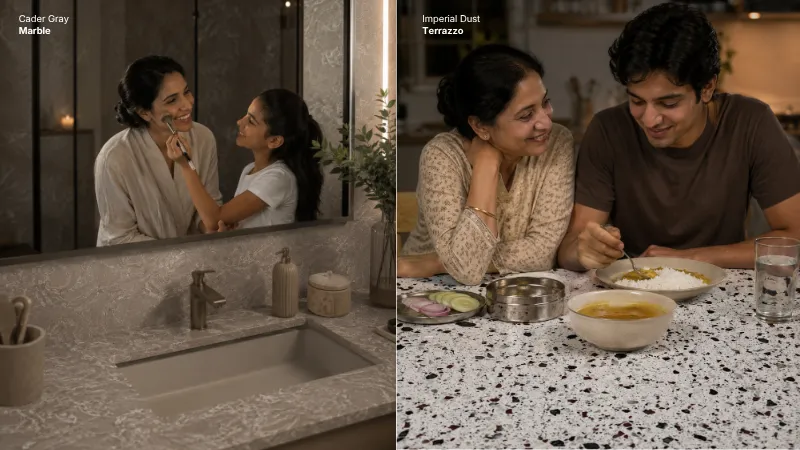
Marble and terrazzo can both give a home a premium finish, but they behave very differently once they are installed.
Marble brings natural veining, variation and a sense of luxury that makes every slab different. Terrazzo offers a more controlled surface, with the ability to customise colours and aggregates while creating a durable finish for larger areas.
So which one should you choose?
The answer depends less on which material looks better in a showroom and more on where you plan to use it, how much maintenance you accept and what you expect from the surface over time.
Marble and terrazzo serve different design needs. Marble is the stronger choice when natural veining, individuality and a luxurious appearance are the priority. Terrazzo is better suited to spaces that need durability, design flexibility and easier long-term maintenance, particularly floors and high-use areas. Marble generally needs more care, including sealing and protection from acidic substances. Terrazzo can have a higher initial installation cost, but its lifecycle value can make sense for larger, heavily used spaces. Many homes can also use both materials together.
Marble is a natural stone formed through geological processes. Every slab has its own colour variation, veining and surface character.
Terrazzo is a composite material made by combining aggregates such as marble, granite, quartz or glass with a cementitious or resin-based binder, then grinding and finishing the surface.
That difference defines much of their performance.
Marble gives you natural variation that cannot be perfectly repeated. Terrazzo gives you greater control over the final colour, aggregate and pattern.
Marble spans a wide price range. Local Indian varieties can be relatively accessible, while rare or imported stones can cost considerably more.
Terrazzo usually involves a more complex installation process, so its initial project cost can be higher.
But the purchase price is only part of the calculation.
Consider:
A higher upfront cost can make sense when the material is going into a high-use area and is expected to remain in place for many years.
Marble is durable, but it is relatively softer than many other surface materials. It can scratch, stain and react with acidic substances.
That does not make marble unsuitable for homes. It simply means the material should be used with an understanding of its behaviour.
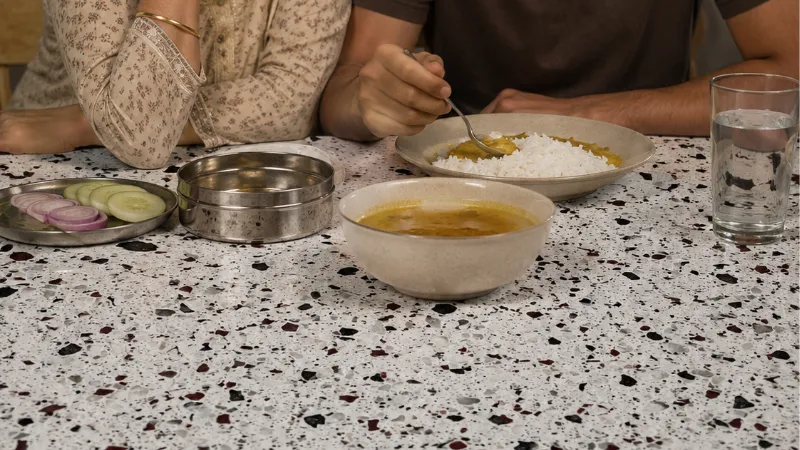
Terrazzo is often a strong option for floors and other surfaces that see repeated everyday traffic. The exact performance depends on the terrazzo system, aggregate, binder, installation and finish.
Low-to-moderate traffic: Marble can work beautifully.
Busy family areas: Terrazzo can offer a more forgiving surface.
Large continuous floors: Terrazzo can be particularly attractive when visual continuity matters.
This is one of the biggest differences between the two.
Marble generally needs more maintenance. Sealing, prompt spill cleanup and suitable cleaning products help protect the surface. Over time, natural marble can also develop a patina.
Terrazzo is generally simpler to maintain once correctly installed. Routine sweeping and mopping with appropriate cleaning products are usually sufficient, although maintenance requirements vary between cement-based and resin-based systems.
So ask yourself:
Do you want a surface that develops character over time, or one that prioritises easier upkeep?
That question can be more useful than comparing price alone.
This is where marble has a clear visual identity.
Natural marble offers:
No two slabs are exactly alike.
Terrazzo takes a different approach. You can influence the aggregate, background colour, chip size and overall pattern. That gives designers much more control over the finished look.
For contemporary interiors, terrazzo can create anything from subtle monochromatic surfaces to bold graphic patterns.
Both materials require skilled installation, but the work is different.
Marble needs careful cutting, handling, levelling and slab matching. One challenge appears later: replacing a damaged slab can be difficult because an exact match may not be available.
Terrazzo requires careful substrate preparation and specialised installation, particularly for poured systems. Grinding and finishing are also part of the process.
The practical difference is simple:
Marble is easier to select visually but harder to match later.
Terrazzo requires more installation planning but gives greater control over the final surface.
The original source makes the same core distinction: marble is especially strong in feature and prestige applications, while terrazzo makes more sense where durability and continuous flooring are priorities.
Choosing marble or terrazzo does not mean one material has to dominate the entire home.
A combination can work extremely well.
For example:
Terrazzo flooring + marble feature wall
Terrazzo living areas + marble bathroom
Marble staircase + terrazzo floor
This approach allows each material to do what it does best rather than forcing one surface into every application.
Before finalising either material, check:
Application: Is it going on a floor, wall, countertop or furniture surface?
Traffic: How much daily wear will it receive?
Maintenance: Is the homeowner comfortable with sealing and ongoing care?
Appearance: Do you want natural variation or a more controlled design?
Availability: Can the required quantity be supplied consistently?
Installation: Does your installer have experience with the selected material?
For larger projects, supplier consistency becomes especially important. Colour, thickness and finish should remain compatible across deliveries.
A showroom slab does not show how the material will behave after years of daily use.
Make sure the homeowner understands what marble or terrazzo will require after installation.
Include installation, maintenance and potential repair costs.
Different areas of a home have different demands. There is no reason every surface has to use the same stone.
Neither is universally better. Marble suits projects that prioritise natural beauty and unique veining, while terrazzo is often more practical for durable, high-use surfaces.
It depends on the marble variety, terrazzo system, installation method and project size. Terrazzo can cost more initially, so compare total project and maintenance costs rather than slab price alone.
Marble generally requires more ongoing care, particularly in areas exposed to moisture, stains or acidic substances.
Terrazzo can use marble aggregate and can be designed in colours inspired by natural stone, but it will still have its own distinct aggregate-based appearance.
Yes. Combining them can create contrast and allow each material to be used where its specific qualities make the most sense.
Marble and terrazzo are not competing for the same job in every room.
Choose marble when you want natural variation, distinctive veining and a strong luxury statement.
Choose terrazzo when durability, design control and practical long-term use matter more.
And remember: the smartest choice does not have to be one material for the entire house.
Use marble where its character matters most, and terrazzo where its performance and flexibility add more value.
Paradigm Surfaces offers marble and terrazzo alongside quartz and granite, allowing homeowners, architects and interior designers to build a material palette around the specific needs of each space.

 24 September, 2026
Festive Home Makeovers: Refreshing Kitchens & Interiors with Stone
 20 September, 2026
 17 September, 2026
CNC Precision Cutting: How Technology Improves Edge & Inlay Work
 13 September, 2026
NSF & Food Safety Certifications: What They Mean for Quartz Surfaces
 12 September, 2026
Whatsapp Chatx
Hi! Click one of our representatives below to chat on WhatsApp or send us email to sales@paradigmquartz.in
 |
Contact Us +91 99440 00900 |