
22
MAY
2026
Natural marble has always been valued for its beauty, but large modern projects need more than a beautiful surface.
Architects, builders and developers also need consistency, predictable performance, manageable maintenance and control over project costs. That is where composite marble, also called engineered marble, becomes useful.
It combines natural marble content with binders and controlled manufacturing to create a more consistent surface for flooring, walls and other interior applications.
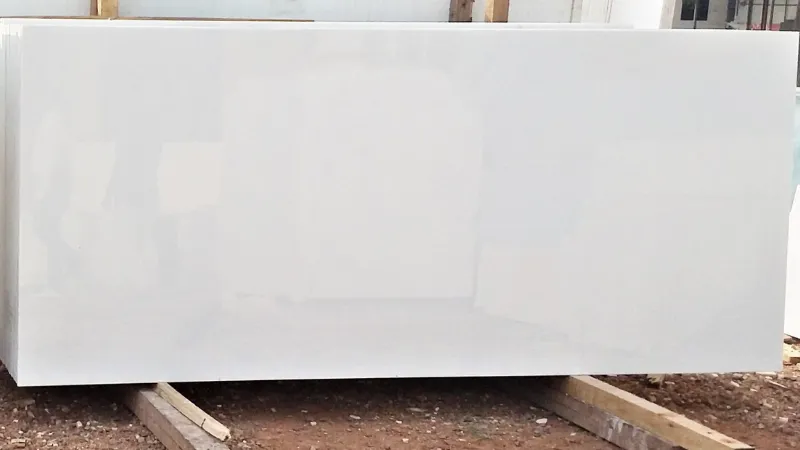
Composite marble, or engineered marble, is made by combining crushed or powdered natural marble with a binder and forming it into slabs or tiles under controlled conditions. Compared with natural marble, it can offer greater consistency in colour and pattern, lower porosity and easier maintenance. It works particularly well in residential, commercial and hospitality interiors where repeatable appearance matters. Before choosing it, check the product\'s application rating, thickness, finish, technical data, installation requirements and supplier reliability.
Composite marble uses natural marble as its primary stone component, which is then combined with materials such as resin, cement or other binders.
Unlike a natural marble slab, where colour and veining depend entirely on the quarry block, engineered marble is manufactured to a controlled specification.
That gives it a key advantage:
Greater control over the finished appearance.
The exact composition and performance can vary by manufacturer, so buyers should always check the technical specifications of the product being considered.
Natural marble can vary significantly between blocks and even between slabs from the same source.
Composite marble is produced under controlled conditions, allowing manufacturers to maintain more consistent colour, pattern and finish across a production batch.
That matters when a project involves thousands of square feet of flooring or several rooms that need to look coordinated.
For hotels, apartments, offices and other large projects, this can make material planning much easier.
Natural marble is porous and can be more vulnerable to staining, scratching and chemical reaction.
Engineered marble has a more controlled and uniform structure, which can make it easier to maintain in suitable interior applications.
That does not mean every engineered marble product has identical performance. Maintenance should always follow the specific manufacturer\'s recommendations.
Natural marble can only offer what the quarry produces.
Engineered marble gives manufacturers more control over:
This gives designers more freedom when developing a coordinated interior palette.
Large projects depend on predictable supply.
Natural marble availability can vary according to quarry production, block quality and sourcing conditions. Manufactured marble products can offer greater consistency in repeat orders, depending on the supplier\'s production capacity and stock planning.
For procurement teams, that predictability can simplify budgeting and project scheduling.
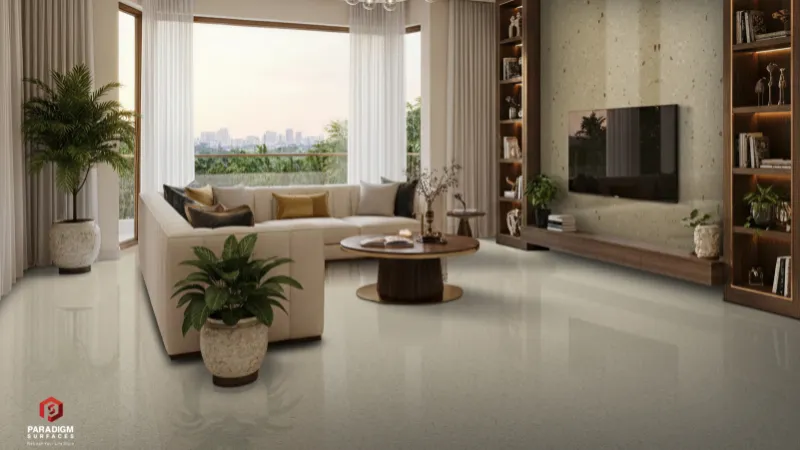
Engineered marble can work well in living rooms, dining areas, corridors and other interior spaces where homeowners want a stone appearance with more consistent material characteristics.
It is particularly useful in projects where several rooms need to maintain a coordinated look.
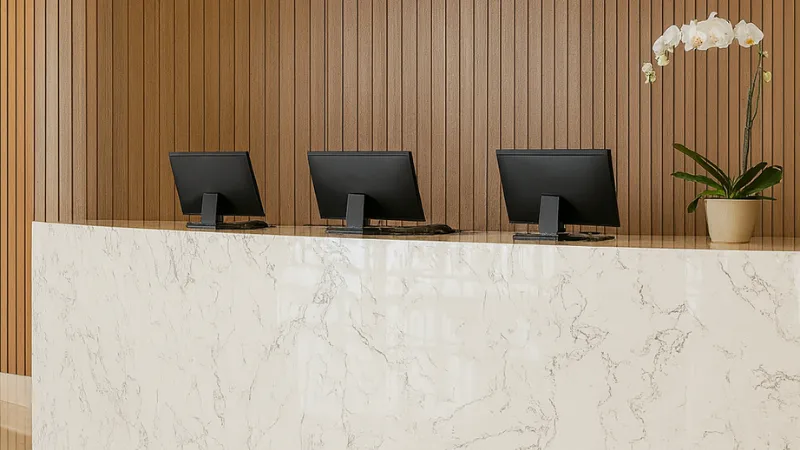
Office reception areas, retail spaces and other commercial interiors often need materials that look premium while remaining practical to maintain.
Consistent colour and finish can also simplify replacement and expansion work.
Hotels and hospitality interiors frequently use the same material across large areas, so consistency becomes important.
Engineered marble can be considered for:
The specific product should always be selected according to the project\'s traffic and environmental conditions.
Composite marble can also be used for bathroom walls, vanity surfaces and other suitable wet-area applications.
Its lower porosity compared with many natural stones can make it easier to manage, but the particular product\'s water-resistance and installation requirements should be checked before specification.
Large engineered marble slabs can create a clean, coordinated look on feature walls, reception areas and elevator interiors.
The consistency of manufactured patterns can be especially useful when several panels need to align visually.
One reason engineered marble is attracting attention is its potential to use marble powder, off-cuts and other stone material that might otherwise become waste.
The actual environmental benefit depends on how a particular product is manufactured, what recycled content it uses, its energy consumption and its complete lifecycle.
So rather than assuming that every engineered marble product is automatically sustainable, buyers should ask suppliers for specific information about material content, manufacturing practices and relevant environmental documentation.
Before approving a product, focus on the details that affect real-world performance.
Thickness should match the application and support conditions. Different products may be offered in different thicknesses, so do not assume that one specification works for every use.
A polished finish can highlight colour and pattern, while matte or honed finishes may be better suited to projects where a softer appearance or reduced visibility of everyday marks is preferred.
Make sure the product is specifically intended for the proposed application.
Check whether it is suitable for:
Do not choose engineered marble only from a showroom sample.
Ask about relevant product specifications, water absorption, wear performance, recommended installation methods and maintenance requirements.
Even a good slab can perform poorly when the substrate, adhesive, joints or installation method is wrong.
Large-format installations require particular attention because uneven substrates and poor support can become more noticeable across bigger pieces.
For architects, builders and procurement teams, supplier capability matters as much as the material.
Ask:
Can you supply the required quantity from a consistent batch?
Can you maintain the same colour and finish across different deliveries?
Are the slabs calibrated consistently for thickness and flatness?
What are the expected lead times?
How is the material packaged and transported?
What support is available if slabs arrive damaged or outside specification?
These questions become increasingly important as project volume increases.
Different manufacturers use different binders, formulations and manufacturing processes.
A good-looking sample does not tell you whether the product suits the application.
Cracking, uneven surfaces or hollow spots can result from installation problems rather than the slab itself.
Ask for actual material and manufacturing information instead of relying on generic “eco-friendly” claims.
It is generally made by combining crushed or powdered natural marble with a binder such as resin, cement or polymer, along with pigments or other components depending on the product.
Yes, suitable products can be used for interior flooring. The correct product should be selected based on traffic, wear requirements, substrate and installation conditions.
It can be, depending on the product. Its controlled structure and lower porosity can reduce some maintenance demands associated with natural marble.
Yes, some products are suitable for bathroom walls, vanity areas and other wet applications. Always confirm the product\'s technical rating before installation.
Some products use recycled stone content or manufacturing by-products, but sustainability varies by manufacturer. Check the actual product\'s composition and environmental documentation.
Composite marble is not simply a substitute for natural marble. It offers a different approach to stone—one that gives designers and project teams greater control over appearance, consistency and procurement.
It can make sense for large residential, commercial and hospitality projects where repeatable design and manageable maintenance are important.
The key is to choose the product according to the application rather than assuming every engineered marble slab performs the same way.
Check the technical data, review the full slab, understand the installation requirements and choose a supplier that can maintain consistent quality across the project.
Paradigm Surfaces offers engineered marble alongside quartz, granite and terrazzo, giving architects, designers, builders and homeowners multiple surface options for contemporary interiors.

 24 September, 2026
Festive Home Makeovers: Refreshing Kitchens & Interiors with Stone
 20 September, 2026
 17 September, 2026
CNC Precision Cutting: How Technology Improves Edge & Inlay Work
 13 September, 2026
NSF & Food Safety Certifications: What They Mean for Quartz Surfaces
 12 September, 2026
Whatsapp Chatx
Hi! Click one of our representatives below to chat on WhatsApp or send us email to sales@paradigmquartz.in
 |
Contact Us +91 99440 00900 |