26
OCT
2026
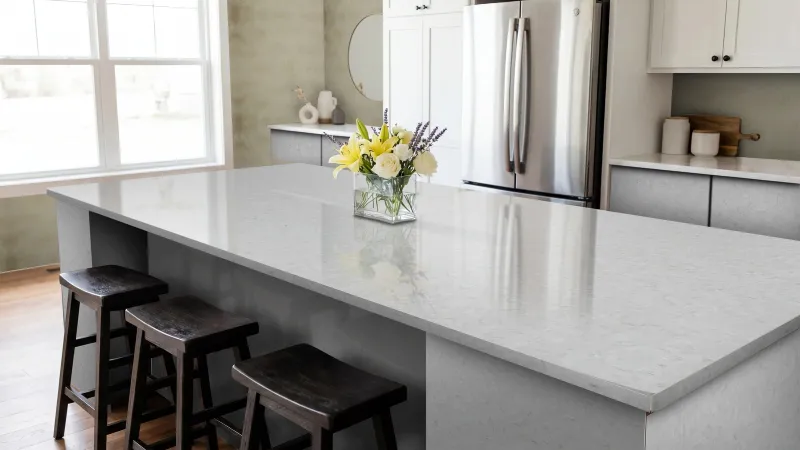
Quartz backsplashes extend the visual and practical benefits of engineered stone from the countertop onto the kitchen wall. Homeowners and designers can choose between short backsplash strips, full-height slabs, and ceiling-height installations depending on the kitchen layout and design goals. Matching the backsplash with the countertop creates visual continuity, particularly with marble-look and veined quartz. However, successful installation requires careful slab selection, wall preparation, appropriate support, appliance clearance, and attention to electrical fittings and maintenance requirements.
A kitchen countertop may receive most of the attention during material selection, but the wall behind it plays an equally important role in the finished design. A well-planned backsplash protects the wall from everyday splashes while helping connect the countertop, cabinetry, and other interior elements.
Quartz backsplashes are increasingly considered in contemporary kitchens because they allow designers to carry the same surface material from horizontal countertops onto vertical walls. From a simple matching strip to a full-height slab, the approach can create a more coordinated appearance with fewer visible grout lines than conventional tiled backsplashes.
The important decision is not simply whether to use quartz, but how to select, match, and install it for the specific kitchen.
A quartz backsplash is a vertical surface installed behind a kitchen countertop, typically around sinks, cooking areas, and preparation zones. It protects the wall from water splashes, food spills, and routine kitchen activity.
Unlike small-format tiles, quartz backsplashes can use larger surface pieces with fewer joints. They can also be coordinated with the countertop to create a continuous material palette.
There are three common design approaches:
Each option creates a different visual effect and requires different levels of material planning and installation coordination.
Full-height quartz backsplashes create a more continuous appearance by reducing the number of separate materials and joints across the kitchen wall.
Using the same quartz design for the countertop and backsplash connects the horizontal and vertical surfaces. This works particularly well in contemporary kitchens with minimal cabinetry details and restrained colour palettes.
Marble-look quartz with flowing veins can create an architectural focal point, while subtle white, cream, or grey surfaces offer a quieter appearance.
Traditional tiled backsplashes contain grout lines that may collect grease, food residue, and moisture over time.
Large-format quartz slabs reduce the number of these joints, making routine surface cleaning more straightforward. However, the junctions between slabs, countertops, corners, and adjoining materials still require appropriate sealing and maintenance.
A full-height installation can extend beyond the cooking or washing area to create a feature wall.
Designers can use directional patterns, contrasting colours, or coordinated surface finishes to establish visual hierarchy without introducing another wall material.
Slab matching is one of the most important decisions when designing a quartz backsplash. Even when the countertop and vertical surface use the same product name, their appearance needs to be reviewed together.
Design approach | Visual effect | Suitable application |
Same quartz on both surfaces | Continuous and coordinated | Minimalist and contemporary kitchens |
Contrasting backsplash | Adds depth and distinction | Kitchens with neutral countertops |
Marble-look matching | Creates visual movement | Premium residential kitchens |
Grey-on-grey combination | Subtle, understated appearance | Modern urban interiors |
Light backsplash with dark countertop | Creates visual contrast | High-contrast kitchen designs |
When selecting patterned or veined quartz, examine the full slab rather than relying entirely on small samples.
Check the following:
Where possible, source both surfaces from the same production batch or lot. This can help reduce variations in colour and pattern, although it does not guarantee an exact match.
For book-matched or highly directional designs, the cutting sequence should be discussed with the fabricator before material is processed.
The appearance of a full-height quartz backsplash depends on the installation planning as much as the material selection.
A full slab backsplash can add considerable weight to a wall. The installer must assess whether the existing substrate and wall structure can support the selected slab.
The wall should also be suitably flat, stable, clean, and prepared for the approved installation system. The required adhesive or mechanical fixing method depends on slab dimensions, thickness, substrate, and manufacturer instructions.
Large-format installations should be handled by experienced professionals rather than treated like ordinary wall tiles.
Kitchen backsplashes often contain electrical sockets, switches, and appliance connections. Their positions should be finalized before slab cutting begins.
The fabricator needs accurate measurements to create the required openings. Poorly planned cutouts can disrupt the surface pattern and complicate installation.
Electrical access and local safety requirements should also be coordinated with the kitchen designer and electrician.
A quartz backsplash behind a cooking appliance requires particular attention.
Engineered quartz contains resin binders, so prolonged or concentrated heat exposure may affect the surface. Suitability depends on the specific quartz product, appliance configuration, ventilation, and required clearances.
Before specifying quartz behind a gas cooktop or other heat-generating appliance, confirm the applicable product instructions, warranty conditions, and appliance installation requirements. Do not assume every quartz design is suitable for every cooking arrangement.
A large backsplash may still require multiple pieces depending on wall dimensions and slab availability.
Seams should be planned around the surface pattern and wall layout. Exposed edges, internal corners, and the junction between the countertop and backsplash also require appropriate detailing.
A suitable flexible joint between the countertop and vertical surface may be needed to accommodate movement, depending on the approved installation method.
The backsplash should complement the entire kitchen rather than appear as an isolated design element.
White and cream quartz can help create a light, open appearance, particularly when paired with neutral cabinetry. Marble-look patterns introduce movement and work well in larger kitchens where the veining has room to stand out.
Grey quartz is another option for contemporary interiors. It pairs naturally with white cabinetry, darker wood finishes, metallic hardware, and concrete-inspired design elements.
Explore Stylish Quartz Countertop Ideas for Modern Homes for additional surface combinations and design inspiration.
For more ideas on using neutral tones in contemporary spaces, read Why Grey Quartz Is the Top Choice for Urban Homes?.
Quartz can be suitable for full-height backsplash applications when the specific product, wall substrate, support system, and installation method are appropriate. Always check the manufacturer\'s technical guidance before installation.
It does not have to. Matching designs create continuity, while contrasting colours introduce visual separation. The decision depends on the cabinetry, lighting, surface pattern, and overall kitchen design.
Both offer different advantages. Quartz slabs create fewer grout joints and a more continuous appearance. Tiles provide greater flexibility in individual patterns, shapes, and replacement. The appropriate choice depends on the design, budget, and installation requirements.
Some quartz products may be approved for these applications, but suitability cannot be assumed universally. Check product-specific heat limitations, appliance clearances, ventilation requirements, and warranty conditions before proceeding.
For routine cleaning, use a soft cloth or sponge with water and a suitable mild cleaning solution. Wipe away grease and food residue regularly. Follow the manufacturer\'s care instructions and avoid unapproved abrasive or aggressive cleaning products.
A well-designed quartz backsplash does more than protect the kitchen wall. It connects the countertop, cabinetry, and surrounding finishes to create a more coordinated interior.
Full-height installations can deliver a distinctive architectural appearance, but their success depends on thoughtful slab matching, suitable wall support, accurate cutouts, and application-specific installation planning.
Whether designing a compact urban kitchen or a spacious premium residence, Paradigm Surfaces offers quartz design options for creating coordinated countertop and backsplash combinations. Explore the available designs and consider the complete kitchen layout before finalizing your material selection.

 24 September, 2026
Festive Home Makeovers: Refreshing Kitchens & Interiors with Stone
 20 September, 2026

Whatsapp Chatx
Hi! Click one of our representatives below to chat on WhatsApp or send us email to sales@paradigmquartz.in
 |
Contact Us +91 99440 00900 |