
23
OCT
2026
Quartz countertop seams are the joints where two fabricated pieces meet. Their placement influences the finished appearance, structural support, and overall countertop layout. The best position depends on slab dimensions, cabinet support, sink and cooktop cutouts, and the direction of the surface pattern. Careful fabrication, accurate alignment, and suitable adhesive colour can make seams less noticeable, but they cannot always be eliminated or made invisible. Planning seam locations before cutting begins helps homeowners and designers achieve a more cohesive, practical finish.
Quartz countertops are often chosen for their clean appearance and contemporary look. But when a kitchen includes a long countertop run, an L-shaped layout, or a large island, one detail can significantly influence the final result: quartz countertop seams.
A seam is not necessarily a sign of poor installation. It is often required when a countertop needs multiple pieces to cover the available area. What matters is where the joint is placed, how securely the pieces are supported, and how well the seam works with the surface design.
For homeowners, architects, and interior designers, understanding these factors before fabrication can prevent unexpected visual interruptions and costly adjustments.
Quartz slabs are manufactured in specific sizes. When the required countertop dimensions exceed the usable slab area, or the kitchen layout involves multiple sections, fabricators may need to join separate pieces.
Seams are common in:
Larger-format slabs may reduce the number of joints, but they do not guarantee a completely seam-free installation. The final layout depends on the available slab dimensions, cutting plan, structural requirements, and site conditions.
The goal is to minimize unnecessary joints while maintaining proper support, safe fabrication, and a visually consistent surface.
There is no universal seam position that works for every kitchen. The fabricator should assess the countertop template, slab pattern, cabinet structure, and cutouts before deciding where pieces will meet.
Whenever the layout permits, seams should be positioned where both adjoining pieces receive appropriate support. Cabinet partitions or other approved support structures may provide suitable locations.
Unsupported joints can be vulnerable to movement and stress, particularly when the surrounding countertop includes an overhang or nearby cutout.
The joint location and support arrangement should follow the selected quartz product\'s fabrication and installation requirements.
Sinks and cooktops require openings that interrupt the countertop surface. These areas need careful fabrication because the remaining material around the openings must be adequately supported.
Where practical, avoid placing a seam immediately beside a cutout. Doing so can help simplify the layout and reduce potential stress concentrations.
The final decision should account for the opening dimensions, countertop design, support structure, and manufacturer guidance rather than relying on a fixed clearance for every installation.
A dishwasher opening differs from a cabinet section because the appliance itself is not necessarily designed to support the countertop.
A seam above this area therefore requires specific attention to the support arrangement. If the layout calls for a joint over a dishwasher, the fabricator and installer should ensure that the assembly provides the required support.
L-shaped and U-shaped countertops require particular attention at inside corners, where the layout changes direction.
The joint arrangement should reflect the product\'s fabrication guidance and the geometry of the countertop. A visually discreet seam is not a good choice if it creates an unsupported section or conflicts with the recommended fabrication method.
The best seam location is the one that balances appearance, support, and practical installation requirements.
A seam\'s visibility depends on more than the precision of the joint. Surface colour, pattern, adhesive selection, lighting, and viewing angle all influence the finished appearance.
Quartz design | What to consider |
Solid white or black | Adhesive colour differences and minor alignment issues may stand out against a uniform background. |
Fine-speckled designs | The surface pattern may help break up the joint visually, depending on the distribution of the particles. |
Marble-look quartz | Vein direction and pattern alignment can influence how naturally the joint blends into the design. |
Bold, directional veining | Mismatched veins may make the seam more noticeable, so slab selection and cutting plans require extra attention. |
For marble-look quartz, ask the fabricator to review the slab layout before cutting. Adjacent pieces can sometimes be selected to create a more coordinated pattern, although exact vein continuity cannot always be achieved.
A suitable bonding adhesive, selected for the specific quartz product and application, helps join the pieces. Matching its colour to the surrounding surface can reduce contrast at the joint.
Accurate edge preparation, a close fit, correct alignment, and appropriate finishing are equally important. Even with careful workmanship, a fine line may remain visible.
Lighting also matters. Light striking the surface from a low angle can emphasize small differences that are less noticeable under general room lighting. Reviewing the countertop under the planned kitchen lighting can help establish realistic expectations.
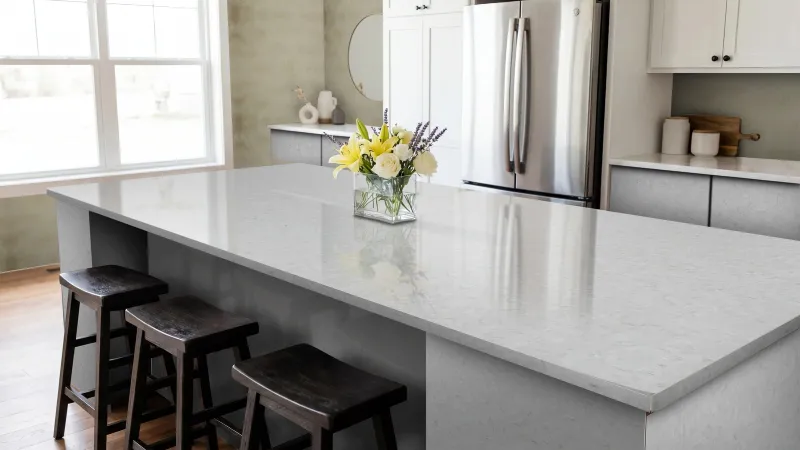
Kitchen islands often serve as visual focal points, making seam placement especially important. A joint across a prominent area may attract attention if it interrupts a bold pattern or divides an otherwise continuous design.
Before finalizing the layout, consider:
Waterfall islands introduce another design consideration because the countertop extends vertically down one or both sides. The junction between the horizontal surface and vertical panel must be planned alongside the pattern direction and edge details.
Explore Waterfall Islands: Trend or Timeless Kitchen Feature? for more on the design considerations involved in this feature.
Homeowners, architects, and interior designers can reduce misunderstandings by discussing the seam layout before cutting begins.
For a broader overview of the process, read Step by Step Guide to Installing Quartz Countertops.
Some smaller countertops can be fabricated from a single suitable slab section. Larger runs and complex layouts may require multiple pieces. Slab dimensions, layout, and installation access determine what is practical.
A seam may remain visible even after professional fabrication. Its appearance depends on the quartz pattern, adhesive colour, joint fit, lighting, and viewing angle.
Not in every installation. Careful alignment, colour-matched adhesive, and thoughtful pattern planning can reduce visibility, but complete invisibility should not be guaranteed.
Not automatically, but the surrounding material, support, and cutout geometry require careful assessment. The fabricator should choose a joint position that follows the product\'s requirements and suits the countertop layout.
Larger slabs can reduce the number of joints when the countertop design fits within their usable dimensions. However, complex layouts, access limitations, and structural considerations may still require seams.
Well-planned quartz countertop seams combine thoughtful design with sound fabrication. Choosing appropriate joint locations, coordinating the surface pattern, ensuring adequate support, and discussing visibility before cutting can help create a more cohesive countertop.
Planning a kitchen or architectural project? Contact Paradigm Surfaces to discuss quartz designs, slab selection, and the material considerations that can influence your countertop layout.

 24 September, 2026
Festive Home Makeovers: Refreshing Kitchens & Interiors with Stone
 20 September, 2026
 17 September, 2026
CNC Precision Cutting: How Technology Improves Edge & Inlay Work
 13 September, 2026
NSF & Food Safety Certifications: What They Mean for Quartz Surfaces

Whatsapp Chatx
Hi! Click one of our representatives below to chat on WhatsApp or send us email to sales@paradigmquartz.in
 |
Contact Us +91 99440 00900 |