
20
SEP
2026
These conditions create unusual demands on interior materials. Surfaces need to look consistent across very large areas, hold up to constant contact and cleaning, and be installable within logistics constraints that don't apply to a typical commercial fit-out. It's in this context that architects and designers increasingly look at large-format stone — including what suppliers call jumbo or super jumbo slabs — as one possible approach to check-in counters, feature walls, lounges, and concourse surfaces.
This isn't a claim that engineered quartz or any single material is automatically the right choice for every airport application. Large-format stone is one option among several, and its value depends heavily on the specific application, the performance requirements, and how well the project team plans for fabrication and logistics. This guide walks through where super jumbo slabs can be useful in airport and transit hub design, what they can and can't realistically deliver, and what architects, developers, contractors, fabricators, and procurement teams should evaluate before specifying them.
"Jumbo," "super jumbo," "extra-large," and "large-format" are all terms used in the stone and engineered surface industry to describe slabs that are bigger than standard production sizes. The important thing to understand is that none of these terms is standardized across the industry. Different manufacturers apply them to different dimension ranges, and a "super jumbo" slab from one producer may be closer to a standard jumbo slab from another.
Because of this, dimensions, thickness options, weight, and handling requirements should always be confirmed directly with the manufacturer or supplier for a given project — never assumed from general industry language. This matters even more in airport work, where slab layout, cut-outs, and structural support all need to be engineered around real, verified dimensions rather than generic marketing figures.
Beyond size, buyers evaluating large-format slabs for a project should also confirm:
Large-format slabs offer a set of architectural possibilities that are harder to achieve with standard-sized material. These are potential advantages, not automatic outcomes — how well they're realized depends on design and fabrication decisions made project by project.
Bigger slabs give designers more surface area to work with before a seam is needed, which supports expansive design compositions across counters, walls, and floors where an uninterrupted visual field is part of the design intent.
Larger dimensions can reduce the number of seams required across a given surface, provided the layout is planned around the actual slab size and the application's geometry. This is a potential benefit, not a guarantee — see the seam-planning section below.
Feature walls, oversized reception counters, and signature lounge surfaces often benefit from broad, continuous stone panels that would otherwise require multiple standard-sized pieces pieced together.
The same slab batch and finish can potentially be repeated across check-in areas, lounges, counters, and commercial zones, supporting a unified material language across a large, multi-zone facility — provided supply and batch consistency are confirmed with the supplier.
Large, continuous stone surfaces are often associated with contemporary, high-end architectural aesthetics, which can support a terminal's broader design identity.
What large-format slabs do not automatically deliver is reduced maintenance or faster installation. Larger, heavier slabs can in some cases mean more complex handling and installation logistics, not less — this is addressed further in the fabrication and logistics sections below.
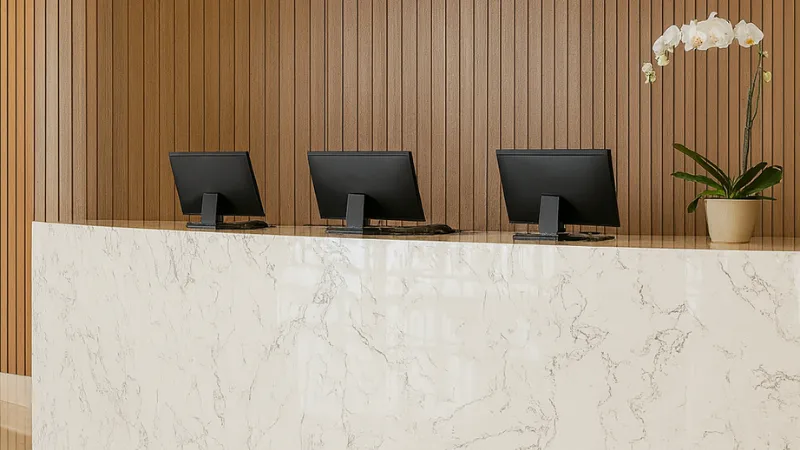
Check-in counters are high-visibility, high-contact surfaces that passengers interact with directly. Large slab faces can support long, visually continuous counter runs, but the application also demands durability against luggage contact, repeated cleaning, and constant public use. Fabrication needs to account for cut-outs for equipment, cabling, and scanner integration.
These are among the most photographed and closely viewed surfaces in a terminal. Visual presentation matters here as much as durability, since passengers stand close to and often lean on these surfaces throughout the day.
Lounges combine several surface types — counters, tables, feature walls — where large-format stone can create a cohesive, premium environment. Table applications in particular require attention to slab thickness and edge detailing given close, repeated contact.
Large-format stone is well suited to feature walls, where the goal is often a striking, continuous visual statement rather than functional durability under heavy contact. This is one of the applications where the visual benefits of large slabs are most directly realized.
Retail zones within terminals often aim for a premium, boutique feel distinct from the rest of the concourse. Large-format surfaces can support display counters, feature walls, and fitting areas designed to a higher finish standard.
Airport lounges, VIP suites, and hospitality zones frequently prioritize a refined material palette, making them a natural fit for large-format stone applications where budget and access allow.
In every case, suitability comes down to the specific application's traffic level, contact frequency, and performance requirements — not a blanket assumption that large-format material is the right fit everywhere in a terminal.
Engineered quartz is one material category commonly considered for large-format airport applications, particularly for consistent-appearance surfaces like reception counters and customer-facing zones. Its appeal in commercial settings typically comes down to more predictable colour and pattern consistency across a large project compared to some natural stones, along with a wide range of colour and finish options for large-format design.
That said, quartz should not be described as scratch-proof, stain-proof, heat-proof, indestructible, or maintenance-free — these are overstated claims that don't hold up under the kind of continuous, heavy public use an airport sees. Where heat exposure or chemical exposure is a real consideration for a given application (a food service counter adjacent to a lounge, for example), architects and procurement teams should request the specific manufacturer's technical documentation rather than relying on general marketing claims about the material category.
This is one of the most important — and most misunderstood — aspects of specifying large-format stone for any high-traffic public project.
Seams matter visually because they interrupt pattern and colour continuity, and in high-contact areas they can also become maintenance points over time. Slab dimensions directly affect how many seams a given surface layout will require, but dimensions are only part of the picture. Fabrication decisions — including how slabs are cut and how corners and cut-outs are planned — determine where seams fall and how visible they end up being. Complex geometries, equipment cut-outs, and corner conditions can all force additional seams regardless of how large the source slab is.
This is why installation planning needs to happen alongside design, not after it. A design that looks seamless on paper can require several additional joints once real-world cut-outs, structural supports, and access points are accounted for.
The realistic framing for architects and procurement teams is this: large-format slabs can support a seam-minimized design strategy, where careful layout planning significantly reduces the number and visibility of joints across a surface. They do not guarantee a seam-free result. Any supplier or fabricator promising a completely seamless outcome for a complex, large-scale application should be asked to explain exactly how that will be achieved for the specific geometry involved.
For related considerations in another high-end commercial setting, see Super Jumbo Quartz Slabs for Five-Star Hotel Lobbies & Reception Counters, which covers similar seam-planning and large-surface design questions for hospitality reception environments.
Airports rarely consist of a single material application. A terminal typically spans check-in, security, concourses, lounges, information areas, retail zones, and waiting areas — often designed and built out over different phases. Coordinating material specifications across all of these zones is a real architectural and procurement challenge.
Key considerations for maintaining design continuity at this scale include:
Procurement teams working across a large, multi-phase facility should treat batch and supply continuity as a core specification question, not an afterthought.
Before specifying any material for airport interiors, project teams should evaluate performance against the realities of continuous public use.
Wear. Airport surfaces face repeated daily contact from luggage, carts, foot traffic, and equipment — a very different load than a typical commercial or residential application.
Staining. Spills, food and beverage contact in lounges and retail zones, and general public use all create staining risk that should be evaluated against the specific material's documented performance.
Scratching. Luggage wheels, service carts, and daily operational equipment are realistic sources of surface abrasion in counters, floors, and lower wall areas.
Impact. Contact with operational equipment, carts, and general public activity should be factored into material selection for high-traffic zones.
Cleaning. Airport surfaces are cleaned far more frequently than typical commercial spaces, and cleaning regimens need to be compatible with the specified material's finish and composition.
Maintenance. Long-term maintenance planning — not just initial installation — should be part of the material selection conversation from the outset.
No material, engineered or natural, is immune to wear or damage under this kind of sustained public use. The goal in specification is matching the material and finish to the realistic performance envelope of the application, not assuming any single product eliminates these considerations.
Surface maintenance is a constant operational concern in airports, given the volume of contact and the need for frequent cleaning throughout the day. Relevant considerations include how easily a surface can be cleaned without damage, how spills are managed on high-contact counters, and how seams and joints affect cleaning — since joints can collect debris or require different cleaning approaches than the surface field.
It's worth being precise here: there's a meaningful difference between a surface that is easy to clean and generally hygienic because of its smooth, non-porous characteristics, and a surface with verified antimicrobial performance, which requires specific testing and certification to claim. Suppliers should be asked to clarify which claim applies to a given product, and any antimicrobial claim should be backed by actual test data rather than general marketing language.
Larger slabs introduce fabrication considerations that don't apply, or apply less significantly, to standard-sized material.
Given these factors, fabricator capability is especially important for airport projects, where design complexity, tight schedules, and public safety expectations leave little room for fabrication errors. Architects and procurement teams should evaluate a fabricator's specific experience with large-format work, not just their general stone fabrication capability.
Getting large-format slabs from factory to site intact is a logistics challenge in its own right. Relevant factors include protective packaging designed for the slab's size and weight, edge protection during transit, appropriate transportation support to prevent flexing or cracking, careful unloading procedures, confirmed site access for large, heavy material, adequate storage space before installation, and personnel trained specifically in large-format slab handling with the appropriate lifting equipment.
Airport projects often carry additional logistical constraints beyond what a typical commercial project faces — restricted site access, security clearance procedures for delivery personnel and vehicles, tight construction schedules coordinated around live operations, work confined to specific operational areas, and narrow delivery windows dictated by the facility's operating schedule. The specifics of these constraints vary significantly by airport and project, so project teams should confirm actual requirements with the facility's operations and security teams early rather than assuming general airport logistics practices will apply.
Large-format stone works best when it's considered during early project planning, not brought in as a late-stage design decision. Early coordination between the architect, designer, supplier, fabricator, contractor, logistics team, and installation team allows slab dimensions, layout, and cut-outs to be finalized before construction sequencing locks in.
This kind of early coordination helps reduce fabrication conflicts discovered too late to resolve cleanly, material shortages that force design compromises, site-access problems that weren't anticipated in the original logistics plan, installation delays caused by last-minute changes, and unnecessary material waste from poor layout planning. For a facility as operationally complex as an airport, the cost of late-stage material changes — in both time and money — is significantly higher than in a typical commercial build.
A thorough supplier evaluation for an airport-scale project should cover:
Volume. Airport-scale projects can require substantial material quantities, which should be confirmed against the supplier's actual production capacity, not just catalogue availability.
Consistency. Batch and colour consistency matter more on a large, continuous project than on a smaller job where minor variation is less noticeable.
Availability. Confirmed production scheduling and inventory — rather than general availability claims — should back any large order.
Lead Time. Delays in stone delivery can cascade into fabrication and installation schedule slippage, which is especially costly on projects coordinated around live airport operations.
Replacement Material. Given the long service life of airport interiors, the ability to source matching material for future repairs or expansions can matter more than it would for a shorter-lifespan commercial space.
Logistics. Packaging, transport, storage, and delivery coordination all need to be planned around the project's specific access and scheduling constraints.
Documentation. Technical and product documentation supports both specification decisions and any facility compliance review the project may require.
Treating "super jumbo" as a standard size. Dimensions vary by manufacturer and must be verified directly rather than assumed from general industry terminology.
Designing without slab layout planning. Finalizing a design before confirming how it maps onto actual slab dimensions can create unnecessary seams and material waste.
Ignoring site access. Large slabs need to physically get into the building. Access constraints should be confirmed before large-format material is specified, not discovered during delivery.
Selecting only for appearance. Visual impact matters, but performance and maintenance characteristics need equal weight in a high-traffic public environment.
Ignoring fabricator capability. Complex, large-format airport work requires a fabricator with specific experience in this scale of work, not just general stone fabrication competence.
Assuming large slabs eliminate all seams. As covered above, large-format material supports a seam-minimized strategy, not a guaranteed seam-free outcome.
Ordering without sample approval. Actual samples and batch consistency should be reviewed and approved before a large order is placed, not assumed from a catalogue image.
Leaving procurement until late in the project. Lead times and material availability need to be factored into the schedule from early planning, not addressed once construction is already underway.
 20 September, 2026
 17 September, 2026
CNC Precision Cutting: How Technology Improves Edge & Inlay Work
 13 September, 2026
NSF & Food Safety Certifications: What They Mean for Quartz Surfaces
 12 September, 2026
 05 September, 2026
Marble in Temple & Religious Architecture: Tradition Meets Craft

Whatsapp Chatx
Hi! Click one of our representatives below to chat on WhatsApp or send us email to sales@paradigmquartz.in
 |
Contact Us +91 99440 00900 |
