
24
SEP
2026
Every year, the same pattern repeats in Indian homes as the festive season approaches: someone stands in the kitchen, looks at a countertop that has seen a decade of use, and wonders whether it\\\'s finally time for a change. The instinct that follows is usually to think in terms of a full renovation — new cabinets, new flooring, new everything. But a complete renovation is rarely what the moment actually calls for.
A festive home makeover does not have to mean tearing a space down to the studs. In most homes, a handful of carefully chosen surfaces do the visual heavy lifting — the kitchen countertop, the island, the wash basin counter, a feature wall. Replacing or upgrading these with the right stone can noticeably change how a room feels, without the cost, disruption or timeline of a larger project. This article looks at how quartz, marble, granite and terrazzo can each play a role in that kind of targeted refresh, where they tend to work best, and what to think through before choosing one over another. The right material depends on the application, your design direction, how the space is actually used, and what the fabrication and installation process demands — not on which stone sounds most impressive.
Festivals bring people into the home in a way that everyday life doesn\\\'t. Relatives visit, guests are entertained in the kitchen and living areas, and the spaces used for cooking and hosting suddenly get more attention than they do the rest of the year. This is usually what triggers the makeover impulse — not a sudden dissatisfaction with the whole house, but a sharper awareness of the two or three areas that guests will actually see and use.
It helps to be clear about what kind of change you\\\'re actually planning, because the four options are quite different in scope:
A stone-surface upgrade sits mostly in the second category, occasionally bordering on the third. It\\\'s deliberately narrower in scope than a renovation, which is exactly why it can be planned and executed within a festive-season timeline. Changing a countertop or a vanity top is a contained project with a predictable process — selection, fabrication, installation — rather than an open-ended one.
Yes, but the honest answer needs a qualifier: it depends on how central that surface is to the room\\\'s overall visual weight.
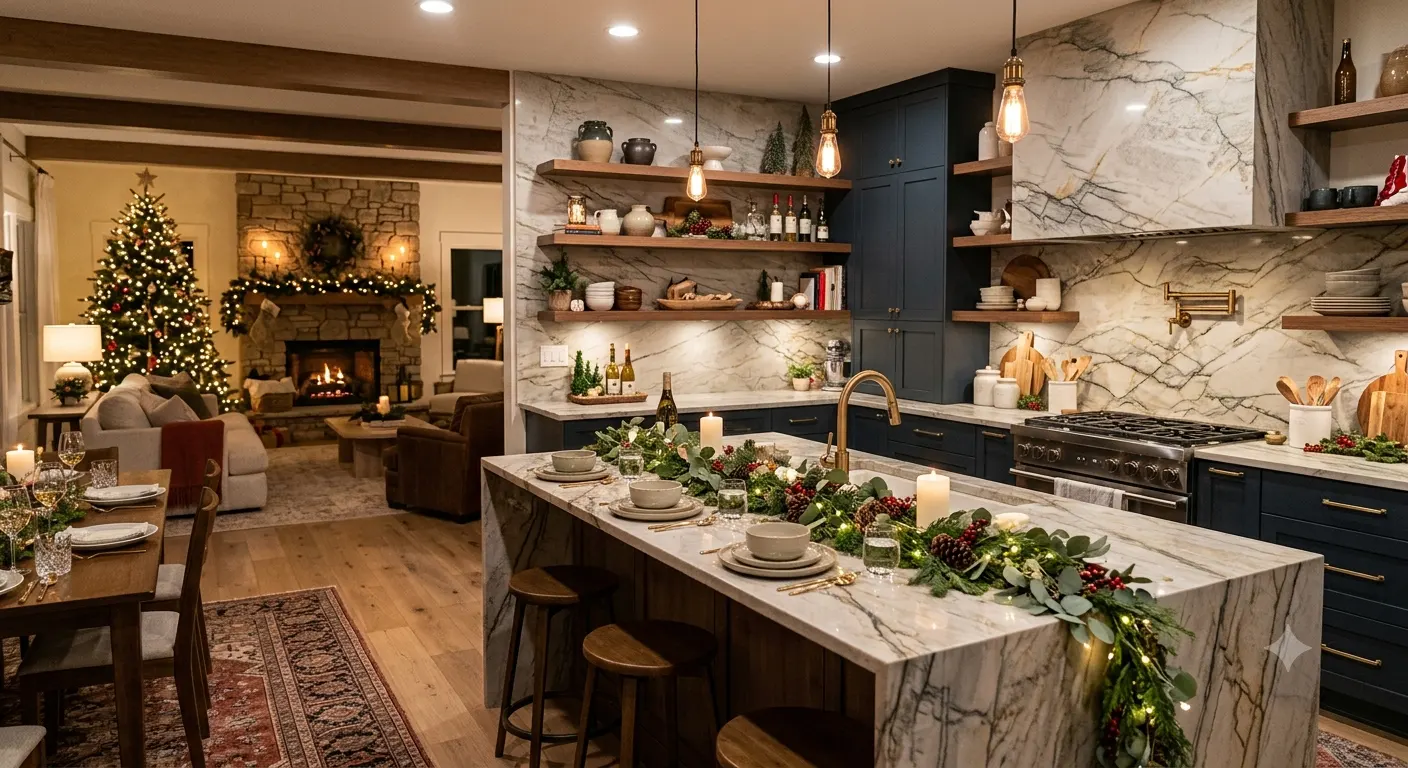
Kitchens are a good example of how this works. A countertop or island is usually the largest continuous surface in the room after the flooring, and it sits at eye level, catching light and drawing attention in a way that upper cabinets or wall tiles don\\\'t. When that surface changes — in colour, pattern, or finish — the room reads differently even if nothing else about it has moved. This is the idea of a visual focal point: a single element strong enough to shift the overall impression of a space.
That said, a new countertop won\\\'t rescue a kitchen where the cabinets are peeling, the lighting is poor, or the layout itself is the problem. The surrounding elements still matter:
Think of the new surface as the anchor of the makeover, not the entirety of it. A realistic festive makeover plan usually pairs one significant surface change with a few smaller, low-cost adjustments — hardware, lighting, wall colour — that let the new stone actually do its job.
For most homes, the kitchen is where a stone makeover delivers the most visible return. It\\\'s used daily, seen by every guest, and photographed more than almost any other room during festive gatherings.
The obvious candidates for change are the countertop, the island (where one exists), and breakfast counters. In some layouts, a backsplash upgrade or extending the counter material partway up the wall can create a stronger sense of visual continuity between the counter and the wall above it.
But a kitchen surface has to work, not just look good, so the selection process needs to weigh actual usage alongside appearance:
Getting these fabrication details right up front avoids a common problem: a countertop that looks right in isolation but creates friction with how the kitchen is actually used.
Quartz kitchen countertops are a common choice where the goal is a clean, consistent look — engineered quartz slabs are manufactured to a controlled pattern, so the colour and veining repeat predictably across a slab in a way natural stone doesn\\\'t. That consistency makes quartz a comfortable fit for contemporary and minimalist kitchens, where the design intent is a calm, unified surface rather than dramatic natural variation.
Quartz kitchen surfaces are available across a wide range of colours, from plain solids to patterns that mimic marble-style veining, so the material can support very different design directions depending on the specific product chosen. Because quartz slabs are manufactured, the exact performance characteristics — heat tolerance, exact hardness, recommended applications — vary by manufacturer and product line, so it\\\'s worth checking the specification sheet for the slab you\\\'re actually considering rather than assuming all quartz behaves identically.
For an island, a quartz countertop slab with a restrained pattern often reads as more deliberate than a busy one, since the island tends to be viewed from multiple angles and under different lighting throughout the day. For a smaller kitchen, a quartz stone for kitchen countertops that closely matches or gently contrasts the cabinet tone can help the space feel more cohesive rather than visually broken up.
The specific character of the new countertop — not just the fact that it\\\'s new — is what determines how much the kitchen\\\'s personality shifts.
A light-coloured surface with minimal veining tends to make a kitchen feel brighter and more open, particularly useful in kitchens with limited natural light. A darker surface, or one with bold, dramatic veining, pulls more visual weight and works better as a genuine statement piece — but it needs cabinetry, walls and lighting that can support that stronger presence rather than compete with it.
A few practical decisions shape the outcome as much as the material choice itself:
The material should be selected with the whole kitchen in view — cabinet colour, wall treatment, lighting, and flooring — rather than evaluated purely as a slab sample under showroom lighting. If you want to go deeper on this specific decision, transforming a kitchen with quartz countertops covers the seamless-look approach to countertop design in more detail.
Where quartz offers consistency, marble offers the opposite — genuine, unrepeatable natural variation. Every marble slab carries its own pattern of veining, colour movement and surface character, which is exactly what gives marble its distinct visual presence in a kitchen island, a vanity counter, a feature wall, or a decorative architectural detail like a threshold or inlay.
Because that variation is natural rather than manufactured, no two slabs — even from the same quarry block — are identical. If the visual pattern of the stone matters to the final look (which it usually does with marble), it\\\'s worth reviewing the actual slab or a large-format sample rather than relying only on a small chip, which can be misleading about how the veining will read across a full countertop or wall.
Marble selection for a festive makeover should weigh several factors together:
Marble is a strong choice for statement applications precisely because of this natural variation — but that same variation means the buying process has to include seeing the actual material, not just approving a swatch.
Granite occupies a middle ground in many festive makeover projects — natural stone with real pattern variation, but generally more resistant to scratching and etching in daily kitchen use than marble. Granite countertops, islands, and utility counters remain a common choice for Indian kitchens, and granite also shows up in selected flooring applications, staircases, and other interior surfaces where a natural stone character with a wide range of colour options is wanted.
Like marble, granite is a natural material, so pattern and colour vary from slab to slab and even across a single quarry\\\'s output over time. Selection should be based on the specific project — how the room is lit, what colours already exist in the cabinetry and flooring, and how the counter will actually be used — rather than a generic assumption that one colour family or finish is universally the better option.
Practical points worth working through before ordering:
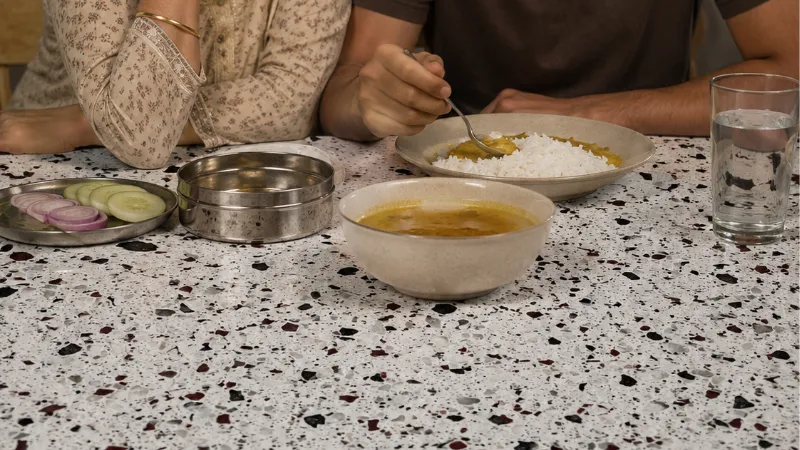
Terrazzo has moved well beyond flooring in recent interior design, and for a festive makeover it\\\'s worth considering for more than just a lobby or entryway floor. Terrazzo countertops, tables and other furniture surfaces, selected wall applications, vanity tops, and decorative surfaces are all realistic uses for a homeowner looking for something distinct from the more familiar quartz, marble and granite options.
What sets terrazzo apart is the degree of customisation available — the aggregate (marble chips, glass, or other materials), the binder colour, and the density and scale of the pattern can all be adjusted, which makes it a genuinely design-led material rather than a fixed product line. This is useful when the goal is a specific look — a particular colour combination or a pattern density — rather than choosing from an existing set of slab options.
Terrazzo is worth considering when:
Terrazzo interior surfaces, terrazzo countertops and terrazzo architectural surfaces are increasingly used in kitchens, vanities and even staircases — not just commercial lobby floors — which makes terrazzo a reasonable option to shortlist for a festive makeover focused on a more contemporary aesthetic.
Not every impactful upgrade has to happen in the kitchen. Wash basin counters, vanity tops and bathroom counters are smaller surfaces, but they\\\'re used constantly and seen by every guest who visits during festival gatherings — which makes them a genuinely efficient place to spend a smaller renovation budget.
A wash basin or vanity refresh has its own set of practical considerations, somewhat different from a kitchen countertop:
A quartz wash basin counter is a common choice here because of its consistent appearance and relatively low maintenance in a wet environment, though a quartz sink countertop or quartz countertop around a sink needs to be specified with the correct cut-out and sealing detail for the specific basin being installed. Marble and granite vanity surfaces are also used where a more natural material character is wanted, with the same porosity and maintenance considerations that apply to kitchen applications.
Rather than ranking quartz, marble, granite and terrazzo against each other, it helps to think about what you\\\'re actually prioritising in the space:
These are general design tendencies, not fixed performance rules — a specific quartz product, marble slab, granite type or terrazzo mix can behave differently from the general pattern, so the final decision should also account for:
The material category (quartz, marble, granite, terrazzo) is only the first decision. Within any category, colour, pattern and finish do most of the work in determining how the final result actually looks in your specific room.
Colour. Lighter surfaces reflect more light and tend to make a space feel larger and brighter, which is useful in kitchens or bathrooms with limited natural light. Darker surfaces absorb more light and create a stronger, more grounded feel, but need adequate lighting to avoid making a small space feel closed in. Either way, the surface colour needs to be considered against the room\\\'s existing cabinet colour, flooring and wall colour, not selected in isolation.
Veining and pattern. Subtle, low-contrast patterns tend to recede into the background and support a calmer overall look. Bold, high-contrast veining draws the eye and works better as a genuine focal point. Directionality matters too — veining that runs a consistent direction across a counter or wall reads more deliberate than veining that appears random. For applications like feature walls, bookmatching (mirroring the pattern across a seam) can create a striking symmetrical effect, but it requires careful slab selection and layout planning at the fabrication stage.
Finish. Polished finishes reflect more light and generally read as more formal or traditional. Matte or honed finishes are softer, hide fingerprints and light scratching more effectively, and tend to suit more contemporary interiors. Neither finish is universally better — the right one depends on how much reflection you want in the space and how visible fingerprints and smudges will be given the room\\\'s use.
For homeowners considering a larger island, a feature wall, or a counter that spans an unusually wide run, large-format and jumbo slabs are worth understanding, at least in general terms.
Larger slabs can help create bigger continuous visual planes, potentially reducing the number of seams needed across a wide surface and supporting stronger visual continuity — useful for a statement kitchen island or a feature wall meant to read as a single unbroken surface.
It\\\'s worth being cautious here, though: \\\"jumbo\\\" or \\\"super jumbo\\\" slabs are not a single standardised product. Exact dimensions, thickness, weight and handling requirements vary by manufacturer, and these details shouldn\\\'t be assumed — they need to be confirmed against the specific product\\\'s documentation, along with whether your site has the access and structural support needed to handle a larger slab. For a home project, the practical planning implication is usually more important than the exact numbers: check with your fabricator early whether a large-format option is realistic for your specific counter or wall dimensions and site access.
A festive makeover often touches more than one space — the kitchen and an adjoining dining area, or a kitchen and a nearby powder room. Coordinating stone across these spaces doesn\\\'t require using the same material everywhere; it requires a sense of material continuity, which can be achieved several ways:
A practical approach many homeowners use is to treat one material as dominant (the kitchen countertop, say) and a second as an accent (a vanity top or a small feature surface), rather than trying to use the same stone across every application in the home.
Quartz ideas
Marble ideas
Granite ideas
Terrazzo ideas
For each of these, the underlying question is the same: does the application make sense practically (water exposure, daily wear, cleaning routine), and does the visual character suit the surrounding interior — not just whether the idea looks appealing in isolation.
Step 1 — Identify the highest-impact area. Prioritise spaces that are highly visible, frequently used, clearly outdated, or important for entertaining guests. The kitchen counter and a guest-facing wash area are usually the two strongest candidates.
Step 2 — Define the design direction. Decide broadly whether you\\\'re aiming for modern, minimal, traditional, contemporary, warm or statement-driven, since this shapes which material and finish combinations make sense.
Step 3 — Select the material. Weigh quartz, marble, granite, terrazzo or engineered marble against the application, maintenance expectations and budget discussed above.
Step 4 — Review actual slabs or samples. Photographs and small chips rarely represent natural stone accurately, and even quartz can look different in a showroom than in your kitchen\\\'s specific lighting. See the real slab wherever possible.
Step 5 — Plan fabrication. Confirm measurements, sink cut-outs, edge profiles, seam placement, corner details and backsplash treatment before fabrication begins, not after.
Step 6 — Coordinate installation. Check site readiness, access for handling the slab, condition of existing cabinetry, and plumbing or electrical work that needs to happen around the installation schedule.
Step 7 — Plan maintenance. Maintenance requirements depend on the specific material, finish, application and manufacturer guidance — confirm this before installation so there are no surprises afterward.
Given fabrication and installation lead times, starting this process at least four to six weeks before the festival date gives enough buffer for slab selection, fabrication and any site-readiness issues that come up.
Yes — this is the central idea behind a targeted stone upgrade. Instead of a full renovation, a homeowner can focus spend and effort on the one or two surfaces that carry the most visual weight: a countertop, an island, a vanity, a wash basin counter, or a single feature wall.
Targeted upgrades make the most sense when the underlying layout and structure of a room are sound, and the main issue is that a specific surface looks dated or worn. A larger renovation becomes more necessary when the layout itself doesn\\\'t work, when multiple systems (plumbing, electrical, structural) need attention at once, or when several surfaces in the same room are all past their usable life simultaneously. For many festive-season timelines, a targeted upgrade is not just the more practical option — it\\\'s often the only one that\\\'s realistically achievable before the festival arrives. If you\\\'d like more ideas along these lines, refreshing a home without a complete renovation goes into broader strategies for this kind of targeted approach.
Whether you\\\'re a homeowner or working with a designer or contractor, the supplier and fabricator you choose has a real effect on how the finished project turns out. A few things worth checking before committing:
None of these factors alone guarantees a smooth project, but together they give a reasonable picture of whether a supplier is set up to deliver a home project on a tight, festival-driven timeline.
A festive home makeover doesn\\\'t need to mean rebuilding the house. In most homes, a small number of high-visibility surfaces — a kitchen countertop, an island, a wash basin counter, a single feature wall — carry most of a room\\\'s visual character, and changing one or two of them thoughtfully can shift how the entire space feels.
Quartz, marble, granite and terrazzo each open up different design possibilities: quartz for consistency, marble for natural character, granite for a practical balance of pattern and durability, and terrazzo for a more customised, contemporary look. None of them is universally \\\"the best\\\" — the right choice depends on the application, your maintenance expectations, budget, and how the fabrication and installation process needs to fit around your timeline.
Good planning matters as much as picking an attractive slab. If you\\\'re weighing a stone upgrade for your kitchen, wash area or a feature surface this festive season, it\\\'s worth walking through your space, being clear about what you actually want to achieve, and discussing the specifics — application, material, finish, timeline — with a qualified supplier or fabricator before committing to a slab.
1. What is a festive home stone makeover? It\\\'s a targeted refresh of high-visibility surfaces — typically kitchen countertops, islands, or wash areas — using stone such as quartz, marble, granite or terrazzo, timed ahead of festival entertaining rather than as part of a full renovation.
2. Can I refresh my kitchen without completely renovating it? Yes. Replacing a major surface such as a countertop or island can create a noticeable visual change without requiring cabinets, flooring or layout to be redone, provided the surrounding elements (lighting, hardware, wall colour) are reasonably in good shape.
3. Which stone is suitable for a kitchen countertop? Quartz, marble and granite are all used for kitchen countertops, each with different maintenance and appearance trade-offs. The right choice depends on how the kitchen is used, your maintenance habits, and the look you want, not a single universal answer.
4. Can quartz be used for festive kitchen makeovers? Yes, quartz kitchen countertops are a common choice for a festive refresh because of their consistent appearance and relatively predictable maintenance, particularly for contemporary kitchen designs.
5. Is marble suitable for interior statement surfaces? Yes, marble\\\'s natural veining and colour variation make it well suited to statement applications like an island, feature wall or vanity, though it generally needs more careful maintenance than engineered stone.
6. Can granite be used beyond kitchen countertops? Yes, granite is also used for utility counters, selected flooring, staircases and other interior surfaces, depending on the specific product and application requirements.
7. Can terrazzo be used for modern home interiors? Yes, terrazzo has moved well beyond flooring into countertops, vanities, furniture and feature surfaces, particularly where a customised, aggregate-driven look is wanted.
8. How should I choose between quartz, marble, granite and terrazzo? Start with what you\\\'re prioritising — consistency, natural variation, practical durability, or customisation — then weigh application, maintenance, budget and fabrication requirements for the specific product you\\\'re considering.
9. Should I inspect the actual stone slab before ordering? Yes, especially for natural stone like marble and granite, where pattern and colour vary slab to slab. Small samples or photographs often don\\\'t represent how the full slab will look installed.
10. What should I consider before installing a new stone countertop? Measurements, sink cut-outs, edge profiles, seam placement, backsplash details, site access and installation scheduling should all be confirmed before fabrication begins.
11. Can large-format or jumbo slabs be used for home interiors? Potentially, for larger islands or feature walls, but dimensions, weight and handling requirements vary by manufacturer and should be confirmed against your specific site conditions before committing to a large-format slab.
12. How early should I plan a stone upgrade before a festival? Given fabrication and installation lead times, starting four to six weeks ahead is generally a safer buffer, since festive-season demand can extend supplier and installer timelines.
 24 September, 2026
Festive Home Makeovers: Refreshing Kitchens & Interiors with Stone
 20 September, 2026
 17 September, 2026
CNC Precision Cutting: How Technology Improves Edge & Inlay Work
 13 September, 2026
NSF & Food Safety Certifications: What They Mean for Quartz Surfaces
 12 September, 2026
Whatsapp Chatx
Hi! Click one of our representatives below to chat on WhatsApp or send us email to sales@paradigmquartz.in
 |
Contact Us +91 99440 00900 |
