
04
MAY
2026
Quartz countertops have a reputation for being almost indestructible.
They are often described as scratch-proof, stain-proof and heat-proof—but that is not quite true.
Engineered quartz is a highly durable surface, but like any countertop material, it has limits. Understanding those limits helps homeowners use it correctly and helps architects, designers and builders specify it for the right applications.
So, how resistant is quartz really?
Engineered quartz is highly resistant to everyday stains, scratches and general kitchen wear, but it is not indestructible. Its non-porous surface makes it easy to clean, while its engineered composition provides consistent performance across slabs. Direct exposure to very high heat, sharp impacts on unsupported edges, abrasive cleaning and poor installation can still cause damage. The best way to maintain a quartz countertop is simple: clean it with suitable products, use cutting boards and trivets, avoid harsh chemicals, and ensure the slab has proper support during installation.
Unlike natural marble and granite, engineered quartz is manufactured rather than simply cut from a quarried block.
Quartz aggregate is combined with binders, pigments and other materials and processed into slabs under controlled manufacturing conditions. This gives manufacturers greater control over colour, pattern and surface characteristics.
One of the main practical advantages is the surface\'s low porosity.
Liquids and common kitchen spills are less likely to penetrate the material, making quartz easier to maintain than many porous natural stones.
That does not mean the surface can never stain or become damaged. It means everyday maintenance is generally simpler because the material does not need routine sealing like many natural stone surfaces.
This is one of the most important distinctions to understand.
Quartz can handle normal kitchen activity, but direct contact with very hot cookware can damage the surface. Excessive heat can affect the resin used in engineered quartz and may result in discolouration or surface damage.
A hot pan, baking tray or cookware taken directly from a hob or oven should therefore not be placed on the countertop.
Use a trivet or heat pad.
This is one of the easiest habits a homeowner can adopt and one of the most important points for designers and installers to communicate during handover.
Quartz performs well against everyday scratching, but no countertop should be treated as scratch-proof.
Dragging rough objects across the surface, using sharp tools directly on the slab or exposing it to abrasive materials can eventually damage the finish.
Use a cutting board rather than cutting directly on the countertop. It protects both the surface and your knives.
This is where quartz offers a major practical benefit.
Its low-porosity surface makes it highly resistant to many common kitchen spills, including coffee, oil, sauces and coloured ingredients.
That makes quartz particularly useful for busy kitchens where the countertop is exposed to spills and food preparation every day.
Still, spills should not be ignored. Cleaning them promptly is good practice for any surface.
Quartz handles normal everyday impact well, but concentrated force can damage edges and corners.
The risk increases around:
Good edge design and correct support can reduce these risks considerably.
Quartz is not automatically better than every other surface. Each material has different strengths.
Granite is a natural stone with strong heat resistance and distinctive natural variation.
Quartz offers greater consistency and lower routine maintenance, while granite provides the natural character some projects specifically want.
For multi-unit projects, colour and pattern consistency can make quartz easier to specify repeatedly.
Marble offers natural veining and depth that many designers consider impossible to reproduce exactly.
Its weakness in demanding kitchen applications is maintenance. It is more vulnerable to etching, staining and surface wear, especially when exposed to acidic ingredients.
Quartz is generally the more practical choice where low maintenance is a priority.
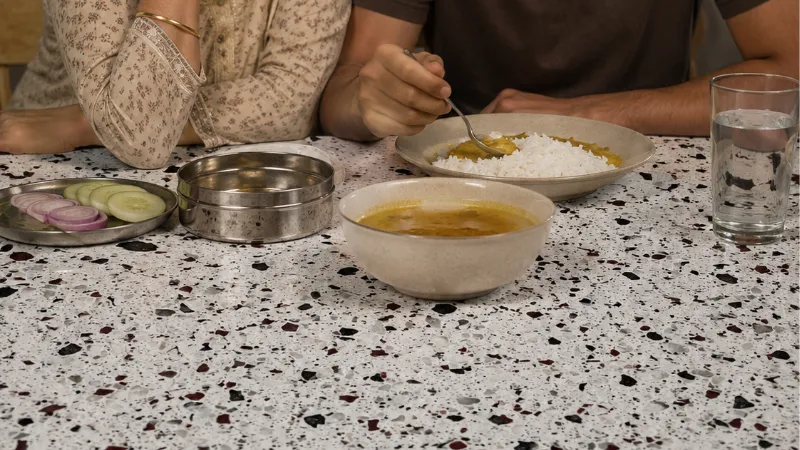
Terrazzo offers a very different design language, with visible aggregate and extensive customisation possibilities.
Its performance depends on the specific formulation and finish. Quartz generally offers a more predictable countertop surface when consistency and straightforward maintenance are important.
The right material still depends on the brief.
Quartz does not require an elaborate maintenance routine.
Use a soft cloth with warm water and a suitable mild cleaner. Wipe the surface regularly to remove food residue, grease and spills.
Allow the residue to soften rather than attacking it with an abrasive pad or sharp metal tool. A non-abrasive scraper can help with stubborn material where appropriate.
Avoid:
Always follow the care instructions supplied with the specific quartz product, because cleaning recommendations can vary between manufacturers and finishes.
A high-quality slab can still fail when it is installed incorrectly.
Quartz countertops need appropriate support across the surface, especially around sink cut-outs, joints and overhangs.
Unsupported sections can experience additional stress when weight or impact is applied. Poor cabinet alignment can also create uneven pressure across the slab.
For professional projects, installation should therefore be treated as part of the material specification rather than a separate step.
Before fabrication, confirm:
Substrate support
Cut-out dimensions
Overhang requirements
Edge profile
Joint positions
Reinforcement requirements
This is one of the simplest mistakes to prevent. Always use a trivet.
Quartz may resist everyday wear, but direct cutting can damage the finish. Use a proper cutting board.
More powerful does not always mean safer. Stick to products recommended for the surface.
Edges and corners can be more vulnerable to impact than the main countertop area.
Cracks can sometimes result from insufficient support, poor fabrication or stress around cut-outs rather than an inherent defect in the slab.
For architects, interior designers, builders and procurement teams, choosing quartz should go beyond the colour catalogue.
Ask the supplier about:
Surface consistency: Does the appearance remain consistent across batches?
Thickness: Are slabs produced within controlled thickness tolerances?
Technical documentation: Can the supplier provide product specifications and recommended applications?
Finish quality: Is the polish or surface finish consistent across the slab?
Fabrication guidance: Does the supplier provide recommendations for cut-outs, edges and support?
After-sales support: What happens if a slab is found to be defective or damaged?
These questions become increasingly important when sourcing quartz for multiple residential units or commercial projects.
A homeowner selecting one countertop can inspect the material before installation.
A developer, distributor or kitchen manufacturer may need dozens or hundreds of slabs.
At that scale, consistency becomes critical.
A single slab with a different shade, finish or specification can create installation delays, replacement costs and problems with the finished project.
That is why professional buyers should evaluate the manufacturing process and supplier reliability, not just the sample slab.
Yes, quartz is resistant to normal kitchen conditions, but it is not heatproof. Direct exposure to very hot cookware can damage the surface, so trivets should always be used.
Quartz is highly scratch-resistant under normal use, but it is not scratch-proof. Use cutting boards and avoid dragging abrasive objects across the surface.
Quartz has a low-porosity surface and is highly resistant to many common household stains. Prompt cleaning and appropriate maintenance still matter.
Engineered quartz generally does not require the periodic sealing associated with many natural stone surfaces.
For homeowners who prioritise easier maintenance and stain resistance, quartz is generally more practical. Marble remains attractive for projects where natural veining and character are the priority and the owner accepts greater care requirements.
Its service life depends on the product, installation quality, use and maintenance. Correct installation and normal care play an important role in long-term performance.
Quartz is resistant—but resistant does not mean indestructible.
Its low-porosity surface, durability and consistent manufacturing make it a practical choice for busy kitchens and other high-use interiors. At the same time, basic precautions still matter.
Use trivets for hot cookware. Use cutting boards. Clean with suitable products. Protect vulnerable edges. Most importantly, make sure the slab is properly fabricated and supported.
For professionals, the material is only part of the specification. Product quality, installation, supplier consistency and correct client guidance all contribute to how well a quartz surface performs over time.
Paradigm Surfaces offers engineered quartz surfaces designed for contemporary interior applications, supported by manufacturing and quality-control processes focused on consistent slab performance

 24 September, 2026
Festive Home Makeovers: Refreshing Kitchens & Interiors with Stone
 20 September, 2026
 17 September, 2026
CNC Precision Cutting: How Technology Improves Edge & Inlay Work
 13 September, 2026
NSF & Food Safety Certifications: What They Mean for Quartz Surfaces
 12 September, 2026
Whatsapp Chatx
Hi! Click one of our representatives below to chat on WhatsApp or send us email to sales@paradigmquartz.in
 |
Contact Us +91 99440 00900 |