
22
APR
2026
Choosing slab thickness is not just about how thick the finished edge should look. It affects handling, support, fabrication, structural performance and project cost.
A 12mm slab can work extremely well as a wall panel or backsplash, but the same thickness may need additional support in a demanding horizontal application. A 20mm slab provides greater rigidity for countertops and islands, but adds weight and material cost.
For architects, interior designers, fabricators and procurement teams, the right question is not “Which thickness is best?” It is “Which thickness suits the application?”
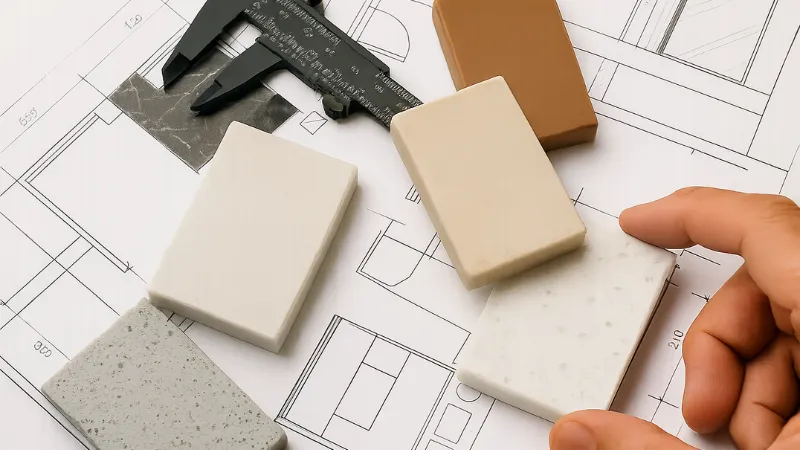
12mm, 15mm and 20mm slabs serve different purposes. 12mm is generally suited to lightweight and vertical applications such as wall cladding, backsplashes and feature panels. 15mm sits between the two and can work for moderate-use surfaces where additional strength is needed without moving to a full 20mm slab. 20mm is the preferred specification for many kitchen countertops, islands and heavy-use horizontal surfaces because it provides greater rigidity and fabrication flexibility. Slab size and support structure matter just as much as thickness, especially with large-format and Super Jumbo slabs.
Thickness influences how a slab behaves once it is fabricated and installed.
Three factors are particularly important:
Strength and rigidity: Thicker slabs generally provide greater resistance to bending and point loads.
Appearance: Thickness changes the visual weight of the finished edge. A slim slab gives a lighter architectural appearance, while a thicker edge creates a more substantial profile.
Installation: Thicker slabs weigh more and may require stronger support structures and more careful handling.
This becomes especially important with large-format slabs, where the size of the piece and the available support must be considered together.
A 12mm slab is a practical choice when reducing weight and thickness matters.
The main advantages are lower weight, easier handling and a thinner visual profile.
The limitation appears when the slab must span unsupported areas or handle significant point loads. In those situations, additional substrate support may be required.
A 12mm slab is therefore not automatically a lower-quality choice. It is simply a specification that makes more sense in the right application.
15mm sits between the lighter 12mm format and the more substantial 20mm slab.
It can suit applications where the project needs more rigidity than 12mm provides but does not require the full thickness of a standard heavy-use countertop.
Typical applications include:
The main consideration is availability. The original specification notes that 15mm can be less commonly stocked than 12mm and 20mm in some markets, which can affect procurement.
For projects that depend on consistent supply across multiple phases, availability should be confirmed before the thickness is locked into the specification.
20mm is the most substantial of the three standard options and is widely used for demanding horizontal surfaces.
The extra thickness provides greater rigidity and gives fabricators more flexibility for edge profiles, cut-outs and other countertop details.
It also creates a stronger visual edge, which works well in premium kitchens and commercial interiors.
The trade-off is straightforward: more material means more weight and higher material cost. Cabinet structures and supporting elements must therefore be designed to handle the finished slab.
Factor | 12mm | 15mm | 20mm |
Typical use | Walls, panels, backsplashes | Moderate-use surfaces | Countertops, islands, heavy-use tops |
Weight | Lowest | Medium | Highest |
Rigidity | Lower | Medium | Higher |
Edge options | More limited | Moderate | Widest range |
Handling | Easier | Moderate | More demanding |
Material cost | Lower | Mid-range | Higher |
Support needs | Higher where unsupported | Application-dependent | Strong support still required |
The table is a starting point, not a substitute for the manufacturer\'s technical guidance and project-specific structural requirements.
One of the most important points in slab selection is that thickness cannot be considered on its own.
Think of performance as:
Slab thickness + slab size + support structure
A 20mm slab with inadequate support may still perform poorly. Likewise, a thinner slab can be perfectly suitable when it has continuous and appropriate backing.
The issue becomes more important with Super Jumbo slabs. Larger pieces are heavier and create greater handling and support demands during fabrication and installation.
This is why large-format projects should be planned around actual slab dimensions, support requirements, handling methods and fabrication limitations from the beginning.
Kitchen islands deserve particular attention because their design often includes overhangs for seating.
The supported portion of the island and the unsupported overhang should be considered separately. A longer overhang can require additional reinforcement beneath the slab regardless of whether the material is 12mm, 15mm or 20mm.
For that reason, designers should not approve an island based on slab thickness alone. The fabricator, cabinet structure and reinforcement details should all be coordinated before production.
Not necessarily.
A thinner slab may cost less per square metre, but additional substrate work, edge build-up or fabrication requirements can reduce the initial saving.
At the same time, specifying 20mm where a 12mm panel would perform perfectly well adds unnecessary material and handling costs.
The better approach is to calculate the total project cost, including:
This is particularly important for B2B projects where even small specification differences can multiply across many units.
Lower material cost does not automatically mean lower project cost if additional support or edge build-up is required.
A large-format design should be checked against the actual slab sizes available from the supplier before fabrication begins.
Thickness and support work together. A slab should never be selected without considering how it will be installed.
For professional procurement, ask suppliers about thickness tolerances and product specifications rather than relying only on the nominal number.
A 20mm slab and a visually 40mm edge are not necessarily the same thing. Laminated or mitred edges may be required depending on the design.
For architects, designers and procurement teams, ask the supplier:
What thicknesses are available consistently?
What are the actual slab dimensions?
What thickness tolerance applies?
Which applications does the manufacturer recommend for each thickness?
What substrate and reinforcement are required?
Are the same thickness and design available across future batches?
These questions matter even more when specifying large-format or Super Jumbo slabs for projects with multiple units or phases.
There is no universal “best” slab thickness.
12mm works well when weight and a slim profile are important, particularly for vertical applications. 15mm provides a middle option for selected moderate-use surfaces. 20mm is a practical choice for many countertops, islands and other demanding horizontal applications.
The important decision is not simply thickness. Consider thickness, slab size, support, fabrication and intended use together.
For large-format projects, working with a supplier that can provide consistent slab dimensions, thickness and technical information makes specification much easier. Paradigm Surfaces offers engineered quartz surfaces for interior applications, including large-format options suited to contemporary kitchen and architectural projects.

 24 September, 2026
Festive Home Makeovers: Refreshing Kitchens & Interiors with Stone
 20 September, 2026
 17 September, 2026
CNC Precision Cutting: How Technology Improves Edge & Inlay Work
 13 September, 2026
NSF & Food Safety Certifications: What They Mean for Quartz Surfaces
 12 September, 2026
Whatsapp Chatx
Hi! Click one of our representatives below to chat on WhatsApp or send us email to sales@paradigmquartz.in
 |
Contact Us +91 99440 00900 |