
28
APR
2026
Marble can change the character of an interior with very little decoration around it. Its natural veining, tonal variation and polished finish can turn a floor, wall, countertop or piece of furniture into a focal point.
But good marble design is not about using the stone everywhere. It is about choosing the right application, finish and marble variety for the space.
From large-format flooring to feature walls and statement furniture, here are seven ways to use marble in modern interiors.
Marble works best when its natural character becomes part of the design rather than just another surface finish. Large-format flooring can make rooms feel more expansive, while bookmatched slabs create dramatic feature walls. Marble also suits bathroom vanities, staircases, dining tables and decorative inlays. Kitchen countertops need more consideration because marble can etch and stain more easily than engineered quartz or granite. Before selecting a marble, consider the space, traffic level, maintenance requirements, slab size, finish and available budget.
Large-format marble flooring remains one of the most effective ways to add depth and character to a spacious interior.
White and beige marble with subtle veining can make a room feel open and visually continuous. In entrance foyers, hotels and large residential spaces, bookmatching can take the effect further by positioning adjacent slabs so their natural patterns mirror each other.
For high-traffic areas, the finish matters as much as the marble itself. Honed surfaces can offer a softer appearance and hide minor wear better than highly polished surfaces.
A full-height marble feature wall can give a living room, reception area or lobby a strong architectural identity without requiring much additional decoration.
Use a marble with distinctive movement behind a television unit, sofa, reception desk or fireplace. For a more dramatic result, designers can use bookmatched slabs to create a continuous veining pattern.
The wall structure also needs attention. Marble is heavy, so the substrate, fixing system and installation method should be checked before fabrication.
Few kitchen surfaces create the same visual impact as natural marble.
A white marble with flowing grey veining can become the centrepiece of a premium kitchen, particularly when paired with understated cabinetry and minimal hardware.
There is, however, an important trade-off. Marble is more vulnerable to etching and staining than engineered quartz. Acidic ingredients such as lemon juice, vinegar and other kitchen substances can affect the surface.
That makes marble particularly suitable for:
For busy everyday kitchens, engineered quartz may offer a more practical balance of appearance and maintenance.
Bathrooms are another strong application for marble because the material can create a sense of luxury without needing multiple decorative finishes.
Use it for vanity tops, shower walls, wall panels or selected flooring areas. A large slab with minimal joints can create a cleaner, more continuous appearance.
Pair light marble with warm wood, brushed metal or muted stone finishes to stop the bathroom from feeling too cold.
Moisture management remains important. The marble, joints and installation system should be selected for the actual wet-area conditions, with maintenance requirements explained to the client before installation.
A marble staircase can turn a functional circulation space into one of the most noticeable elements in a building.
Using the same or coordinated marble across the treads and risers creates a strong visual rhythm, while contrasting railing materials can provide balance.
For staircase applications, surface traction is critical. Highly polished stone can become slippery, so the finish and edge treatment should be selected with the intended use in mind.
Always coordinate the stone thickness and support details with the staircase structure before fabrication.
Marble does not have to stay on floors, walls and countertops.
Dining tables, coffee tables, console tops and side tables can introduce natural stone into an interior without covering large areas.
This works particularly well when the room already contains wood, metal or fabric elements. The marble becomes a controlled focal point rather than overwhelming the space.
Round marble dining tables can also work well in compact dining rooms because the softer shape offsets the visual weight of the stone.
For everyday furniture, use appropriate protective pads and explain that acidic food and drinks can mark natural marble.
Sometimes the most effective use of marble is the smallest one.
Instead of cladding an entire room, use marble for:
Contrasting marbles can create geometric patterns or frame larger surfaces. This approach allows the natural stone to stand out without making the entire interior dependent on it.
For intricate inlay work, account for cutting, matching and installation time during project planning.
Each stone has a different role.
Marble: Best known for natural veining, depth and visual character. It demands more care, particularly in kitchens and other areas exposed to acids.
Quartz: Offers a more consistent manufactured appearance and generally lower routine maintenance. It is often the practical choice for busy countertops.
Granite: Provides natural variation, durability and good heat resistance. It can be a strong option for heavy-use surfaces where natural stone is preferred.
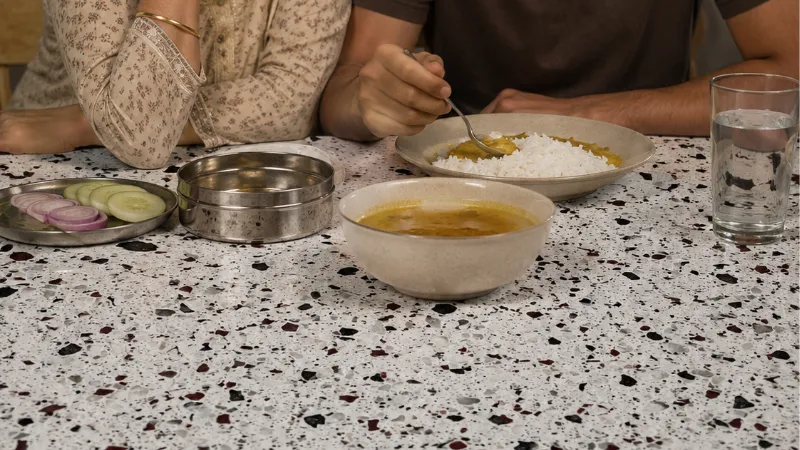
Terrazzo: Offers a distinctive aggregate-based appearance and broad design possibilities. It works particularly well in projects looking for a more graphic or customised surface.
The strongest material specification is often a combination rather than a single stone throughout the project.
Before selecting a slab, look at five things.
A marble suitable for a feature wall may not be the best choice for a heavily used kitchen countertop or staircase.
High-traffic areas require greater attention to hardness, finish, maintenance and slip resistance.
Look at the full slab rather than relying only on a small sample. Pattern movement can change dramatically across a large surface.
Polished, honed and other finishes create different visual and functional results.
Always check marble in lighting conditions close to the final installation. Warm artificial light and daylight can change how the stone\'s colour and veining appear.
For architects, builders, interior designers and distributors, the visual quality of the marble is only one part of the specification.
Before ordering, check:
For bookmatched installations or large projects, supply consistency becomes particularly important because replacement slabs may need to coordinate with material already installed.
Choosing from a small sample: A small piece cannot show the full movement of a natural slab.
Ignoring maintenance: Marble needs more care than engineered quartz. Clients should understand this before installation.
Using the wrong finish: A finish that looks beautiful may not suit a wet floor, staircase or high-traffic zone.
Forgetting wastage: Large installations and bookmatching can require additional material because slabs must be selected and cut around the pattern.
Selecting marble only for its colour: Veining, finish, thickness and application all affect the final result.
Marble remains one of the most expressive materials available for interior design because every slab carries natural variation that gives a space its own character.
Use it strategically. Let it define a foyer floor, become the centrepiece of a feature wall, add luxury to a bathroom, or introduce smaller moments of contrast through furniture and inlays.
The most successful marble interiors do not simply choose the most attractive slab. They choose a marble whose appearance, finish, maintenance requirements and application all match the project.
Paradigm Surfaces offers marble surfaces alongside quartz, granite and terrazzo, giving architects, designers and homeowners the flexibility to select the material that best fits each part of an interior project.

 24 September, 2026
Festive Home Makeovers: Refreshing Kitchens & Interiors with Stone
 20 September, 2026
 17 September, 2026
CNC Precision Cutting: How Technology Improves Edge & Inlay Work
 13 September, 2026
NSF & Food Safety Certifications: What They Mean for Quartz Surfaces
 12 September, 2026
Whatsapp Chatx
Hi! Click one of our representatives below to chat on WhatsApp or send us email to sales@paradigmquartz.in
 |
Contact Us +91 99440 00900 |