04
APR
2026
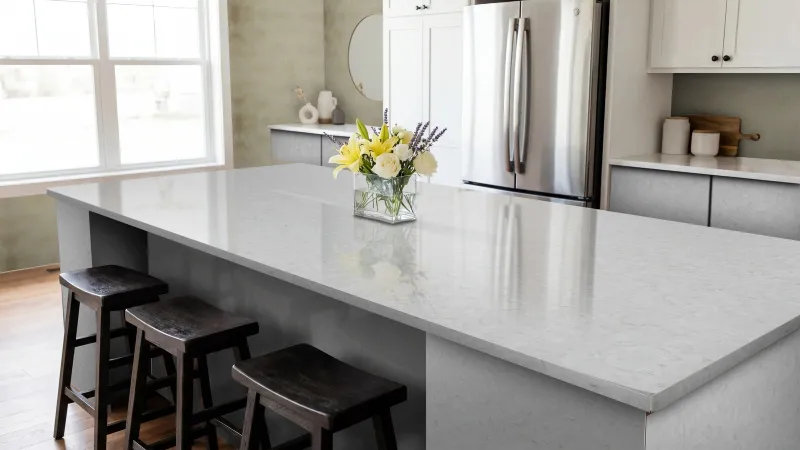
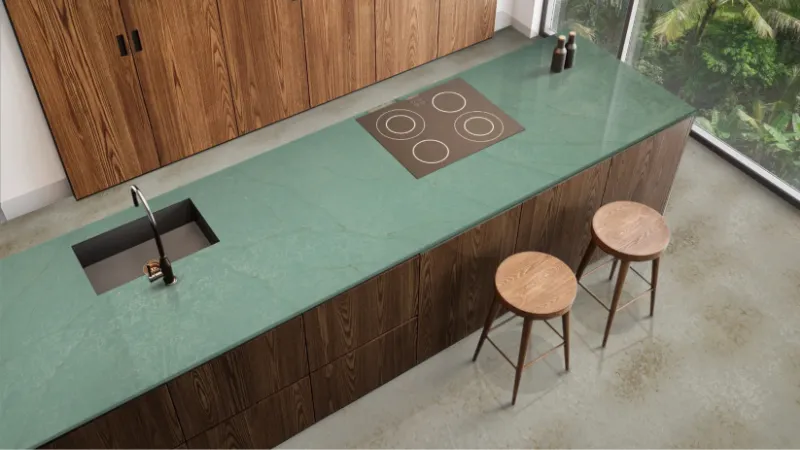
Engineered quartz countertops are heat-resistant, but they are not heat-proof. Their quartz particles tolerate high temperatures, while the resin binder can be affected by intense or sudden heat. Direct contact with hot pans, oven trays, slow cookers, and other heat-generating appliances can cause permanent discolouration or cracking. Because thermal performance varies by product, there is no single safe temperature for every quartz countertop. Using a trivet or heat pad is the simplest way to prevent damage.
Engineered quartz is a popular choice for modern kitchens because of its scratch resistance, stain resistance, consistent appearance, and relatively low maintenance requirements.
However, one common misconception can lead to expensive mistakes: quartz countertops are not heat-proof.
A countertop may handle normal kitchen conditions without difficulty but still be damaged when a hot pan is placed directly on its surface. For homeowners, this can mean permanent marks. For fabricators, contractors, and material suppliers, it can mean complaints, replacement costs, and disputes over product performance.
Understanding why quartz reacts to heat helps professionals specify it appropriately and give clients realistic care instructions.
Engineered quartz is manufactured using predominantly natural quartz aggregates combined with polymer resin binders, pigments, and other formulation-specific ingredients. Exact compositions vary between products.
The quartz mineral itself has excellent thermal stability. However, the resin-bound composite behaves differently from a solid piece of natural stone.
When exposed to intense or concentrated heat, the binder and finished surface can be affected. Depending on the product and exposure, the result may include:
Not every incident causes visible damage, and the precise outcome depends on the product and exposure. However, a countertop that appears unaffected after one incident should not be assumed safe for repeated direct contact with hot cookware.
You may encounter claims that quartz can withstand approximately 150°C or even 200°C. These figures should not be treated as universal operating limits.
Thermal performance depends on the slab formulation, exposure duration, contact area, temperature change, and other conditions. A manufacturer\'s test result for a particular product does not automatically establish a safe temperature for every quartz surface.
Major manufacturers such as Cambria and Caesarstone recommend using trivets or hot pads because direct or sustained heat can damage the surface. Both also warn about damage caused by sudden temperature changes.
For practical purposes, do not use a published temperature threshold as permission to place hot cookware directly on quartz. Follow the selected product\'s care instructions and use a suitable heat barrier.
Some everyday tasks create more risk than others.
Kitchen situation | Recommended practice |
Hot pan removed from a stove | Place it on a heat-resistant trivet |
Baking tray taken from an oven | Use a heat-resistant mat or trivet |
Pressure cooker after cooking | Keep it on a suitable heat-safe surface |
Slow cooker, air fryer, or electric griddle | Follow the appliance and countertop manufacturers\' guidance; provide appropriate heat protection |
Warm mugs and serving dishes | Normal use is generally less concerning, but avoid prolonged or unusually hot contact |
Hot cookware placed near an edge or seam | Use a trivet and avoid direct contact |
The important distinction is not simply whether an object feels hot. Cookware and oven trays can reach temperatures well beyond typical countertop-use conditions, while prolonged contact can increase the risk of damage.
Each surface has different performance characteristics. No material should be selected on heat resistance alone.
Property | Engineered quartz | Granite | Marble |
Heat performance | Vulnerable to intense or sudden heat | Generally offers better heat tolerance | Tolerates normal kitchen conditions but can still be heat-damaged |
Surface appearance | Controlled colours and manufactured patterns | Natural mineral patterns and variation | Distinctive veining and natural variation |
Maintenance | Usually does not require sealing | Sealing needs vary by stone | Often benefits from appropriate sealing and careful maintenance |
Acid sensitivity | Depends on the product and formulation | Generally better than marble, though stone varies | Particularly vulnerable to acid etching |
Main consideration | Protect against direct heat | Avoid assuming it is immune to thermal shock | Protect against heat, acids, and staining |
Granite generally has the advantage in heat tolerance because it does not contain the polymer binder used in engineered quartz. This makes it worth considering where exposure to hot cookware is a frequent concern.
However, granite is not indestructible. Rapid temperature changes can damage stone surfaces, particularly around vulnerable areas. Trivets remain good practice even with natural stone.
Marble is often selected for its distinctive appearance rather than its suitability for demanding kitchen conditions. It can be affected by heat, while acidic substances such as lemon juice and vinegar can etch its surface.
For a design where marble is essential, clients should understand these maintenance requirements before installation.
Simple daily habits can substantially reduce avoidable heat damage.
Use trivets consistently. Place hot pans, oven trays, and heat-generating cookware on a suitable heat-resistant barrier rather than directly on the countertop.
Protect areas beneath appliances. Slow cookers, electric skillets, air fryers, and similar appliances may generate sustained heat. Follow the manufacturer\'s instructions for both the appliance and the surface.
Avoid sudden temperature changes. Do not expose the countertop to concentrated heat and then rapidly cool the same area.
Give appliances appropriate clearance. Follow installation guidance for appliances that discharge heat or sit close to the counter, splashback, or cabinetry.
Keep the care instructions available. Pass the slab manufacturer\'s maintenance guidance to the client at handover. This is particularly useful in rental properties, hospitality projects, and other settings where several people use the same kitchen.
Increasing slab thickness should not be treated as a substitute for heat protection. Thickness, support, and fabrication affect structural behaviour, but they do not make engineered quartz heat-proof.
Engineered quartz can be suitable for selected kitchen surfaces, particularly where appearance, routine cleaning, and consistent design are priorities. Its suitability depends on the intended application.
A commercial food-preparation space may involve frequent hot cookware, intense cooking activity, or appliances that produce sustained heat. In these conditions, the specifier must consider the surface\'s documented limitations, applicable hygiene requirements, and the operational needs of the kitchen.
For heavy-duty cooking zones, granite or another material specifically suited to the required heat exposure may be more appropriate. The final choice should follow the product documentation and project requirements rather than a general claim that one material is best for every kitchen.
For B2B projects, heat-related damage is often preventable when expectations are established before handover.
Before specifying quartz, confirm the manufacturer\'s care guidance and relevant product limitations. During installation, ensure the surface is fabricated and supported according to the approved requirements. At handover, explain that trivets are essential for hot cookware and that sustained heat from countertop appliances also needs consideration.
Material specifications and client documentation should describe quartz accurately: durable and practical for many applications, but not intended for unrestricted direct heat exposure.
Yes. Intense or sudden temperature changes can create thermal stress that may result in cracks. Risk depends on the product, exposure, and location, including edges, joints, and cutouts.
It is not recommended. Even brief contact can cause damage under certain conditions. Use a trivet rather than relying on contact time or an estimated temperature.
Thickness alone does not establish safe heat tolerance. Structural support and slab thickness matter for installation, but direct heat protection is still necessary.
Granite generally tolerates heat better than resin-bound engineered quartz. However, material selection should also account for the particular stone, kitchen use, maintenance requirements, and installation.
No. Formulations and product guidance vary. Check the technical documentation and care instructions for the specific slab being considered.
Quartz countertops offer an attractive combination of design flexibility, stain resistance, and relatively easy maintenance. Their main limitation is that they cannot be treated like a heat-proof surface.
For homeowners, using trivets is a simple preventive habit. For architects, designers, fabricators, and distributors, accurate product selection and clear handover instructions help prevent damage and protect client confidence.
The best specification is not the material with the boldest performance claim. It is the material whose documented properties match the demands of the project.

 24 September, 2026
Festive Home Makeovers: Refreshing Kitchens & Interiors with Stone
 20 September, 2026
 17 September, 2026
CNC Precision Cutting: How Technology Improves Edge & Inlay Work
 13 September, 2026
NSF & Food Safety Certifications: What They Mean for Quartz Surfaces

Whatsapp Chatx
Hi! Click one of our representatives below to chat on WhatsApp or send us email to sales@paradigmquartz.in
 |
Contact Us +91 99440 00900 |