
03
JUN
2026
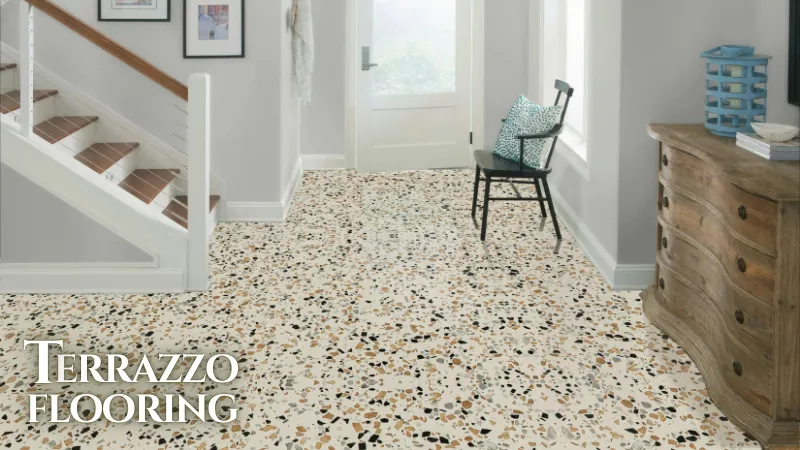
Terrazzo began as a resourceful act of thrift. Venetian craftsmen in the 15th century pressed leftover marble chips into clay to surface their terraces, then polished them smooth underfoot. For centuries it remained exactly that: a practical, hardwearing floor.
That definition no longer holds. Terrazzo has become one of the most expressive materials available to contemporary architects and interior designers—a surface that can be tuned, composed, and authored almost like a painting. Where it was once specified for durability alone, it is now specified for identity.
The shift comes down to control. Few materials let a designer dictate colour, scale, texture, and pattern with this degree of precision while still delivering a single monolithic, seamless surface. A terrazzo floor or wall is not selected from a catalogue of finishes—it is built to a brief. That makes it uniquely suited to projects where a space needs to feel singular rather than specified.
The appeal sits in its open-endedness.
Unlimited colour possibilities. Because both the binder and the aggregate are chosen independently, the palette is effectively infinite. A designer can pull a precise brand colour into the base matrix and scatter it with chips that either harmonise or deliberately clash.
Pattern flexibility. Terrazzo can read as a quiet, near-solid field or as an energetic confetti of large chips. The same material vocabulary produces both restraint and drama.
One-of-a-kind surfaces. No two terrazzo pours are ever identical. The distribution of aggregate is genuinely random, which means even a repeated recipe yields a surface that belongs only to that project.
Contemporary relevance. Terrazzo's mix of mineral texture and clean monolithic finish aligns naturally with current design movements—biophilic interiors, warm minimalism, and tactile material-led spaces all find a home in it.
Understanding terrazzo customisation means understanding its four design levers. Each one is a decision point, and together they define the final surface.
The aggregate is the visible character of the terrazzo—the chips suspended in the binder.
Marble chips remain the classic choice. They bring soft veining, natural depth, and a refined, slightly luminous quality. Marble terrazzo reads as premium because the stone itself carries subtle tonal variation within each chip.
Glass chips introduce reflectivity and saturated colour that natural stone cannot achieve. Recycled glass is popular in sustainability-led projects and produces vivid, jewel-like flecks that catch light.
Stone aggregates—granite, quartz, basalt—add hardness and a more grounded, geological appearance. These suit high-traffic commercial floors where both look and resilience matter.
Metal inclusions, typically brass or aluminium strips and shavings, create accents of shine and can be used to trace lines or zones within a pour.
The mix of these determines whether a surface feels organic, industrial, luxurious, or playful.
Colour in terrazzo is engineered in two layers.
The binder colour sets the mood of the whole surface. A pale, neutral binder lets the aggregate sit quietly; a dark or richly pigmented binder makes chips pop with high contrast.
Neutral palettes—bone, sand, soft grey—remain the workhorse of hospitality and residential work because they age gracefully and partner with almost any joinery.
Bold architectural colours—deep terracotta, forest green, oxblood, ink blue—are increasingly specified for feature areas where the floor or wall is meant to command attention.
Brand-specific colour matching is where terrazzo becomes a marketing asset. A binder can be mixed to a brand's exact reference, and chips chosen to echo it, turning a reception floor into a three-dimensional expression of identity.
Chip size changes everything about how a surface is read from across a room.
Fine terrazzo uses small chips for a calm, almost solid appearance. It suits minimalist interiors and large continuous areas where busyness would overwhelm.
Medium terrazzo is the balanced, traditional look—legible texture without visual noise.
Large-chip terrazzo uses oversized aggregate—sometimes whole slices of marble several centimetres across—to create bold, sculptural surfaces that function almost as artwork.
To explore a wide variety of ready-to-use designs and color options, see our guide: Buy Terrazzo Slabs Online – High-Quality Patterns & Colors.
Beyond the field itself, terrazzo accepts inlay and division.
Using metal dividing strips, fabricators can set logos into a floor, build wayfinding systems that guide movement through a building, embed custom graphics, and create decorative inlays that border or zone a space. These techniques turn the material from a surface into a communication tool.
Monochromatic terrazzo—chips and binder in a single tonal family—is rising because it delivers texture without colour commitment, fitting the appetite for quiet, sophisticated interiors.
Oversized aggregate designs answer a demand for statement surfaces; the dramatic scale photographs well and gives a space an instant focal point.
Minimalist terrazzo with fine chips and pale binder grows alongside the broader warm-minimalism movement, offering subtle interest where plain finishes feel flat.
Organic patterns, often using irregular chip shapes and earthy tones, appeal to biophilic and wellness-led design.
Luxury hospitality terrazzo leans on marble chips and refined palettes to signal quality the moment a guest arrives.
Retail-focused statement surfaces use bold colour and brand matching because stores increasingly compete on experience, and the floor is real estate that can carry identity.
Hotels use terrazzo in lobbies and bathrooms to establish a consistent, premium identity across every guest touchpoint.
Luxury residences specify it for seamless, durable floors that feel bespoke rather than off-the-shelf.
Retail stores deploy branded terrazzo to reinforce identity and create a memorable, photographable environment.
Corporate offices embed logos and use colour zoning to express brand and aid navigation across large floorplates.
Restaurants rely on its durability and atmosphere, using colour and texture to set tone from casual to fine dining.
Public spaces—airports, museums, transit hubs—choose terrazzo for its extreme longevity and its ability to integrate wayfinding into the surface itself.
A custom terrazzo project moves through clear stages.
Initial design consultation establishes the project's intent—mood, palette, traffic, and any branding requirements.
Material selection translates that brief into specific binder colours and aggregate types.
Sampling produces physical samples so the design team can assess colour, chip distribution, and finish in real light. This step is critical; screens distort both colour and scale.
Fabrication manufactures the slabs or prepares the in-situ pour to the approved recipe.
Installation lays the material, followed by grinding and polishing to reveal the aggregate and achieve the final finish.
Quality control checks consistency, finish, and tolerance across the whole surface before handover.
Choosing patterns without considering scale. A chip size that looks right on a small sample can read very differently across a large floor. Always evaluate at the intended scale.
Overcomplicating designs. Too many colours and inclusions can turn an elegant surface into visual clutter. Restraint usually reads as quality.
Ignoring lighting conditions. Terrazzo shifts noticeably under natural versus artificial light. A palette must be assessed in the actual environment.
Failing to create mockups. Skipping physical samples and mockups is the most common—and most expensive—error. A mockup catches problems before they are set in stone.
For architects, developers, and distributors, the supplier is part of the design outcome. The right partner offers genuine design support, helping translate a concept into a buildable recipe. Strong sampling capability lets teams iterate quickly with accurate physical references.
Manufacturing consistency matters most at scale—colour and chip distribution must hold across hundreds of square metres and repeat orders. Custom fabrication expertise determines whether ambitious inlays and logos are achievable. And project-scale supply reliability ensures a large specification can be delivered on programme without compromise.
A supplier that combines these is not merely a vendor but a collaborator in the design.
Can terrazzo be customised? Yes—comprehensively. Binder colour, aggregate type, chip scale, and embedded patterns can all be specified to a brief, making each surface unique.
How are terrazzo colours created? Colour comes from two sources: pigment mixed into the binder matrix and the natural or coloured chips suspended within it. The two are tuned together.
Is custom terrazzo more expensive? Bespoke colour matching, large aggregates, and inlay work add cost over standard recipes, but the result is a one-of-a-kind, extremely durable surface that often outlasts the building's other finishes.
Can logos be incorporated into terrazzo? Yes. Using metal dividing strips and precise fabrication, logos, graphics, and wayfinding can be set permanently into the surface.
Terrazzo has outgrown its origins. It is no longer simply a floor—it is a design medium with the range to express colour, texture, and identity on its own terms.
For the architects and designers shaping today's hotels, retail spaces, and residences, that range is the point. Terrazzo functions as a branding tool, a wayfinding system, and an architectural surface capable of giving a space a character that exists nowhere else. Specified well, with the right manufacturing partner, it turns a brief into a surface that is genuinely one of a kind
 24 September, 2026
Festive Home Makeovers: Refreshing Kitchens & Interiors with Stone
 20 September, 2026
 17 September, 2026
CNC Precision Cutting: How Technology Improves Edge & Inlay Work
 13 September, 2026
NSF & Food Safety Certifications: What They Mean for Quartz Surfaces
 12 September, 2026
Whatsapp Chatx
Hi! Click one of our representatives below to chat on WhatsApp or send us email to sales@paradigmquartz.in
 |
Contact Us +91 99440 00900 |