
25
JUN
2026
Climate is one of the most consequential — and most overlooked — factors in selecting interior surface materials. Architects and designers routinely evaluate aesthetics, finish, cost, and availability. Environmental performance? Often an afterthought.
That changes the moment a project runs into problems: efflorescence on marble walls in a coastal hotel, mold creeping along grout lines in a residential bathroom, or surface staining that sets in within the first year of installation. In each case, the root cause isn't poor maintenance or bad luck. It's a material chosen without accounting for where it would live.
Humidity creates a specific and persistent set of challenges. And engineered marble and quartz surfaces are, by design, well-suited to address them. This guide explains why — technically, practically, and from a project specification standpoint.
Before evaluating material options, it's worth understanding what humidity actually does to a surface over time.
Moisture absorption is the starting point. Natural stone and many composite materials are porous to varying degrees. When ambient humidity is consistently high, these pores absorb atmospheric moisture even without direct water contact. Over months and years, this contributes to internal stress, surface discoloration, and structural degradation.
Mold and mildew thrive in moisture-retaining surfaces. In bathrooms, laundry rooms, and coastal properties where humidity rarely drops, even micro-porous surfaces become hospitable environments for fungal growth — particularly along grout lines and in areas with limited airflow.
Staining accelerates in humid conditions. Moisture acts as a carrier, helping minerals, cleaning agents, and organic matter penetrate more deeply into susceptible surfaces. Calcareous stones are especially vulnerable.
Dimensional movement — the expansion and contraction of materials in response to moisture and temperature changes — is less dramatic in interiors than exteriors, but it's real. In surfaces with inconsistent density or inadequate bonding, this movement manifests as cracking, lifting, or joint failure over time.
Long-term maintenance is disproportionately burdensome for moisture-sensitive materials. Resealing natural stone in humid environments isn't a one-time task; it's an ongoing operational cost that project buyers and facility managers increasingly want to avoid.
Engineered marble and quartz are manufactured composites. Their performance in humid environments isn't accidental — it's a direct consequence of how they're made.
Engineered marble is produced by binding crushed marble aggregate with resin binders under controlled pressure and heat. Quartz surfaces follow a similar process, combining ground quartz crystal with polymer resins. The result in both cases is a material with significantly lower porosity than naturally quarried stone.
Water absorption rates for engineered marble and quartz typically fall below 0.1% — well under the thresholds that would make moisture a meaningful performance concern in most interior applications. This matters in humid climates because it interrupts the primary mechanism through which humidity damages surfaces: ingress.
A non-porous or low-porosity surface doesn't just resist water — it fundamentally changes the hygiene and maintenance profile of the material.
In humid environments, this translates to:
For commercial and hospitality applications in particular, this performance characteristic has direct implications for cleaning protocols and lifecycle hygiene certifications.
Because engineered marble and quartz are manufactured to consistent density throughout, they respond more predictably to temperature and humidity fluctuations than natural stone.
Natural marble can have internal veining, mineral variations, and micro-fractures that respond unevenly to moisture movement. Engineered alternatives, produced under controlled manufacturing conditions, exhibit tighter dimensional tolerances. This reduces the risk of cracking, grout joint failure, and surface distortion — outcomes that become progressively more likely in high-humidity settings with natural stone that hasn't been carefully sourced and installed.
Natural stone is celebrated for its uniqueness. In humid environments, that uniqueness can work against a project. Uneven mineral density means some areas of a slab absorb moisture faster than others, leading to patchy discoloration, differential weathering, and surface finish degradation that's difficult to reverse.
Engineered surfaces maintain a more consistent finish precisely because their composition is uniform. The visual quality you see at installation is closer to what you'll see in five or ten years, assuming reasonable care.
Resealing is the operational reality that catches many project buyers off guard. High-quality natural marble in a humid bathroom may need resealing every 6–12 months to maintain its resistance to moisture and staining. Engineered marble and quartz in similar conditions require no resealing and can be maintained with regular cleaning alone.
For large-scale commercial projects — hospitality, healthcare, commercial offices — this difference in maintenance overhead translates directly to operational cost savings over the building's lifecycle.
The kitchen combines heat, moisture, and chemical exposure in ways that stress surface materials continuously. Splashing water, steam from cooking, and cleaning product residue all interact with countertop and wall surfaces daily. Engineered marble and quartz perform reliably here because their low absorption rate prevents staining from oils and food acids, and their non-porous surface makes hygiene maintenance straightforward.
Bathrooms are the most humidity-intensive interior space in most buildings. Shower enclosures, vanity tops, and floor surfaces in bathrooms are in near-constant contact with water, steam, and cleaning chemicals. Engineered surfaces are particularly well-suited here. Their dimensional stability reduces the risk of grout joint failure, and their resistance to mold makes them a pragmatic choice for projects where hygiene is a design priority.
Often overlooked in material specification, laundry rooms combine high humidity, chemical exposure (detergents, fabric softeners), and mechanical vibration. Engineered marble or quartz benchtops and wall cladding hold up well in this environment, where natural stone would require consistent maintenance attention.
Coastal environments introduce salt-laden air into the humidity equation. Salt is hygroscopic — it attracts and retains moisture — and it accelerates the degradation of porous surfaces. Engineered surfaces, with their lower porosity, are more resistant to salt-air conditions. They're increasingly specified in coastal residential and hospitality projects as architects factor in environmental exposure during material selection.
Temperature cycling — from steam rooms to cool treatment areas — combined with high ambient humidity makes spas an unusually demanding environment for surface materials. Dimensional stability and resistance to thermal movement are important here, alongside the hygiene requirements inherent to any wellness facility.
Hotels, resorts, and serviced apartments in tropical or coastal locations need surfaces that can withstand continuous high-humidity conditions while maintaining the aesthetic standard guests expect. Engineered marble allows designers to achieve the visual language of natural stone with more predictable long-term performance — an important consideration when a hotel's surface materials need to perform at a high standard for 10–15 years between major refurbishments.
Selecting the right material is necessary but not sufficient. Finish, installation approach, and spatial design all influence how well any surface performs in a humid environment.
Finish selection: Polished surfaces show water spots and soap residue more readily than honed or matte finishes. In bathrooms and kitchens particularly, honed or leathered finishes tend to be more forgiving in humid environments — easier to keep looking clean between formal cleaning cycles.
Ventilation: No surface material compensates for poor ventilation. In humid climates, mechanical ventilation in bathrooms and kitchens is as important as the material itself. Without adequate airflow, even the most humidity-resistant surfaces become part of a moisture-retention problem rather than a solution.
Color choices: Lighter surfaces reveal water marks and mineral deposits more clearly. In hard water areas combined with high humidity, mid-tones or surfaces with movement in the patterning tend to conceal day-to-day deposits better than stark whites.
Seamless installation: Large-format slabs with minimal grout lines reduce the number of moisture ingress points. Where joints are unavoidable, proper waterproof grout and silicone detailing is critical — this is a detail that engineered marble fabricators and installers with humidity-climate experience will specify correctly.
Engineered materials are no longer confined to interior wet areas. Their performance credentials and improving aesthetics have opened up exterior applications — facades, terraces, and commercial public spaces — particularly in humid and coastal climates where natural stone would require intensive maintenance.
To explore how engineered materials are shaping modern architectural projects, read How Engineered Marble Is Transforming Interior & Exterior Design Trends.
Correct substrate preparation: Ensure the substrate is completely dry before installation. Installing over damp concrete or plywood in a humid climate traps moisture that can compromise adhesive bonds over time.
Appropriate adhesive selection: Use adhesives rated for wet or high-humidity environments. Standard adhesives can fail over time when subjected to continuous moisture.
Silicone joints at transitions: At changes between surfaces — wall to floor, countertop to wall — flexible silicone joints allow for minor movement and prevent water from tracking behind the surface.
Sealing (where applicable): While engineered marble and quartz generally don't require sealing, grout joints in tiled applications do. Use a penetrating grout sealer rated for wet areas and reapply at manufacturer-recommended intervals.
Cleaning method: Use pH-neutral cleaners. Avoid abrasive pads and acidic products, which can etch surface resin over time. In commercial settings, establish a cleaning protocol in writing to ensure consistency.
Routine maintenance: Address standing water quickly — not because the surface can't handle it, but because persistent standing water encourages mold and mineral deposit build-up at edges and joints. A dry-wipe routine after showers or cooking is a low-effort practice with meaningful long-term benefits.
Selecting purely on appearance: A slab that looks identical in the showroom can behave very differently in a humid coastal bathroom versus a dry climate kitchen. Material performance data — water absorption rates, porosity ratings, surface hardness — should inform specification decisions alongside visuals.
Ignoring finish requirements: A polished finish in a high-humidity environment will require considerably more attention to look well-maintained than a honed alternative. This isn't always communicated clearly at the point of sale.
Poor ventilation planning: Buyers sometimes invest in premium surfaces and then install them in bathrooms without adequate extraction fans, or in coastal homes without cross-ventilation. The surface underperforms not because of the material but because of the environment it was placed into.
Skipping technical documentation: In commercial projects especially, specifying a surface without reviewing the manufacturer's technical data sheet — including water absorption, chemical resistance, and installation guidelines — is a risk that frequently results in post-installation issues that are expensive to remediate.
Choosing based on cost alone: Opting for a lower-specification engineered product to reduce upfront cost in a humid environment tends to increase long-term maintenance and replacement costs. The lifecycle cost calculation usually favours a higher-specification material, particularly in commercial settings.
For architects, builders, and commercial buyers specifying engineered marble or quartz for humid-climate projects, supplier capability matters beyond the product itself.
Manufacturing consistency: Surface materials need to be consistent across production batches, particularly for large projects requiring multiple slabs. Colour and finish variation between batches is a persistent problem in the industry.
Technical documentation: Professionals need water absorption data, chemical resistance data, and installation guidance that reflects real-world performance rather than marketing language. Suppliers who can provide detailed technical data sheets signal a higher level of manufacturing rigour.
Climate-specific expertise: A supplier who understands the difference between specifying for a dry interior versus a coastal spa isn't just selling slabs — they're providing project support that reduces specification risk.
Project support: For large commercial specifications, the ability to provide samples, cut-to-size fabrication, and on-site technical support during installation is increasingly expected by contractors and project managers.
Supply reliability: Material shortages mid-project are an operational risk. Suppliers with consistent stock levels and reliable lead times are preferred for commercial and residential developments operating to tight construction programmes.
Is engineered marble suitable for humid climates? Yes. Engineered marble is manufactured with resin binders that significantly reduce its porosity compared to natural marble. This makes it more resistant to moisture absorption, mold, and staining — all relevant performance criteria in humid environments.
Does quartz absorb moisture? Engineered quartz has very low water absorption — typically below 0.1%. This makes it one of the more moisture-resistant surface materials available for interior applications. It does not require sealing and can be maintained with standard cleaning.
Which engineered surface is best for bathrooms? Both engineered marble and quartz perform well in bathrooms. Quartz is slightly denser and has marginally lower porosity. Engineered marble offers a closer visual approximation to natural stone. The decision is often driven by the aesthetic requirements of the project, with both materials delivering comparable functional performance.
Can engineered marble be used in coastal homes? Yes, for interior applications. In coastal environments, the low porosity of engineered marble makes it more resistant to salt-air humidity than natural marble, which benefits from its predictable finish maintenance in environments where surface care is more challenging.
The best-looking surface material is not always the best-performing one. In humid climates — from coastal residences to tropical hospitality projects — the gap between a material's showroom appearance and its 10-year performance depends heavily on whether it was selected with environmental context in mind.
Engineered marble and quartz surfaces are not a compromise. They're materials engineered to perform reliably in conditions that challenge natural stone, and to do so with lower maintenance overhead and more predictable long-term aesthetics.
For architects, designers, and commercial buyers working in humidity-prone environments, they represent a technically sound and commercially practical choice — provided the material is correctly specified, properly installed, and supported by a supplier who understands the performance demands of the project.
Climate-appropriate material selection isn't a niche consideration. In an increasing number of project locations, it's the baseline for getting the specification right
 24 September, 2026
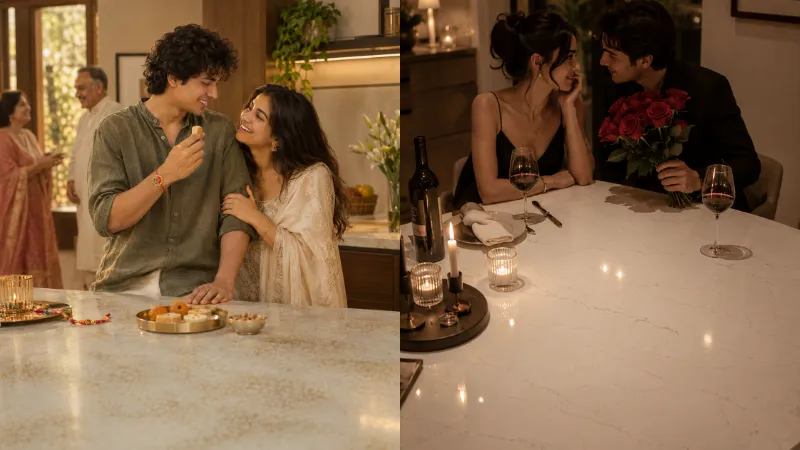
Festive Home Makeovers: Refreshing Kitchens & Interiors with Stone
 20 September, 2026
 17 September, 2026
CNC Precision Cutting: How Technology Improves Edge & Inlay Work
 13 September, 2026
NSF & Food Safety Certifications: What They Mean for Quartz Surfaces
 12 September, 2026
Whatsapp Chatx
Hi! Click one of our representatives below to chat on WhatsApp or send us email to sales@paradigmquartz.in
 |
Contact Us +91 99440 00900 |