
28
JUL
2026
An office reception is often the first physical interaction a visitor has with a company. The materials used there can shape the space before a conversation even begins.
But commercial interiors need more than a good first impression. Reception desks, counters, meeting tables and pantry surfaces face constant daily use, regular cleaning and frequent contact with people and equipment.
That makes engineered quartz an attractive option for office interiors. It combines a controlled appearance with durability and relatively simple maintenance, while giving designers a wide range of colours, patterns and finishes.
Engineered quartz can work well across commercial office interiors because it combines a consistent appearance with good everyday durability and easy routine maintenance. It is especially useful for reception desks, counters, pantry worktops, conference tables and selected feature walls. Large-format slabs can also reduce visible joints on built-in furniture and wall applications. Before specifying quartz, consider the colour, finish, lighting, slab size, edge details, fabrication requirements and actual usage of each space. For larger projects, supplier consistency, inventory and technical support are equally important.
Commercial offices place different demands on surfaces than homes.
A reception desk may be touched constantly. A pantry countertop deals with coffee, tea and food spills. A conference table may hold laptops, documents and cups for hours every day.
Quartz offers several practical advantages:
Consistent appearance: Engineered production provides greater control over colour and pattern than many natural stones.
Low routine maintenance: Its low-porosity surface is easy to clean and does not require the regular sealing associated with many natural stones.
Design flexibility: Quartz is available in a broad range of colours, patterns and finishes.
Fabrication flexibility: Slabs can be cut and fabricated for desks, counters, tables and other built-in elements.
These advantages make it useful across both front-of-house and working areas.
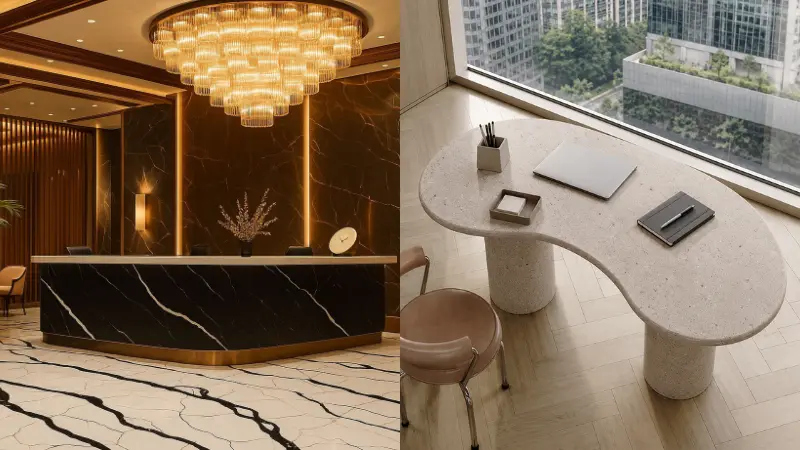
The reception desk is often the visual anchor of the entrance.
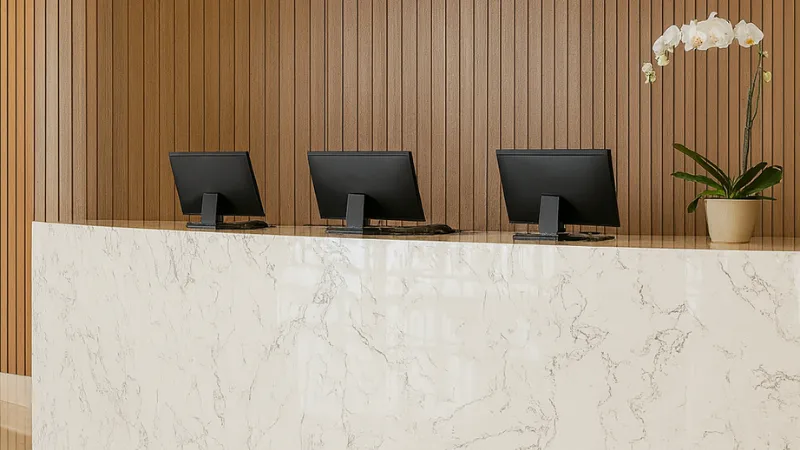
Quartz can create a clean, monolithic appearance that works well with wood, metal, glass and lighting elements. Large slabs can also help reduce visible seams when the desk is designed around the available slab dimensions.
For companies with multiple offices, a consistent quartz colour or pattern can also help maintain a common visual identity across locations.
Reception counters are high-contact surfaces. Visitors lean on them, place bags and documents on them, and interact with staff across the counter throughout the day.
A quartz surface provides an easy-to-clean option for this environment.
Edge design also matters. Rounded or eased edges can create a more comfortable point of contact than sharp profiles, particularly in high-use areas.
A quartz tabletop can give meeting rooms a refined appearance without introducing a busy material into the space.
It works particularly well when the table needs to coordinate with cabinetry, wall panelling or other stone surfaces.
For long conference tables, slab layout should be planned before fabrication so pattern direction and joint locations are considered from the start.
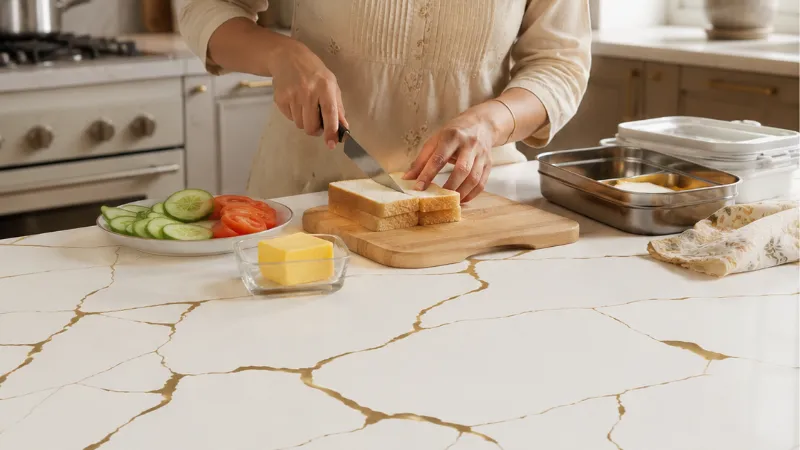
Pantries are among the most practical office applications for quartz.
Coffee, tea, food, water and cleaning products are part of everyday use. A low-porosity countertop is therefore useful because spills generally remain on the surface rather than being absorbed like they can be with porous natural stone.
Routine cleaning should still be carried out using products suitable for the specific quartz surface.
Quartz can also be used vertically in reception areas, boardrooms and other high-visibility spaces.
Large-format slabs can create a cleaner wall surface with fewer joints than smaller-format finishes. A dramatic veined design can become a focal point, while a neutral quartz can provide a quieter architectural background.
Office interiors often need to balance corporate identity with a comfortable workplace atmosphere.
Light neutrals can create an open and calm appearance. Darker quartz can add depth to executive spaces and reception areas.
Where the surface is part of a company\'s visual identity, check the selected quartz against the brand\'s existing colours and materials.
Finish changes both appearance and practicality.
Polished quartz offers a reflective, premium look and can work particularly well on reception desks and executive surfaces.
Matte or honed finishes can create a softer appearance and may reduce the visibility of reflections and some fingerprints.
The best choice depends on the location and how the surface is used.
Large-format and jumbo slabs can reduce visible joints on long desks, tables and feature walls.
But slab dimensions should be checked before the furniture or wall design is finalised. Designing first and checking available slab sizes later can create unnecessary joints, waste or fabrication compromises.
Lighting can dramatically change the appearance of quartz.
A polished surface near large windows or strong overhead lighting may reflect more light than expected. Always review the material under lighting conditions close to the finished office.
Quartz works well with many office materials.
Try pairing it with:
The objective is to make the quartz part of a coherent material palette rather than an isolated feature.
Quartz is durable, but it is not indestructible.
Correct cleaning and sensible use still matter. Avoid abrasive cleaning materials, use suitable products and protect the surface from excessive heat and heavy impact.
Installation also affects long-term performance. Built-in desks, counters and tables need proper support, particularly around cut-outs, corners and joins.
The source makes the same important distinction: quartz is a durable, low-maintenance material, but its performance also depends on fabrication, installation and proper use.
A quartz sample viewed in a showroom may look different under office LEDs or daylight.
This can create unnecessary seams or force changes during fabrication.
Edges are among the most frequently touched parts of reception counters and desks. Profile choice affects both appearance and comfort.
Reception desks, pantry counters and feature walls do not have identical functional requirements.
A premium pattern is not automatically the right specification. Consider use, maintenance and fabrication as well.
For commercial projects, supplier capability matters as much as the quartz itself.
Ask:
Can you supply enough slabs for the entire project?
Will colour and finish remain consistent across batches?
What slab sizes are available?
Can you support custom fabrication and edge profiles?
What technical information is available for the selected product?
How are slabs packaged and transported?
What happens if a slab is damaged or does not meet the approved specification?
These questions become especially important when the project involves several floors, multiple offices or repeated furniture elements.
Office Area | What to Prioritise |
Reception desk | Appearance, slab size, edge detail |
Reception counter | Cleanability, durability, edge comfort |
Conference table | Consistency, pattern direction, fabrication |
Pantry | Stain resistance, easy maintenance |
Feature wall | Pattern, slab size, lighting |
Executive office | Finish, colour, visual character |
This approach prevents the common mistake of specifying the same surface solution for every application.
Yes. Its consistent appearance, durability and relatively simple maintenance make it suitable for many office applications, including reception desks, counters, tables and selected wall surfaces.
Yes. Quartz can be fabricated for reception furniture and can provide a clean, premium appearance with carefully planned joints and edge profiles.
It depends on the application. Polished quartz can work well for reception and executive surfaces, while matte finishes may be more suitable where glare or visible fingerprints are concerns.
Yes. Its low-porosity surface and easy routine cleaning make it a practical option for pantry worktops.
Yes. Larger slabs can cover more area and reduce the number of joints when the furniture or wall layout is designed around the actual slab dimensions.
Quartz works well in office interiors because it brings together design consistency, durability and manageable maintenance.
Use it where the surface needs to look polished and perform under daily commercial use—from reception desks and counters to conference tables, pantries and feature walls.
But good results depend on more than choosing the right colour.
Check the slab size, finish, lighting, edge details, fabrication requirements and supplier capability before finalising the design.
For architects, workplace designers and corporate buyers, early coordination with the quartz supplier can prevent unnecessary joints, fabrication issues and supply problems later.
Paradigm Surfaces offers engineered quartz surfaces for residential, commercial and architectural applications, with a broad range of colours and designs suitable for contemporary workplace interiors.

 24 September, 2026
Festive Home Makeovers: Refreshing Kitchens & Interiors with Stone
 20 September, 2026
 17 September, 2026
CNC Precision Cutting: How Technology Improves Edge & Inlay Work
 13 September, 2026
NSF & Food Safety Certifications: What They Mean for Quartz Surfaces
 12 September, 2026
Whatsapp Chatx
Hi! Click one of our representatives below to chat on WhatsApp or send us email to sales@paradigmquartz.in
 |
Contact Us +91 99440 00900 |