
03
AUG
2026
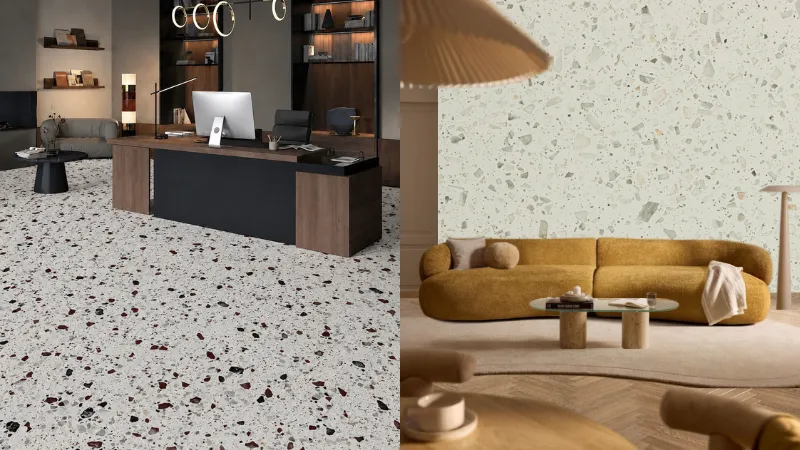
Terrazzo can be made and installed in two very different ways.
Precast terrazzo is manufactured in a factory, finished before delivery and installed as individual units. Poured-in-place terrazzo is mixed, poured, cured and finished directly on the project site.
Both can deliver durable, high-quality surfaces. The better choice depends on what your project needs: a seamless floor, faster installation, repeatable components, complex custom patterns or easier future replacement.
Precast and poured-in-place terrazzo are suited to different applications. Precast terrazzo works well for factory-made elements such as stair treads, wall panels, counters and modular surfaces, offering controlled production and faster site installation. Poured-in-place terrazzo is better suited to large continuous floors where seamless appearance and site-specific patterns are important. Before choosing, compare the project size, construction schedule, design requirements, installation conditions, maintenance strategy and future repair needs. Many commercial projects use both systems in different areas.
Precast terrazzo is manufactured away from the construction site.
Aggregates such as marble, glass, granite or quartz are combined with a cement or resin-based binder, cast into moulds, cured, ground and finished in a controlled factory environment.
The finished pieces are then transported to the site and installed.
The biggest advantage is factory-controlled production. Dimensions, finish and aggregate composition can be established before the material reaches the building.
That makes precast particularly useful when the project needs repeatable components.
Poured-in-place terrazzo is installed directly on site.
The substrate is prepared first, followed by divider strips and the terrazzo mix. After curing, the surface is ground, polished and sealed to create the finished floor.
Because the material is poured across the floor rather than installed as separate units, it can create a highly continuous surface with patterns and zones designed specifically for the building.
The source highlights this distinction clearly: poured systems suit large, continuous floor fields, while precast suits modular and precision-fabricated elements.
Poured-in-place gives designers more freedom for large, site-specific patterns. Curves, divider-strip layouts, medallions, transitions and other floor graphics can be developed directly within the floor.
Precast is better when the goal is precise repetition. It works particularly well when the same stair tread, panel or counter needs to be reproduced across a project.
So:
Custom continuous floor ? Poured-in-place
Repeatable architectural components ? Precast
This is one of the biggest practical differences.
Precast pieces arrive largely finished. Installation is closer to a conventional dry-trade process, so less wet work needs to happen on site.
Poured terrazzo involves several stages:
Substrate preparation ? divider strips ? pouring ? curing ? grinding ? polishing ? sealing
That requires more coordination and keeps the floor area unavailable for longer.
For projects with tight construction schedules, precast can therefore have a significant advantage.
Both systems can support different colours and aggregate combinations.
The difference is when the decision is made.
With precast, the colour, aggregate and dimensions are usually finalised before manufacturing begins.
With poured terrazzo, the floor layout can be adapted more closely to actual site conditions, which can be useful when the finished building differs slightly from the drawings.
For highly custom floors, poured-in-place offers more flexibility.
Both systems can provide durable, relatively low-maintenance surfaces when properly installed and maintained.
The main difference appears when something gets damaged.
A damaged precast panel or stair tread may be replaceable as an individual unit, provided a suitable match is available.
A damaged poured floor can also be repaired, but blending a local repair into an existing terrazzo field often requires skilled re-pouring, grinding and polishing.
So precast can have an advantage where individual component replacement matters.
There is no universal cheaper option.
Precast moves more of the cost into:
Poured-in-place moves more of the cost into:
Project size, site accessibility, pattern complexity and installation conditions can change the final calculation.
Instead of asking which system has the lower material price, compare the total installed cost and expected maintenance over the life of the project.
And there is no rule saying a project must use only one system.
A hotel, office or large residence can use poured terrazzo for the main floor and precast terrazzo for stairs, counters or wall panels.
Project | Poured-in-Place | Precast |
Hotel lobby | Excellent fit | Possible for selected areas |
Airport concourse | Strong fit | Supporting applications |
Hospital corridor | Strong fit | Panels and stairs |
Retail flagship | Strong fit | Modular elements |
Office reception | Possible | Excellent for counters and features |
Staircases | Possible | Excellent fit |
Feature wall | Limited | Strong fit |
Luxury home | Strong fit for floors | Strong fit for furniture and panels |
These are starting points rather than fixed rules; project conditions can change the right choice.
Ask these questions before the specification is finalised:
How large is the surface? Large continuous floors often favour poured-in-place systems.
How quickly does the site need the surface completed? Precast can reduce on-site wet work.
How custom is the design? Site-specific patterns generally favour poured terrazzo.
How will future repairs be handled? Consider whether individual component replacement is valuable.
What does the substrate allow? Structural and floor-build-up requirements need to be checked early.
Who will install it? Terrazzo quality depends heavily on installation skill.
Discuss these points with the fabricator during design development rather than after the drawings are complete.
Do not select precast or poured terrazzo before understanding the project\'s schedule, layout and design requirements.
Poured terrazzo needs time for preparation, curing and finishing. Build that into the programme.
They solve different problems. A strong project may use both.
Thickness, panel sizes, divider strips, tolerances and lead times all benefit from early technical input.
Document how the finished surface should be cleaned, maintained and repaired before handover.
For a professional project, ask:
Which system is best suited to this application?
What custom colours and aggregate mixes are available?
What installation method do you recommend?
What are the lead times?
How will repairs be handled in the future?
Can you provide technical and maintenance documentation?
Can you support the project at the required scale?
A capable supplier should be able to discuss both the material and the installation method—not simply sell you a sample. The original source correctly identifies manufacturing consistency, customisation, technical consultation, fabrication, logistics and after-sales support as important supplier criteria.
Neither is universally better. Poured-in-place suits large continuous floors and custom patterns, while precast suits repeatable components such as stairs, panels and counters.
Usually, because most manufacturing and finishing happen before the pieces reach the site.
Yes. It is particularly suitable for custom floor patterns, divider-strip layouts and site-specific designs.
Individual components can often be replaced without disturbing the entire installation, provided matching material is available.
Absolutely. Using poured terrazzo for floors and precast terrazzo for stairs, counters or wall elements is often a practical approach.
Precast and poured-in-place terrazzo are not competing versions of the same product. They are two installation systems designed for different project needs.
Choose precast when repeatability, factory precision and faster site installation matter.
Choose poured-in-place when a continuous floor, custom pattern or site-specific design is the priority.
For larger projects, the smartest solution may be to use both.
The decision should be made early, with the architect, contractor, fabricator and supplier considering design intent, schedule, installation, maintenance and lifecycle cost together.
Paradigm Surfaces offers terrazzo solutions alongside quartz, marble and granite, giving architects and project teams flexibility across flooring, wall and architectural surface applications.

 24 September, 2026
Festive Home Makeovers: Refreshing Kitchens & Interiors with Stone
 20 September, 2026
 17 September, 2026
CNC Precision Cutting: How Technology Improves Edge & Inlay Work
 13 September, 2026
NSF & Food Safety Certifications: What They Mean for Quartz Surfaces
 12 September, 2026
Whatsapp Chatx
Hi! Click one of our representatives below to chat on WhatsApp or send us email to sales@paradigmquartz.in
 |
Contact Us +91 99440 00900 |