
22
JUL
2026
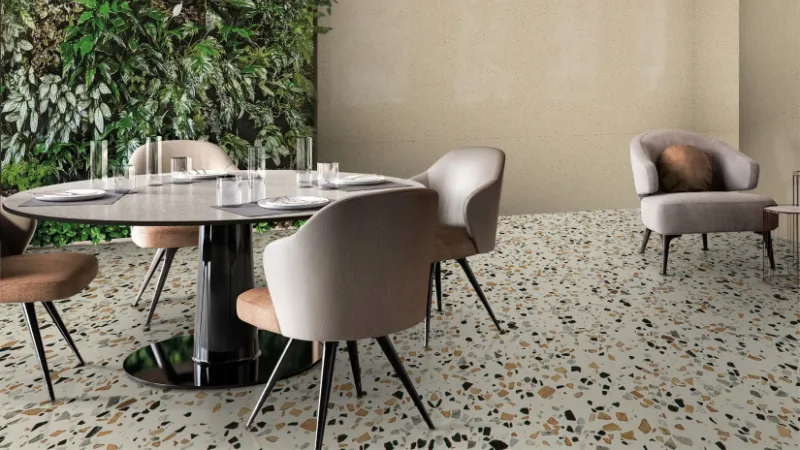
Terrazzo is often described as a surface, but that undersells what it really is. Every terrazzo slab is a composite — a binder matrix holding a deliberate arrangement of aggregates in suspension. Strip away the aggregates and terrazzo loses its identity entirely. It becomes a plain, uniform surface with none of the depth, movement, or character that makes the material worth specifying in the first place.
This is why aggregate selection deserves far more attention than it usually gets. Colour, texture, visual movement, durability, maintenance behaviour, and even how a space reads under different lighting are all shaped by which aggregates go into the mix. Two terrazzo floors using the same binder and the same installation method can perform and age completely differently depending on what's suspended inside them.
For architects and designers, aggregate selection is a specification decision, not a finishing touch. This guide walks through the major aggregate categories — marble chip, glass, brass and metal, and other decorative options — and how each one influences a project beyond surface appearance. The goal isn't to declare a winner. It's to give you a framework for choosing aggregates based on what a project actually needs.
Terrazzo aggregates are the solid particles — stone chips, glass fragments, metal pieces, or other decorative materials — that are embedded within a binder (traditionally cement, more recently epoxy resin) and then ground and polished to create the finished surface.
The binder holds everything together and determines base properties like flexibility, moisture resistance, and installation method. The aggregate is what gives terrazzo its visual identity and, in many cases, contributes to its performance characteristics too.
Three variables define how an aggregate behaves within a terrazzo system:
Size — Larger chips create bold, high-contrast patterns with visible negative space between pieces. Smaller chips produce a denser, more uniform field with subtler texture.
Shape — Angular fragments catch light differently than rounded or tumbled pieces. Shape also affects how aggregates settle and pack during casting, which influences density and finish consistency.
Material hardness and porosity — This determines how the aggregate grinds and polishes alongside the binder, how it wears over time, and how it responds to sealing and maintenance.
Understanding these three variables is the foundation for every aggregate decision that follows.
Marble chips are the traditional core of terrazzo and remain the most widely specified aggregate today. Because marble is a natural stone, no two batches are identical — colour variation within a single shipment is normal and, for many designers, part of the appeal.
Marble chips read as warm and organic. Veining fragments, subtle tonal shifts, and the way marble reflects light without the sharp glint of glass or metal all contribute to a softer, more classical aesthetic. This makes marble chip terrazzo a natural fit for lobbies, heritage renovations, hospitality interiors, and any space where the brief calls for timeless rather than trend-driven design.
Because marble is a calcite-based stone, it's more prone to etching from acidic substances than engineered alternatives. This doesn't rule it out for high-traffic commercial floors, but it does mean maintenance protocols need to be part of the specification conversation from the start, not an afterthought.
Glass aggregates behave optically in a way stone simply cannot. Where marble absorbs and softens light, glass refracts and throws it back, which is why glass terrazzo photographs so well under artificial lighting and reads as noticeably more contemporary.
Colour range is the other major advantage. Glass can be manufactured in nearly any hue and saturation, giving designers a level of colour control that natural stone can't match. This makes glass aggregates useful for brand-driven interiors — retail flagship stores, corporate lobbies, hospitality concepts — where a specific colour story needs to be reproduced consistently across a large floor area.
Recycled glass aggregates have become a significant category in their own right, sourced from post-consumer bottle glass or industrial glass waste. Beyond the sustainability angle, recycled glass often has a slightly more varied, organic quality than uniformly manufactured glass, which some designers prefer for a less "manufactured" look.
The trade-off worth noting: glass aggregates require careful attention during grinding and polishing to avoid pitting or uneven edges, and their reflectivity means surface imperfections are more visible than they would be in a stone-based mix. This is a manufacturing precision issue, which is exactly why supplier expertise matters more with glass than with most other aggregate choices.
Brass and other metal aggregates occupy a different role entirely. They are almost never used as the primary aggregate across an entire terrazzo field — instead, they function as accent material, introduced as inlay strips, border details, or scattered highlight pieces within a marble or glass base.
Used this way, brass introduces a level of visual contrast and material luxury that neither stone nor glass can replicate. A thin brass strip separating zones of a lobby floor, or a scattering of brass fragments within a reception desk surround, signals a premium finish without requiring the entire surface to carry that cost or maintenance profile.
Metal aggregates do require more maintenance awareness than stone or glass — brass can tarnish or patina over time depending on sealing and exposure, which is sometimes treated as a deliberate aesthetic (an aged, living finish) and sometimes actively managed against with protective coatings. Either way, this needs to be an explicit conversation with the client before installation, not something discovered after the floor ages.
Beyond the three core categories, several other materials appear in terrazzo specifications:
These aren't interchangeable with marble, glass, or metal — each is chosen for a specific technical or aesthetic reason rather than as a general-purpose substitute.
Colour harmony. Aggregate colour needs to work with the surrounding material palette — wall finishes, joinery, lighting temperature — not just look good in isolation on a sample board.
Texture. Aggregate density and chip size determine whether a floor reads as smooth and continuous from a distance or textured and detailed up close. This matters more in large open-plan spaces than in small rooms.
Pattern density. A high ratio of aggregate to binder creates a busier, more textured field. A lower ratio lets the binder colour show through more, producing a calmer, more minimal surface.
Surface reflectivity. Glass and metal aggregates increase how much a floor reflects ambient and artificial light. In spaces with limited natural light, this can be used deliberately to brighten a room; in spaces with harsh overhead lighting, too much reflectivity can create glare.
Scale and visual balance. Aggregate size needs to be proportional to the space. Oversized chips can overwhelm a small room, while very fine aggregates can disappear entirely in a large hall.
Contemporary vs classic design styles. Marble chip leans classical; glass leans contemporary; metal accents can push either direction depending on how sparingly they're used. Designers frequently blend categories deliberately — a marble base with glass highlights, for instance — to land somewhere between the two.
Luxury homes often prioritise marble chip or marble-glass blends for warmth, paired with brass accents in feature areas like entryways or bathrooms.
Hotels tend to favour aggregate combinations that photograph well and reinforce brand identity — glass aggregates in signature colours are common in lobbies and public circulation areas.
Retail stores frequently use custom-coloured glass aggregates to reinforce brand palette across flagship locations, prioritising consistency over natural variation.
Commercial offices typically lean toward more neutral, low-maintenance aggregate mixes — granite or quartz chips — chosen for durability and a calm, professional backdrop.
Public buildings prioritise long-term durability and ease of maintenance above all else, which often points toward harder, more uniform aggregates over decorative or metal accents.
Educational facilities need high-traffic durability and slip resistance, with aggregate choice secondary to base performance requirements — though colour is still used to support wayfinding and branding.
The common thread: project type shifts the priority order between appearance, durability, maintenance, and cost. The "right" aggregate changes accordingly.
Recycled glass is one of the more established sustainable aggregate options, diverting post-consumer or industrial glass waste into a durable, long-life surface material. Reclaimed marble chips — offcuts from stone fabrication that would otherwise be waste — serve a similar function within natural stone terrazzo.
Recycled aggregates more broadly support a circular construction approach: material that has already been extracted and processed gets a second functional life rather than heading to landfill. This doesn't mean every recycled aggregate mix is automatically the lower-impact choice in every scenario — sourcing distance, processing energy, and the mix's expected service life all factor into genuine lifecycle impact. What matters is treating sustainability as one input among several in the specification decision, rather than a marketing checkbox.
For readers who want a deeper look at how custom aggregate combinations are developed for signature projects, The Art of Custom Terrazzo covers the design process in more detail. For a closer look at recycled material strategy in terrazzo specifically, Recycled Terrazzo & The Future of Sustainable Architecture is a useful companion resource.
Selecting aggregates based only on colour. A sample that looks right under showroom lighting can behave completely differently under the client's actual lighting conditions.
Ignoring lighting conditions. Reflective aggregates like glass amplify whatever light is present — this can be an asset or a liability depending on the space.
Overlooking maintenance requirements. Marble's sensitivity to acidic cleaners, metal's tarnishing behaviour, and glass's polishing requirements all need to be communicated to the end client before installation, not discovered afterward.
Mixing incompatible design styles. Combining aggregates that pull in opposite aesthetic directions — heavily veined marble with high-saturation glass, for instance — can read as unresolved rather than intentional if not handled carefully.
Choosing unsuitable aggregate sizes. Aggregate scale that doesn't match room proportions undermines the overall design, regardless of how good the individual material choice is.
Each of these mistakes traces back to the same root cause: treating aggregate selection as a colour decision rather than a full specification decision.
Working with architects and designers on terrazzo specification surfaces a consistent set of expectations:
Aggregate consistency across large orders, so that a floor poured in phases or across multiple rooms reads as one continuous surface.
Colour control, particularly for glass aggregates being matched to a specific brand palette.
Customization capability — the ability to develop a bespoke aggregate blend rather than choosing only from a standard catalogue.
Manufacturing precision, especially for reflective aggregates like glass and metal, where grinding and polishing quality is far more visible than in a stone-only mix.
Project-scale production capacity, so that large commercial installations aren't compromised by batch-to-batch material variation.
Quality assurance processes that catch inconsistencies before material reaches site, not after installation.
Technical consultation at the specification stage — a supplier who can advise on aggregate behaviour, maintenance implications, and lighting interaction, not just take an order.
Suppliers who can consistently deliver on these points earn the kind of trust that turns a single project into a long-term specification relationship.
What are terrazzo aggregates? They are the stone, glass, metal, or other decorative particles embedded within terrazzo's binder matrix, responsible for the material's colour, texture, and visual character.
Which aggregate is best for terrazzo flooring? There's no universal answer — the right choice depends on the project's durability requirements, maintenance capacity, lighting conditions, and design intent. Marble, glass, granite, and quartz all serve different priorities well.
Are glass aggregates durable? Yes, when properly manufactured and installed. Glass aggregates are hard-wearing, though grinding and polishing quality matters more with glass than with most stone aggregates.
Can recycled aggregates be used in terrazzo? Yes. Recycled glass and reclaimed marble chips are established options that support a circular material approach without compromising performance.
How do designers choose aggregate combinations? By working backward from the project's lighting, colour palette, maintenance expectations, and design style, then testing combinations against those criteria rather than choosing on appearance alone.
Aggregates are not a decorative afterthought layered onto terrazzo — they are the material's defining feature. The choice between marble chip, glass, brass, or another decorative aggregate shapes how a surface looks, how it performs over its service life, how much maintenance it demands, and how well it aligns with a project's sustainability goals.
The strongest specifications come from evaluating aggregate type against the full picture: project use, lighting conditions, maintenance capacity, sustainability objectives, and the manufacturing expertise of the supplier producing the mix. Approached this way, aggregate selection stops being a swatch-matching exercise and becomes what it should be — a core part of the design and performance strategy for the space
 20 September, 2026
 17 September, 2026
CNC Precision Cutting: How Technology Improves Edge & Inlay Work
 13 September, 2026
NSF & Food Safety Certifications: What They Mean for Quartz Surfaces
 12 September, 2026
 05 September, 2026
Marble in Temple & Religious Architecture: Tradition Meets Craft

Whatsapp Chatx
Hi! Click one of our representatives below to chat on WhatsApp or send us email to sales@paradigmquartz.in
 |
Contact Us +91 99440 00900 |
