

31
JUL
2026
Marble becomes a completely different design element when its natural veining is mirrored across two adjoining slabs.
That technique is called bookmatching. Instead of treating each slab as a separate surface, designers position consecutive slabs so the veins reflect across the joint, creating one larger symmetrical composition.
It can turn a feature wall, kitchen island or hotel reception into the focal point of the space. But bookmatching only works when the marble, slab sequence, layout and fabrication are planned from the beginning.
Bookmatched marble uses two or more consecutive slabs from the same block and positions them so their veining mirrors across the joint. It works best on large, uninterrupted surfaces such as feature walls, hotel lobbies, reception backdrops, fireplace surrounds and statement kitchen islands. Successful bookmatching depends on selecting the right marble, checking vein direction, preserving slab sequence, planning the layout before cutting and using an experienced fabricator. Always review the actual slabs, because natural marble varies even within the same block.
Bookmatching means placing adjoining marble slabs so one appears as the mirror image of the other.
The slabs normally come from consecutive cuts of the same block. This allows the natural vein pattern to continue in a mirrored form across the central joint.
It is different from vein matching.
The choice depends on the effect you want to create.
Natural marble already has movement. Bookmatching makes that movement intentional.
A dramatic vein can form a butterfly-like shape on a wall. A long flowing pattern can become the visual centre of a reception area. On an island, the same technique can make the countertop feel almost sculptural.
That is why bookmatching works best when the marble itself needs to be the focal point.
This is one of the strongest applications because the large, uninterrupted surface allows the complete pattern to be seen.
Living rooms, hotel lobbies, reception backdrops and boardrooms can all benefit from a well-planned bookmatched wall.
A bookmatched marble wall can create an immediate sense of detail and craftsmanship in an entrance space.
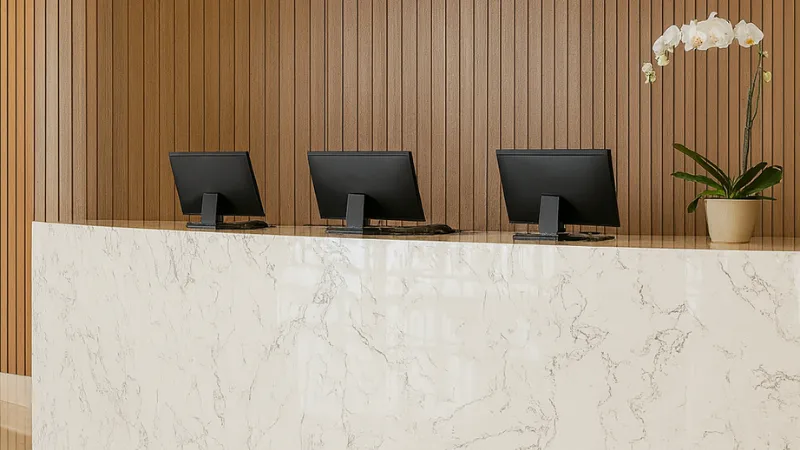
It also works well behind reception desks, where the marble can become part of the brand environment.
In homes, bookmatching is usually more effective when used selectively.
Good locations include:
Using it in one or two key areas often creates more impact than covering every surface.
Bathrooms offer shorter viewing distances, which makes vein alignment especially noticeable.
A bookmatched shower wall or vanity backdrop can create a strong luxury effect, provided the fabrication and installation are precise.
Not every marble is suitable for bookmatching.
Marbles with clear, directional veining generally produce a stronger mirrored effect than stones with scattered or highly fragmented patterns.
Do not choose only by background colour. Look at how the veins move across the entire slab.
This is critical.
The slabs should come from the same block and, where the design requires it, from consecutive positions within that block. Vein position, tone and density naturally shift through the block, so using unrelated slabs can break the symmetry.
For important projects, ask the supplier to identify and reserve the required slab pair or sequence before fabrication.
Before cutting, decide which direction the slabs should face.
A slab may look excellent on its own but produce the wrong visual flow when mirrored. Rotate and review the pair together before committing to the final layout.
Do not treat bookmatching as something the fabricator figures out after the slabs arrive.
Create a layout showing:
For large installations, digital slab previews can help the design team test the composition before cutting begins.
Bookmatching leaves little room for visible errors.
Even a small mismatch in dimensions or edge alignment can make the central joint stand out. Experienced fabricators should understand how to preserve the planned vein orientation and alignment during cutting.
Lighting can either strengthen or weaken the effect.
Directional lighting can make veins look deeper and more pronounced, while flat lighting may reduce the contrast.
For feature walls and reception spaces, consider the lighting direction during the slab-selection stage—not after installation.
The marble should be reviewed under lighting conditions close to those in the finished space.
No.
Bookmatching needs enough uninterrupted surface area for the mirrored pattern to read clearly.
On very small surfaces, the pattern can become cramped or be interrupted by sinks, fixtures, cabinetry and other elements. In those situations, a simpler vein-matched or single-slab layout may create a better result.
The technique should support the architecture, not exist simply because it is visually impressive.
Similar-looking slabs may still have completely different vein positions and density.
Some variation is unavoidable. Good planning works with that variation rather than trying to eliminate it.
Rearranging slabs on site can break the pattern planned during design.
A small sample cannot show the complete composition.
The same veins can look dramatically different under different light sources.
Bookmatching needs coordinated slab selection and fabrication from the beginning.
For a bookmatched project, supplier capability matters enormously.
Ask:
Are the slabs from the same block?
Are they consecutive slabs?
Can I review the actual slabs before approval?
Can you provide high-resolution slab images or digital layouts?
Can the slabs be reserved until fabrication?
Does your fabricator have experience with bookmatched work?
Can the required quantity be supplied without changing the marble sequence?
The source\'s B2B criteria are especially relevant here: consecutive slab availability, block consistency, digital previews, fabrication expertise, dimensional accuracy and project-scale inventory all help reduce the risk of a failed pattern.
It is a layout where adjoining marble slabs are positioned so their veining mirrors across the joint, creating a symmetrical composition.
No. Bookmatching creates a mirror image, while vein matching creates directional continuity without necessarily producing symmetry.
Marble with clear, continuous and directional veining generally produces the strongest mirrored patterns.
Not effectively. Some marbles have irregular or fragmented patterns that do not create a clear mirrored composition.
Photographs are useful for planning, but important projects should ideally be approved using the actual slabs or accurate high-resolution representations of the exact slabs.
Bookmatched marble is more than two slabs placed side by side. It is a planned composition that depends on the marble\'s natural vein structure, slab sequence, orientation and fabrication accuracy.
The best results start early.
Choose the right marble, reserve compatible slabs, plan the layout before cutting and work with a fabricator who understands mirror-pattern installation.
When those decisions are handled properly, the natural variation in marble becomes the design—not the problem.
Paradigm Surfaces offers marble surfaces for statement residential, hospitality and architectural applications, with slab selection and project requirements forming an important part of high-specification stone work.

 24 September, 2026
Festive Home Makeovers: Refreshing Kitchens & Interiors with Stone
 20 September, 2026
 17 September, 2026
CNC Precision Cutting: How Technology Improves Edge & Inlay Work
 13 September, 2026
NSF & Food Safety Certifications: What They Mean for Quartz Surfaces
 12 September, 2026
Whatsapp Chatx
Hi! Click one of our representatives below to chat on WhatsApp or send us email to sales@paradigmquartz.in
 |
Contact Us +91 99440 00900 |