
07
MAY
2026
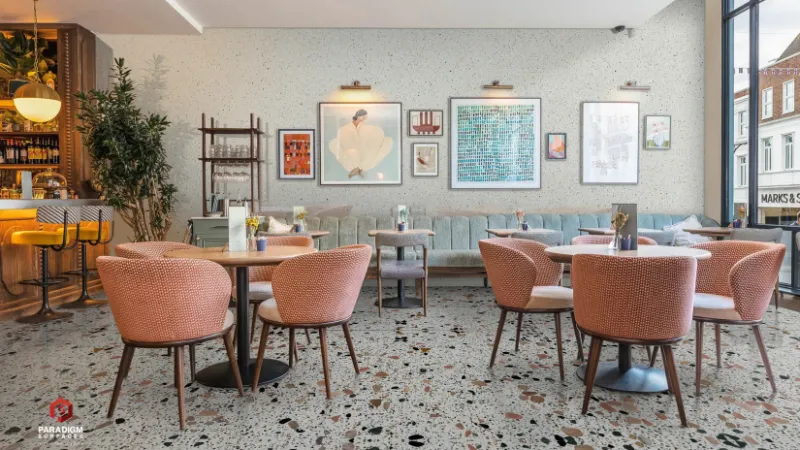
Commercial floors have to handle far more than everyday residential spaces. Thousands of people may walk across them every day, cleaning happens constantly, and the finished surface needs to look good long after the opening-day photos are forgotten.
That is where terrazzo makes a strong case.
Its combination of durability, design flexibility and relatively simple routine maintenance makes it useful for lobbies, offices, hospitals, retail spaces, hotels and other busy interiors. But terrazzo is not automatically the right choice for every project. The system, installation method and expected use all need to be considered before specification.
Terrazzo is well suited to commercial interiors because it can handle heavy foot traffic while giving designers extensive control over colour, aggregate and pattern. Its continuous surface can also reduce the number of grout lines found in tiled floors, making cleaning simpler. Cement-based and epoxy-based terrazzo serve different project requirements, with epoxy systems offering a thinner and lighter option. The main trade-offs are higher initial cost and the need for experienced installation. For commercial buyers, supplier quality, installation capability, customisation and project support should all be assessed before placing an order.
Terrazzo is a composite surface made by combining decorative aggregates—such as marble, granite, quartz or glass—with a binder, then grinding and finishing the surface.
Two common systems are cement-based terrazzo and epoxy terrazzo.
Cement terrazzo is the more traditional approach and is generally thicker and heavier. Epoxy terrazzo can be installed in a thinner build-up and offers greater flexibility in colour and design.
The system chosen should depend on the building, substrate, traffic level, design requirements and installation conditions.
A commercial floor has to withstand repeated footfall, wheeled traffic, cleaning equipment and everyday wear.
Terrazzo\'s combination of aggregate and binder creates a hardwearing finished surface when it is correctly designed and installed. Because the surface is ground and polished rather than relying on a thin decorative coating, it can be refinished when appropriate.
This makes terrazzo particularly relevant for:
The quality of installation still matters enormously. A poorly prepared substrate or incorrect installation can undermine the performance of even a good terrazzo system.
A continuous terrazzo floor can eliminate the network of grout lines found in many tiled installations.
That can make routine cleaning easier and create a visually cleaner floor, particularly in large circulation areas.
For spaces such as healthcare facilities, schools and food-service environments, easy-to-maintain surfaces are an important part of the specification.
Terrazzo still needs regular cleaning and, depending on the system, appropriate sealing or surface protection. “Seamless” should not be confused with “maintenance-free.”
Terrazzo generally costs more to install than many conventional flooring options.
The value argument comes from how the floor performs over time.
A durable surface that can remain in service for many years without frequent replacement can reduce disruption, material replacement and renovation work. For large commercial projects, those lifecycle considerations can be more meaningful than comparing installation prices alone.
When evaluating terrazzo, consider:
Initial installation + maintenance + refinishing + replacement + downtime
That gives procurement teams a better picture of overall cost.
One of terrazzo\'s biggest advantages is its design flexibility.
Designers can control the:
This allows terrazzo to become part of the architecture rather than simply act as a background floor.
It can be used for branded colour schemes, decorative patterns, directional elements and large graphic designs. That makes it particularly useful in hospitality, retail and corporate interiors where the floor needs to contribute to the identity of the space.
Large commercial interiors often need one surface language to continue across reception areas, corridors and circulation zones.
Terrazzo is particularly effective where designers want that continuity across a substantial floor area.
It can also be coordinated with terrazzo wall panels, stairs or other architectural elements when the project calls for a unified material palette.
Marble offers natural veining and variation, which can make it an excellent material for luxury interiors.
Terrazzo provides more control over colour and aggregate composition and can be particularly practical when a large commercial project needs a repeatable design.
The better choice depends on whether the project prioritises natural stone character or controlled design and performance.
Granite is a durable natural stone with strong resistance to wear.
Terrazzo has a different advantage: customisation. Designers can develop a specific aggregate and colour combination rather than working within the naturally occurring appearance of a quarry slab.
Quartz and terrazzo overlap in some applications, but they are often selected for different purposes.
Engineered quartz is commonly used for countertops, vanities and vertical surfaces, while poured or properly installed terrazzo is particularly well suited to large floor areas.
The intended application should drive the choice.
Terrazzo is not limited to flooring.
Its most obvious application is large-scale flooring in areas exposed to heavy traffic.
Terrazzo can continue onto selected walls, reception areas and washroom surfaces to create a coordinated look.
Treads and risers can use terrazzo where durability and visual continuity are important.
Custom terrazzo can turn reception desks, feature zones and other public-facing areas into distinctive design elements.
The choice between the two systems should be made according to the project rather than appearance alone.
Cement terrazzo is traditional, substantial and commonly associated with thicker floor systems.
Epoxy terrazzo can offer a thinner build-up and a wider range of colour possibilities, making it useful where lower weight or more detailed design flexibility is important.
The appropriate system depends on the substrate, environmental conditions, traffic, thickness requirements and installation method.
Terrazzo has real advantages, but there are also practical constraints.
Installation requires skill. Substrate preparation, aggregate distribution, grinding, polishing, joints and finishing all affect the final result.
Initial cost can be higher. Projects with very tight upfront budgets may find simpler flooring options easier to justify.
Repairs can be noticeable. Major localised damage may require careful colour and aggregate matching to achieve a discreet repair.
This is why terrazzo should be treated as a complete flooring system, not simply as a surface material.
For architects, contractors, developers and procurement teams, supplier evaluation is critical.
Check aggregate mix, colour and finish across samples and production batches.
Ask whether the supplier can reproduce the required colour, aggregate combination or pattern at project scale.
A supplier that can work with experienced terrazzo installers or provide technical guidance can reduce project risk.
Custom terrazzo often requires more planning than off-the-shelf flooring. Confirm production and installation schedules early.
Request product information covering the proposed system, maintenance requirements and intended applications.
Choosing only on appearance: A terrazzo sample does not tell you how the complete floor will perform under the project\'s actual conditions.
Underestimating installation: Experienced terrazzo installation is essential to achieving a consistent result.
Comparing only initial prices: Include maintenance, refinishing, replacement and downtime in the cost discussion.
Ignoring the substrate: The finished terrazzo floor depends heavily on the condition and preparation of the surface beneath it.
Leaving colour decisions too late: Custom aggregate and colour combinations need to be approved before production.
Yes. Terrazzo is well suited to many high-traffic commercial environments where durability, design flexibility and ease of maintenance are important.
Its initial installation cost can be higher than many conventional flooring options. The overall value depends on installation quality, maintenance and how long the floor remains in service.
Neither is universally better. Cement and epoxy terrazzo have different thickness, weight, design and installation characteristics. The project requirements should determine the system.
Yes. Aggregate type, colour, size and pattern can be customised for many terrazzo systems. Customisation should be agreed during the design stage.
Routine maintenance is generally straightforward, but the exact cleaning and protection requirements depend on the terrazzo system and finish. Follow the manufacturer\'s maintenance recommendations.
Terrazzo makes sense for commercial spaces when the project needs a durable surface with strong design flexibility and long-term usability.
Its biggest strengths are not simply its appearance. It can handle busy environments, create large continuous surfaces and give designers control over colour and aggregate that many conventional materials cannot match.
But the material alone does not guarantee a successful result. The system, substrate, installation quality, finish and maintenance plan all matter.
For architects, designers, contractors and developers, the right terrazzo supplier should therefore offer more than a product catalogue. Material consistency, customisation, technical support and installation expertise are all part of the specification.
Paradigm Surfaces offers terrazzo surfaces alongside quartz, marble and granite, giving professionals a broader range of stone solutions for contemporary residential and commercial projects.

 24 September, 2026
Festive Home Makeovers: Refreshing Kitchens & Interiors with Stone
 20 September, 2026
 17 September, 2026
CNC Precision Cutting: How Technology Improves Edge & Inlay Work
 13 September, 2026
NSF & Food Safety Certifications: What They Mean for Quartz Surfaces
 12 September, 2026
Whatsapp Chatx
Hi! Click one of our representatives below to chat on WhatsApp or send us email to sales@paradigmquartz.in
 |
Contact Us +91 99440 00900 |