
10
APR
2026
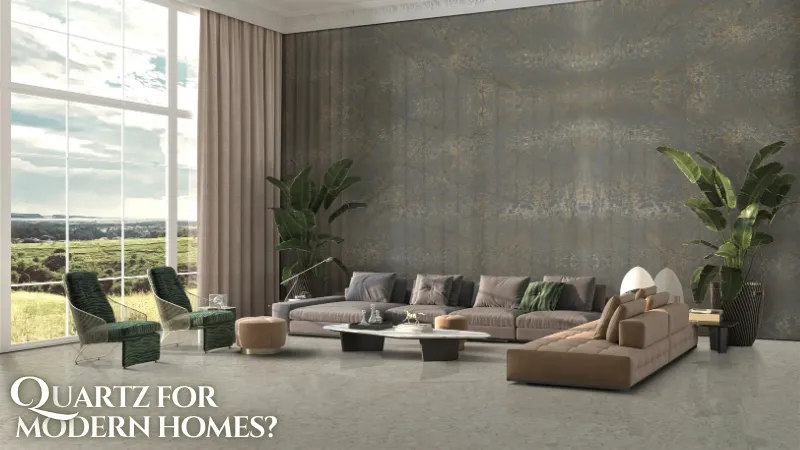
Urban homes today are defined by a quiet kind of ambition. Smaller footprints, open layouts, and the pressure to make every surface count — these realities are reshaping how architects and designers approach material selection. And in this context, one material has steadily risen above the noise: grey quartz.
It's not a trend born from a single mood board or seasonal palette. Grey quartz has earned its place through a combination of design intelligence and material performance. For professionals specifying high quality stone surfaces for interiors, it consistently delivers on both fronts.
Grey occupies a rare position in the design spectrum — it reads as neutral without being absent. Unlike white, it hides imperfection. Unlike black, it doesn't dominate. It simply holds space.
In urban homes, where the palette often needs to do heavy lifting across multiple zones, grey creates visual coherence without monotony. It works with warm wood tones, cool concrete finishes, brushed metals, and even bold accent colours. Across minimalist, industrial, and understated luxury styles, grey reads consistently well.
There's also a longevity argument. Bold accent colours cycle in and out of relevance. Grey doesn't. It's the material equivalent of a considered investment — something clients rarely regret five years after installation.
Quartz stone is engineered, and that's precisely its advantage. Natural stone is extracted and cut — its character comes from geological change. Engineered quartz surfaces are manufactured under controlled conditions: ground quartz aggregate bonded with polymer resins and pigments, pressed and cured to spec.
The result is a surface that performs predictably across all dimensions — hardness, porosity, colour consistency — in a way natural stone simply cannot match.
For urban applications, the practical advantages are significant:
Non-porous surface. Unlike granite or natural marble, quartz does not absorb liquids. There's no sealing, no re-sealing, no anxious moment when red wine meets a countertop.
Durability in daily use. Kitchen countertops and kitchen platforms take constant abuse — heat, impact, acidic spills, cutting. Quartz handles these conditions without the maintenance overhead that natural alternatives demand.
Consistency at scale. When outfitting multiple units in a residential project, matching slabs from natural stone is a logistical challenge. With engineered quartz, what you see in the sample is what you get across every slab.
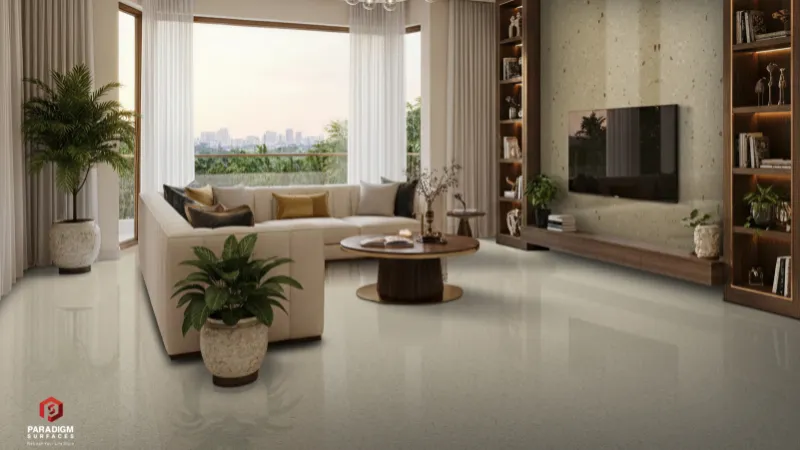
Grey quartz doesn't compete with the rest of the room — it completes it. Paired with white lacquer cabinetry, it reads clean and sharp. With dark walnut joinery, it adds contrast without conflict. Against terrazzo flooring or exposed concrete walls, it feels architecturally intentional.
For designers working across multiple project types, this adaptability reduces specification risk considerably.
In compact urban homes where every square foot is deliberate, visual noise is the enemy. Grey quartz creates an uninterrupted surface plane — especially effective in kitchen platforms, island countertops, and vanity tops where clean sight lines matter.
The cooler tones of grey also photograph exceptionally well, which has practical value in an era where project documentation and social sharing are part of the professional portfolio.
Clients in urban environments tend to be time-poor. They're not reaching for maintenance schedules and surface sealants. Grey quartz suits this lifestyle without compromise — a wipe-down is sufficient for daily upkeep, and the surface holds its finish over years of use without specialist intervention.
This is a genuine selling point during client conversations, particularly when comparing against marble or natural granite alternatives.
One of the most significant developments in the quartz category has been the availability of super jumbo quartz slabs — panels large enough to span a full kitchen countertop, a bathroom wall, or a feature surface without a single visible joint.
This matters in modern interiors because continuity is compositional. A seam interrupts visual flow; a seamless surface amplifies it. Large format slabs also reduce installation complexity and long-term maintenance points.
Grey quartz isn't limited to the kitchen. It works on wash area countertops, feature wall cladding, bathroom vanities, and flooring. The consistency across applications means a project can maintain material harmony from room to room — something increasingly valued in high-end urban residential work.
Grey Quartz vs Marble
Marble's appeal is undeniable. The veining, the depth, the prestige. But for urban kitchens and high-traffic surfaces, natural marble is a demanding material. It etches from acidic contact, requires periodic sealing, and varies significantly from slab to slab. Engineered marble slabs address some of these issues, but quartz remains the stronger performer where practicality and consistency are priorities.
Grey Quartz vs Granite
Granite is hard and durable, but it's porous enough to require sealing and unpredictable enough in pattern that matching across multiple slabs is difficult. For project-scale procurement, quartz offers more supply reliability and colour consistency.
Grey Quartz vs Terrazzo
Terrazzo surfaces have experienced a genuine design revival and bring a warmth and texture that quartz doesn't attempt to replicate. However, terrazzo works best as a flooring or accent material. For kitchen platforms and countertop applications where hygiene and durability matter, quartz outperforms on practically every technical metric.
The honest answer is that these materials aren't in competition — they're complementary. A well-specified project might use grey quartz on countertops alongside terrazzo flooring and engineered marble on feature walls. Knowing where each material belongs is the mark of a confident designer.
The shift toward large format and super jumbo quartz slabs reflects a broader design principle: the fewer interruptions, the better. Modern interiors favour continuity — in material, in plane, in finish.
When a kitchen island can be surfaced in a single unbroken slab, the result is fundamentally different from one assembled from multiple pieces. The same applies to bathroom walls and feature surfaces. Fewer joints also mean fewer maintenance points over the life of the installation.
For suppliers, the ability to offer large format slabs consistently — in standard greys as well as custom shades — is a real competitive differentiator. For designers and builders, it unlocks a level of finish quality that smaller-format alternatives simply can't match.
To explore broader material and design insights, read our detailed guide on Why Quartz is the Best Choice for Modern Homes.
Honest material advice requires acknowledging limitations.
Grey quartz can feel cold or clinical in spaces where warmth is the design intent — a traditional kitchen, a heritage home, or a bedroom-adjacent bathroom meant to feel spa-like and retreat-oriented. In these contexts, warmer stone tones, wood surfaces, or even the right terrazzo pattern may serve the project better.
Similarly, in large, open-plan homes with abundant natural light, all-grey surfaces across every plane can create visual fatigue. The material works best when it's part of a considered palette — not the entirety of it.
For professionals, the material specification is only half the decision. Supply quality and reliability matter as much as aesthetics. When evaluating a stone supplier for premium interior stone surfaces, consider:
Slab consistency. Batch-to-batch colour and texture matching is non-negotiable on multi-unit residential projects.
Large slab availability. Can your supplier consistently provide super jumbo formats for feature applications? Not every supplier can.
Finish range. Matte, polished, soft-touch — the same grey quartz reads very differently across finishes. A supplier with a full finish range gives you design flexibility without sourcing complexity.
Supply reliability. Lead times matter, especially in fast-moving construction and interior fit-out environments. A supplier who treats the B2B relationship seriously — with consistent stock and clear logistics — is worth the premium.
Choosing colour under showroom lighting. Grey quartz tones shift significantly between cool LED environments and warm natural light. Always evaluate samples in conditions close to the intended installation space.
Ignoring slab size. Specifying a large countertop and then sourcing standard-format slabs creates unnecessary joints. Confirm slab dimensions early in the specification process.
Overlooking finish choice. A polished grey quartz and a matte grey quartz in the same tone can feel like entirely different materials in situ. The finish decision deserves as much attention as the colour selection itself.
Is grey quartz good for kitchen countertops?
Yes — it's one of the most practical choices. Non-porous, durable, easy to maintain, and available in large formats that suit modern kitchen layouts.
Does grey quartz go out of style?
Unlikely. Grey is a foundational neutral in modern design, and its versatility means it adapts to evolving design directions rather than becoming dated.
What is better: quartz or marble for interiors?
It depends on the application. For high-use surfaces in kitchens and bathrooms, quartz outperforms marble on maintenance and consistency. For feature walls and lower-traffic decorative applications, marble's natural character is hard to replicate.
Can grey quartz be used in bathrooms?
Absolutely. Its non-porous nature makes it particularly well-suited to wet areas — vanity tops, shower walls, and floor applications all benefit from its hygienic properties.
Grey quartz has earned its dominance in urban interiors through a combination of design intelligence and material reliability. It doesn't impose — it enables. It adapts to the project's intent without demanding concessions in performance or maintenance.
For architects, interior designers, and builders working at scale, it's a specification that consistently holds up — aesthetically and technically. And for clients who want a surface that performs as well as it looks, it remains one of the clearest recommendations in the category.
The best material decisions aren't made on trend alone. They're made when design intent, material science, and project realities all align — and grey quartz, more often than not, sits squarely at that intersection.
 20 September, 2026
 17 September, 2026
CNC Precision Cutting: How Technology Improves Edge & Inlay Work
 13 September, 2026
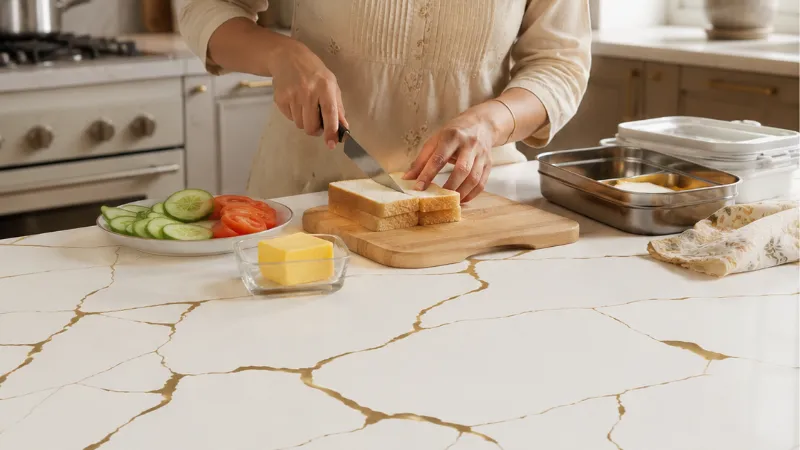
NSF & Food Safety Certifications: What They Mean for Quartz Surfaces
 12 September, 2026
 05 September, 2026
Marble in Temple & Religious Architecture: Tradition Meets Craft

Whatsapp Chatx
Hi! Click one of our representatives below to chat on WhatsApp or send us email to sales@paradigmquartz.in
 |
Contact Us +91 99440 00900 |
