
10
MAY
2026
Bathrooms demand more from a surface than most rooms in a home. Constant moisture, water splashes, cleaning products and daily use can quickly expose the weaknesses of a poorly selected material.
That is why choosing bathroom stone should go beyond colour and appearance.
The right surface needs to handle moisture, remain practical to clean, provide suitable slip resistance and fit the design of the space. Marble, terrazzo, engineered marble and quartz can all work well—but not in exactly the same places.
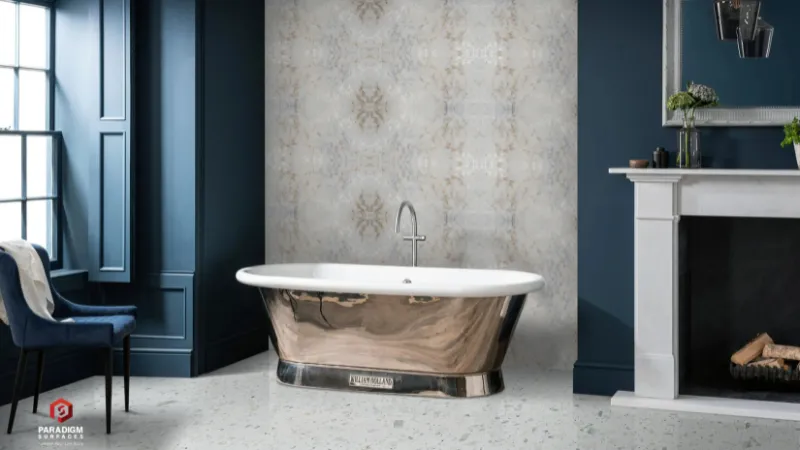
The best bathroom surface depends on where it will be used. Quartz is a practical choice for vanity tops and basin surrounds because it is low-porosity, easy to maintain and resistant to everyday stains. Marble works well for feature walls and luxury bathrooms but needs more care. Terrazzo is especially useful for flooring and design-led commercial spaces, while engineered marble offers a more consistent alternative for walls and vanity applications. For bathroom floors, always consider the surface finish and wet-slip performance—not appearance alone.
Before selecting a stone, look at five things.
Moisture resistance: Wet areas need materials and installation systems that can handle regular water exposure.
Slip resistance: A beautiful polished surface is not necessarily suitable for a wet floor. Floor finish matters greatly.
Stain resistance: Soap, cosmetics, hard-water deposits and cleaning products can affect some materials over time.
Maintenance: Consider how often the material needs sealing or specialised cleaning.
Durability: The surface must suit the level of traffic and everyday use.
The material should always be considered together with waterproofing, substrate preparation, joints and installation details.
Natural marble remains one of the most visually striking choices for premium bathrooms.
Its natural veining and variation work particularly well on feature walls, vanity surrounds, shower niches and other areas where appearance is a major part of the design.
The trade-off is maintenance. Marble is more vulnerable to staining and chemical reaction than engineered surfaces, so sealing and proper cleaning are important.
For floors, the finish also needs careful consideration. A highly polished surface can become slippery when wet, making a honed or appropriately textured finish more suitable in many situations.
Terrazzo is particularly interesting for bathrooms because it combines durability with design flexibility.
It can contain marble, granite, quartz, glass or other aggregates, giving designers control over colour and pattern.
The finish can also be selected according to the application. A smoother finish creates a refined look, while a more textured surface can provide better grip where required.
Cement-based and resin-based terrazzo have different maintenance and installation requirements, so the exact system should be confirmed before specification.
Engineered marble combines crushed marble with a binder to create a more controlled surface.
It can be useful when the project needs a marble-inspired appearance with greater consistency across multiple slabs or rooms.
Compared with natural marble, engineered marble can offer more predictable colour and lower porosity. It still needs to be selected according to the manufacturer\'s application and maintenance recommendations.
Engineered quartz is particularly useful for bathroom countertops and basin surrounds.
Its low-porosity surface makes it easy to maintain and resistant to many everyday stains from soap, cosmetics and water exposure. It also offers strong consistency from slab to slab, which is valuable for larger residential and commercial projects.
Quartz is not completely maintenance-free. Heat, certain chemicals and prolonged environmental exposure can affect some products, so the manufacturer\'s care instructions should always guide the specification.
You have more design flexibility here.
A common approach is to use marble or engineered marble on walls, quartz on vanity surfaces and a suitably textured floor material for wet areas.
Natural marble can create the strongest visual impact, particularly on feature walls and large-format surfaces.
Using quartz or another engineered surface on high-use vanity areas can reduce maintenance without losing the overall premium feel.
Here, durability, maintenance and slip performance become more important than decorative appeal.
Terrazzo flooring paired with quartz or engineered marble on counters and walls can create a durable and coordinated material palette.
The same stone can look and behave very differently depending on its finish.
Polished: Reflective and luxurious, but generally better suited to walls and vertical surfaces where slip risk is not a concern.
Honed: Softer in appearance and often more suitable where reduced sheen is desirable.
Textured: Useful where additional grip is important.
For bathroom floors, always check the wet-slip performance of the proposed product and finish instead of selecting purely from photographs or showroom samples.
Different materials need different levels of care.
Natural marble and some cement-based terrazzo systems may require periodic sealing. Quartz and engineered marble generally have simpler day-to-day maintenance requirements.
For any bathroom surface:
The installation system matters just as much as the surface itself. Poor waterproofing or badly managed joints can cause problems even when a suitable material has been selected.
For larger projects, material selection should include supplier evaluation.
Ask for:
Technical data: Look for information on moisture behaviour, slip performance, chemical resistance and recommended applications.
Slab consistency: Important when several bathrooms need the same material.
Finish options: Confirm that the required finish is available consistently.
Availability: Check stock and lead times before finalising the specification.
Installation guidance: A reliable supplier should be able to explain the recommended fixing, substrate and maintenance requirements.
These checks become especially important in hotels, residential developments and other projects with multiple bathrooms.
A beautiful polished stone may not be suitable for a wet floor.
Waterproofing, joints and substrate preparation are part of the overall system.
Composition, finish and installation method can significantly change performance.
Make sure the client understands sealing, cleaning and long-term care before installation.
The answer depends on traffic, moisture exposure and slip requirements. Terrazzo can work particularly well in high-traffic bathroom floors, while other suitably finished stone surfaces can work in residential applications.
Yes. Marble works particularly well for feature walls, vanity areas and luxury interiors when it is correctly sealed and maintained.
Engineered quartz generally requires less ongoing maintenance because of its low-porosity surface and lack of routine sealing.
Yes, but the specific terrazzo system and finish matter. Resin-based terrazzo can be well suited to wet applications, while cement-based systems need appropriate sealing and installation.
Not automatically. Floor finish should be selected based on wet-slip performance as well as appearance.
The best bathroom stone is not necessarily the most expensive material. It is the one that fits the application, moisture exposure, traffic level, maintenance expectations and design.
Choose marble when natural character is the priority. Choose terrazzo when durability and custom design are important. Choose engineered marble when consistency matters. Choose quartz when easy maintenance and a low-porosity surface are key.
And before approving any bathroom surface, look beyond the slab. The finish, waterproofing, substrate, joints and installation method all influence the final result.
Paradigm Surfaces offers quartz, marble and terrazzo surfaces for residential and commercial interiors, giving architects, designers and homeowners the flexibility to match the material to the demands of each bathroom.

 24 September, 2026
Festive Home Makeovers: Refreshing Kitchens & Interiors with Stone
 20 September, 2026
 17 September, 2026
CNC Precision Cutting: How Technology Improves Edge & Inlay Work
 13 September, 2026
NSF & Food Safety Certifications: What They Mean for Quartz Surfaces
 12 September, 2026
Whatsapp Chatx
Hi! Click one of our representatives below to chat on WhatsApp or send us email to sales@paradigmquartz.in
 |
Contact Us +91 99440 00900 |