
29
MAR
2026
The best quartz stone is not determined by brand name alone. Raw-material quality, resin distribution, vacuum vibrocompression, curing, surface finishing, and quality testing all influence the finished slab. For architects, fabricators, and bulk buyers, the smartest approach is to compare technical specifications, test reports, design consistency, and supply reliability. Understanding how engineered quartz is made helps you select a surface suited to the project rather than relying on marketing claims.
Many quartz brands promise premium quality, durability, and consistent finishes. But how can buyers distinguish measurable performance from marketing?
The answer starts inside the manufacturing plant.
Engineered quartz is a composite surface made primarily from natural quartz particles, polymer resin binders, pigments, and other formulation-specific additives. Unlike granite and marble, it is manufactured under controlled conditions, allowing producers to develop specific colours, patterns, thicknesses, and finishes.
However, manufacturing alone does not guarantee quality. The materials, production controls, inspection methods, and consistency between batches all matter.
Production begins with selecting, crushing, and grading quartz aggregates according to the required formulation.
Particle size, material cleanliness, and consistency influence how the ingredients mix and compact. Manufacturers must also control contaminants that could affect the slab\'s colour or appearance.
Rather than relying on a generic quartz-purity claim, buyers should ask suppliers for relevant material specifications and product test results. The finished slab\'s performance depends on the complete formulation and manufacturing process, not one raw-material figure alone.
The selected aggregates are blended with resin binders, pigments, and other ingredients in controlled proportions.
Consistent mixing helps distribute the resin and colour throughout the material. Poorly controlled batching can contribute to visual variation, surface defects, or inconsistent finished properties.
For large commercial and residential projects, repeatable production is particularly important. A supplier should be able to explain its batch-identification and quality-control procedures, especially when a project requires multiple slabs or future replacements.
The prepared mixture is placed into a mould and compacted using vibration, pressure, and vacuum.
Vibration helps the particles settle, while compression consolidates the material and vacuum reduces entrapped air. Together, these processes help create a dense, uniform slab.
Vacuum vibrocompression is an established manufacturing approach for engineered quartz. Breton is one recognised technology provider, but manufacturing lines and equipment vary among producers. The quality of the finished slab depends on process control as well as the equipment used.
Effective compaction can help reduce voids, but buyers should not assume that every quartz product has absolutely zero porosity. Relevant test results provide a stronger basis for comparison.
After forming, the slab undergoes a controlled curing process appropriate to its resin system.
Curing develops the bond between the aggregate and binder, helping the slab achieve its intended physical properties. Temperature, processing time, and other conditions must suit the manufacturer\'s formulation.
Poor process control can affect the finished product\'s strength, appearance, and consistency. These are reasons to evaluate the manufacturer\'s quality-management procedures rather than relying on showroom appearance alone.
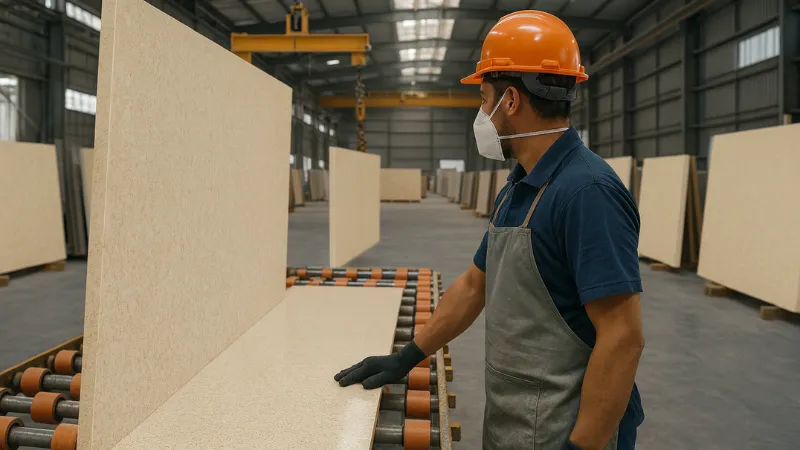
Once cured, slabs are calibrated to the required thickness and processed through finishing equipment.
Common finishes include:
Available finishes depend on the specific product range. Calibration and finishing quality influence dimensional consistency, surface appearance, and how well adjoining slabs work together in an installation.
Before dispatch, manufacturers should inspect slabs for visible defects, dimensions, thickness variation, finish quality, and consistency with product specifications.
Technical testing can provide additional evidence of performance. For example, the EN 14617 series includes methods for assessing agglomerated stone properties such as apparent density and water absorption, flexural strength, and chemical resistance. See the relevant BSI test-method overview for density and water absorption, flexural strength, and chemical resistance.
Not every test applies to every product or use. Buyers should request current reports identifying the tested product, method, results, and testing laboratory. ISO 10545, meanwhile, is a series for ceramic tiles and should not be presented as a universal engineered-quartz testing standard.
The strongest supplier is one that can demonstrate consistency and provide evidence to support its product claims.
Manufacturing controls: Ask how raw materials, mixing, compaction, curing, and finishing are controlled.
Product performance: Request relevant test reports for the properties that matter to your application, rather than relying on broad terms such as premium or high strength.
Colour and batch consistency: Compare samples and slabs under similar lighting. Confirm how batch identification and replacement orders are managed.
Certifications: Check exactly what a certification covers. For example, UL GREENGUARD relates to chemical emissions and indoor air quality; it is not a blanket certification of mechanical strength or overall slab quality. Verify product-specific claims through UL Solutions.
Product availability: Confirm the designs, dimensions, thicknesses, and finishes actually available for your project.
Supply reliability: For bulk procurement, delivery schedules, packaging, technical documentation, and after-sales support can be as important as the slab itself.
Engineered quartz can be selected by finish, design, and intended application.
Type | Typical design purpose |
Solid colours | Clean, uniform kitchens and contemporary interiors |
Marble-inspired veining | Premium countertops, islands, and feature surfaces |
Aggregate or terrazzo-inspired patterns | Decorative interiors with visible particle variation |
Polished finishes | Glossy, light-reflective surfaces |
Matte or textured finishes | Subtler visual effects and tactile design schemes |
For kitchens, consider cleaning requirements, stain resistance, heat exposure, and fabrication details. Bathrooms require careful attention to joints and moisture-prone areas. Commercial projects may demand additional evidence of durability, batch consistency, and suitability for the intended use.
No single design or finish is best for every application. Always confirm the selected product\'s maintenance instructions and technical limitations.
Before placing a bulk order, ask the supplier:
These questions help reduce procurement risk and establish clearer expectations before material reaches the site.
There is no universal answer for every project. Compare manufacturers on documented product performance, consistency, available designs, technical support, and reliable supply.
Engineered quartz is made by blending quartz aggregates with resin binders and pigments, compacting the mixture using processes such as vacuum vibrocompression, curing it under controlled conditions, and then calibrating, finishing, and inspecting the slab.
It depends on the application. Engineered quartz offers manufactured colours and patterns with controlled specifications. Natural marble and granite offer different natural characteristics and variation. Compare maintenance needs, heat exposure, design priorities, and product-specific performance before choosing.
Request relevant technical data and test reports, inspect samples, check batch consistency, and confirm that certification claims apply to the specific product. Appearance alone cannot establish all performance characteristics.
The best quartz stone is the one that meets your project\'s design, performance, and procurement requirements with verifiable quality.
Understanding the manufacturing process—from raw-material selection and mixing to compaction, curing, finishing, and testing—helps buyers ask better questions and make more informed comparisons.
For architects, developers, fabricators, and distributors, working with a supplier that offers consistent products and clear technical documentation can make the difference between a smooth procurement process and avoidable project delays.
Looking for quartz surfaces for an upcoming project? Contact Paradigm Surfaces to discuss available designs, product specifications, samples, and bulk supply requirements.

 24 September, 2026
Festive Home Makeovers: Refreshing Kitchens & Interiors with Stone
 20 September, 2026
 17 September, 2026
CNC Precision Cutting: How Technology Improves Edge & Inlay Work
 13 September, 2026
NSF & Food Safety Certifications: What They Mean for Quartz Surfaces
 12 September, 2026
Whatsapp Chatx
Hi! Click one of our representatives below to chat on WhatsApp or send us email to sales@paradigmquartz.in
 |
Contact Us +91 99440 00900 |