
27
JUN
2026
The more useful question is not "which category of stone is more sustainable?" but rather: how does this specific material perform across its entire lifecycle, from the quarry or factory floor to demolition and beyond?
That is precisely what a Life Cycle Assessment is designed to answer.
A Life Cycle Assessment is a standardised methodology for evaluating the environmental impact of a material or product across every stage of its existence. It accounts for far more than just the energy used to manufacture something—it traces the full chain from raw material extraction through manufacturing, transport, installation, service life, maintenance, and ultimately what happens when the product is removed or replaced.
The framework is governed internationally by ISO 14040 and ISO 14044 standards, and it is increasingly referenced in green building certifications such as LEED, BREEAM, and the Living Building Challenge.
For architects and developers evaluating sustainable building materials, LCA data provides a fact-based foundation rather than a marketing claim. It turns "eco-friendly" from a label into a measurable profile.
Most sustainability conversations about stone surfaces focus on the manufacturing stage. That is understandable—it is visible and measurable. But manufacturing is only one chapter of a longer story.
Natural stone—granite, marble, limestone, travertine—is quarried from the earth. The extraction process involves heavy machinery, controlled blasting, water use, and significant land disturbance. Quarrying has a real environmental cost, though it varies considerably depending on the scale of the operation, regional regulations, land rehabilitation practices, and proximity to the processing facility.
Engineered stone surfaces, including engineered quartz and engineered marble slabs, are manufactured from a mixture of natural mineral content (typically 90–95% crushed quartz or stone aggregate), polymer resins, and pigments. The raw material sourcing for engineered products involves both mining of stone aggregate and the production of petrochemical-derived binders—each carrying its own environmental profile.
Neither starting point is inherently cleaner. Both involve resource extraction. The relevant questions are: how efficiently is that extraction managed, and what does the downstream lifecycle look like?
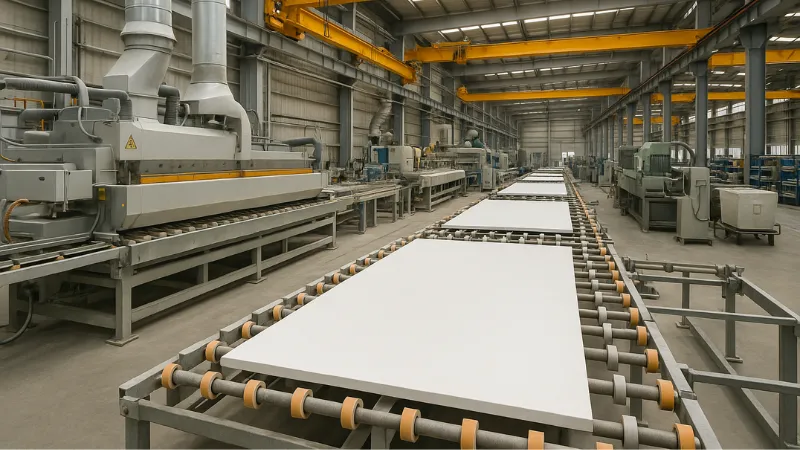
This is where engineered and natural stone diverge most visibly. Natural stone processing primarily involves cutting, grinding, and finishing—energy-intensive operations, but relatively straightforward in terms of chemical inputs. Engineered quartz surfaces require additional steps: mixing, pressing under vacuum vibration, curing under heat, and finishing. These processes typically consume more energy per unit produced than natural stone finishing alone.
However, manufacturing efficiency matters considerably here. Facilities powered by renewable energy, equipped with waste heat recovery systems, or operating under certified environmental management systems can substantially reduce the actual carbon impact of production. A modern engineered stone plant operating on low-carbon energy may carry a lower manufacturing footprint than a natural stone facility relying on diesel-heavy quarrying and coal-fired processing.
The honest answer is that manufacturing impact varies by supplier, location, and energy mix—not simply by material category.
Transport is one of the most significant and frequently underestimated contributors to embodied carbon in stone surfaces. A locally quarried and processed granite slab may carry substantially lower transport emissions than an imported engineered marble slab shipped from overseas—or vice versa, depending on origin and destination.
The critical variables are:
For projects where transport distance is long, a regionally produced engineered surface may outperform an imported natural stone on carbon even if its manufacturing phase is more intensive. This is why evaluating materials on manufacturing alone misrepresents the actual sustainability picture.
Stone installation generates waste—off-cuts, breakage, and trim material. Natural stone, being a finite natural resource, creates irreversible loss when material is discarded. Engineered surfaces produced in standardised dimensions and consistent quality batches can reduce waste through more precise fabrication, though this depends heavily on project design and the skill of the installer.
Long-format slabs, higher dimensional consistency, and lower breakage rates during handling all contribute to installation efficiency. Where a project specifies large format surfaces or complex cuts, material consistency becomes a meaningful sustainability variable—not just a quality one.
This is arguably the most important stage in the lifecycle calculation, and it is the one most often omitted from surface-level sustainability claims.
A material that lasts 50 years without replacement contributes far less to cumulative embodied carbon than a material requiring full replacement every 15–20 years. Long-lasting surface materials effectively amortise their upfront carbon cost over a much longer period.
Engineered quartz surfaces are non-porous, highly resistant to staining and bacterial growth, and dimensionally stable over time. These properties make them particularly well-suited to high-use commercial environments—hospitality, healthcare, commercial kitchens, office interiors—where surfaces face intensive daily demands. A surface that maintains its performance and appearance for decades without significant intervention carries an intrinsic lifecycle advantage.
Natural stone durability varies considerably by stone type and application. Dense, hard granites in low-traffic environments can last virtually indefinitely. Softer marbles in high-traffic settings may require more intensive maintenance and earlier replacement. Durability must be evaluated in context, not assumed from category.
Maintenance is a recurring carbon cost that compounds over a product's lifespan. Natural stone—particularly marble, limestone, and travertine—typically requires periodic sealing to prevent staining and moisture penetration. Some stones need professional resurfacing or polishing over time. The cleaning agents used, the frequency of application, and whether professional services are required all contribute to the ongoing environmental footprint.
Engineered surfaces, being non-porous by design, generally require less sealing and fewer specialty cleaning products. In environments demanding frequent or aggressive cleaning—such as healthcare or food service—this difference becomes material to the lifecycle calculation.
At the end of a project's life—renovation, demolition, or repurposing—what happens to the material?
Natural stone has a well-established reclaim and reuse tradition. Salvaged marble, granite, and limestone slabs can be repurposed across generations of buildings. Where natural stone is not reclaimed intact, it can be crushed for aggregate or fill. End-of-life recovery rates for natural stone are generally high where reclamation infrastructure exists.
Engineered stone presents a more complex picture. The polymer resin binders used in quartz composite products make mechanical recycling more difficult than for pure mineral materials. While some manufacturers are investing in take-back and recycling programmes, and the mineral aggregate component can theoretically be recovered, end-of-life options for engineered surfaces are currently more limited.
This is a genuine area where natural stone holds an advantage in circular economy terms—though it depends on whether reclamation actually occurs in practice rather than the material ending up in landfill by default.
Environmental Product Declarations (EPDs) provide verified, third-party assessed lifecycle data for construction materials. Increasingly, architects and specification writers are requesting EPDs as part of procurement documentation—particularly for projects targeting LEED credits, BREEAM ratings, or net-zero carbon targets.
LCA thinking shifts the conversation from upfront cost and aesthetics to whole-life value. Durable materials with lower maintenance requirements and longer replacement cycles look considerably better over a 30 or 50-year building life than their initial embodied carbon figures suggest. This is lifecycle value: understanding that the true environmental cost of a material is not determined at the factory gate.
Carbon is the dominant metric in current sustainability discourse, but it is not the only one that matters for environmentally responsible interiors.
Indoor air quality is relevant where surface products emit volatile organic compounds (VOCs). Both natural and engineered surfaces can carry certifications attesting to low or negligible VOC emissions, but this should be verified by product.
Material longevity directly reduces the volume of materials consumed over a building's life—a tangible waste reduction benefit regardless of how embodied carbon is calculated.
Responsible sourcing encompasses labour standards, community impact, and land restoration at extraction sites—considerations that fall outside a carbon LCA but are increasingly included in comprehensive sustainability assessments.
Waste reduction during fabrication matters both economically and environmentally. Consistent, dimensionally accurate materials reduce site waste and rework.
For architects and developers evaluating sustainable surface materials for commercial applications, engineered quartz surfaces represent a well-documented option with specific lifecycle strengths—particularly around durability, maintenance requirements, and consistent performance in demanding use environments.
For a deeper exploration of how engineered quartz performs across commercial project types, Engineered Quartz: The Future of Sustainable Stone Surfaces for Commercial Use provides detailed analysis of performance considerations and specification guidance relevant to low-carbon construction objectives.
Evaluating a supplier on sustainability requires asking beyond the product itself. Key considerations include:
Environmental documentation. Does the supplier provide Environmental Product Declarations, third-party LCA data, or verifiable sustainability certifications? Claims unsupported by documentation should be treated with scepticism.
Manufacturing transparency. Where are products manufactured? What energy sources power production? Are environmental management systems certified (ISO 14001 or equivalent)?
Sourcing practices. How is raw material extraction managed? Are quarry operations or aggregate suppliers assessed for environmental and social compliance?
Consistency and quality. Consistent product quality reduces waste at fabrication and installation—a sustainability consideration as much as a quality one.
Long-term supply reliability. For commercial projects, supply chain stability affects whether specified materials remain available for future phases, repairs, or matched replacements—directly relevant to a material's effective service life.
"Natural always means environmentally friendly."
Natural stone is a finite resource extracted through energy-intensive processes. Transportation distances, quarry practices, and processing methods all affect its actual carbon profile. Natural origin does not automatically confer environmental credentials.
"Engineered surfaces always have high embodied carbon."
Manufacturing complexity does contribute to embodied carbon, but durability, maintenance reduction, and transport efficiency can offset initial manufacturing impact across a typical building lifecycle. The comparison must be made across the full lifecycle, not the factory gate alone.
"Carbon footprint is determined primarily by manufacturing."
As this analysis shows, transport, maintenance, service life, and end-of-life management are all material contributors to total environmental impact. Manufacturing is one stage among many.
"Sustainable materials require compromising on durability or performance."
Durability and sustainability are aligned, not in tension. Materials that perform well over longer lifecycles reduce cumulative resource consumption, maintenance-related emissions, and replacement waste.
Commercial developers and institutional clients are increasingly incorporating lifecycle costing and environmental performance into their procurement criteria. This reflects both regulatory direction—particularly around embodied carbon reporting in the built environment—and genuine client demand from occupiers and investors with sustainability commitments.
For project teams, this means surface material selection decisions are being made with longer time horizons in mind. Initial cost and aesthetic performance remain important, but they are evaluated alongside durability, maintenance cost, replacement intervals, and environmental certifications.
Suppliers who can provide verified lifecycle data, demonstrate manufacturing transparency, and supply materials with documented performance longevity are better positioned for commercial specification than those relying on general sustainability claims.
What is a Life Cycle Assessment?
A Life Cycle Assessment (LCA) is a standardised methodology for measuring the total environmental impact of a product across its entire life—from raw material extraction through manufacturing, transport, installation, use, maintenance, and end of life. It is the primary tool used by sustainability professionals to compare the environmental performance of building materials on a like-for-like basis.
Is engineered stone environmentally friendly?
It depends on the product, manufacturer, and context. Engineered stone products with durable performance characteristics, low maintenance requirements, and verifiable manufacturing standards can perform well in lifecycle assessments—particularly in high-use commercial settings where durability and hygiene matter. No material can be accurately described as universally environmentally friendly without lifecycle data to support the claim.
Does natural stone always have a lower carbon footprint than engineered stone?
No. Natural stone can carry significant carbon costs associated with quarrying, processing, and—especially—transportation from distant sources. In some project scenarios, a locally manufactured engineered surface may have a lower total carbon footprint than an imported natural stone, even accounting for manufacturing energy. The comparison must be made with actual lifecycle data, not assumed from material category.
Why does transportation matter so much in sustainability?
Transport emissions can represent a substantial proportion of a material's total embodied carbon, particularly for heavy products like stone that are frequently sourced internationally. A material with efficient manufacturing but a long supply chain may carry higher total lifecycle carbon than a locally produced alternative with a more intensive manufacturing process.
What documentation should I request when specifying sustainable stone surfaces?
Look for Environmental Product Declarations (EPDs) assessed against recognised product category rules, ISO 14001 manufacturing certification, and any relevant indoor air quality or low-emission certifications. Verify that claims are third-party assessed rather than self-declared.
The sustainability performance of stone surfaces—engineered or natural—cannot be determined by category. It depends on how and where raw materials are sourced, how efficiently they are manufactured and under what energy regime, how far they travel, how long they perform without replacement, what maintenance they require, and what happens to them at the end of a building's life.
Life Cycle Assessment provides the framework to evaluate these variables systematically, replacing marketing claims with verifiable data. For architects, developers, and commercial buyers operating in an environment of increasing environmental accountability, LCA literacy is becoming a core specification competency.
No single material wins every category across every project scenario. The most informed decision is one grounded in lifecycle thinking—matching material performance to project requirements, weighing total environmental cost over the full building life, and selecting suppliers who can support those decisions with transparent, documented evidence.
That is the foundation on which genuinely sustainable construction is built

 24 September, 2026
Festive Home Makeovers: Refreshing Kitchens & Interiors with Stone
 20 September, 2026
 17 September, 2026
CNC Precision Cutting: How Technology Improves Edge & Inlay Work
 13 September, 2026
NSF & Food Safety Certifications: What They Mean for Quartz Surfaces
 12 September, 2026
Whatsapp Chatx
Hi! Click one of our representatives below to chat on WhatsApp or send us email to sales@paradigmquartz.in
 |
Contact Us +91 99440 00900 |