
13
APR
2026
A kitchen island has to do more than look good. It handles food preparation, spills, heavy cookware, daily cleaning and years of regular use. That makes the choice of surface material a practical decision as much as a design one.
For most modern kitchens, the main options include engineered quartz, granite, marble and terrazzo. Each has clear strengths, but the right choice depends on how the island will be used, how much maintenance the homeowner accepts, and the finish and look the project demands.
The right kitchen island material should balance durability, maintenance, appearance, slab availability and long-term value. Engineered quartz is a practical option for many residential and modular kitchens because it offers a consistent appearance, a non-porous surface and low routine maintenance. Granite suits projects that prioritise natural stone and heat resistance, while marble delivers distinctive veining and luxury but needs more care. Terrazzo works well when a customised, design-led surface is the priority. Always check slab size, finish, fabrication requirements and supplier consistency before making the final decision.
Start with how the island will actually be used.
A good surface should handle everyday wear while fitting the visual direction of the kitchen. Five factors matter most:
Durability: The island sees constant activity, from food preparation to moving appliances and cookware.
Heat and stain resistance: Spills, oils, acidic ingredients and hot vessels are part of everyday kitchen use.
Maintenance: A surface that needs frequent sealing or specialised care can increase long-term effort and cost.
Appearance: Colour, pattern and finish should work with the cabinetry, flooring, walls and lighting.
Total cost: Consider fabrication, joints, maintenance and potential replacement—not just the price of the slab.
Quartz is manufactured using quartz aggregate, resins and pigments. This controlled production allows manufacturers to create consistent colours and patterns across slabs.
Its non-porous surface makes routine maintenance simple, and it does not require the periodic sealing associated with many natural stone surfaces. These qualities make quartz well suited to busy residential kitchens, modular kitchens and multi-unit projects where consistency matters.
Quartz does have limitations. Prolonged exposure to high heat can damage or discolour the surface, so hot cookware should not be placed directly on the slab. It is also generally unsuitable for outdoor kitchens where prolonged UV exposure can affect some quartz products.
Best suited to: Modern residential kitchens, modular kitchens, multi-unit projects and contemporary interiors.
Granite is a natural stone known for its hardness, durability and heat resistance. Every slab has its own natural variation, which can give a kitchen island a distinctive appearance.
The trade-off is maintenance and consistency. Granite is porous and normally requires sealing, while matching colour and pattern across multiple slabs can be more difficult.
Best suited to: Custom kitchens where natural variation and heat resistance are important.
Marble remains a popular choice for statement kitchen islands because of its natural veining, depth and luxurious appearance.
It also demands more care than quartz or granite. Marble can react with acidic substances such as lemon juice, vinegar and wine, causing visible etching. It can also scratch more easily during heavy everyday use.
Best suited to: Luxury kitchens and design-led projects where appearance takes priority and the client accepts higher maintenance.
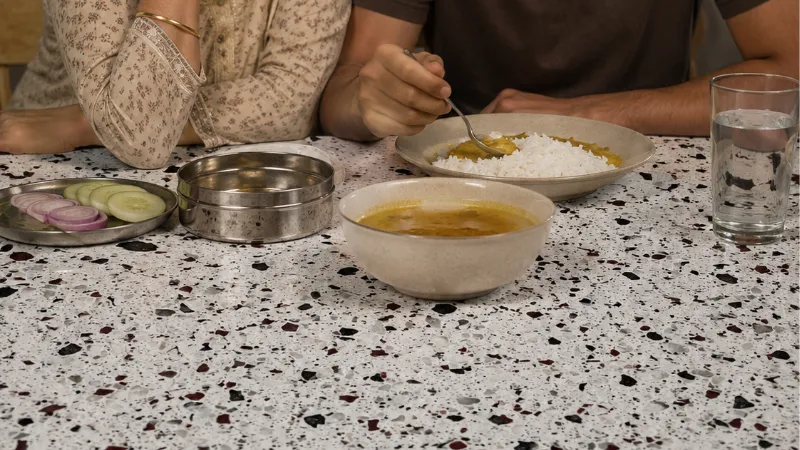
Terrazzo offers something different. Its visible aggregate and broad colour possibilities make it useful for interiors where the surface itself is part of the design statement.
Its performance depends on the type of terrazzo and the binder used. It can work well in kitchens, but fabrication, joints and overall project cost need careful consideration.
Best suited to: Bespoke residential and hospitality projects with a strong design focus.
Quartz brings several practical advantages together.
Its controlled manufacturing process provides greater colour and pattern consistency than natural stone. That is particularly useful when several slabs need to coordinate across a project.
Quartz also works well with modern fabrication details such as integrated sink cut-outs, precise edge profiles and waterfall island designs.
For homeowners, the main advantage is simple: less routine maintenance without giving up a modern stone look.
That does not mean quartz is maintenance-free. Use trivets for hot cookware, avoid cutting directly on the surface and follow the manufacturer\'s care instructions.
Island design increasingly favours larger surfaces, and slab dimensions can affect the final result.
A large island made from smaller slabs may require additional joints. These joints can interrupt the pattern, affect the visual continuity and add fabrication complexity.
Large-format and super-jumbo slabs can reduce the number of joints and create a cleaner appearance, especially on long islands and waterfall edges.
Before finalising the design, confirm the actual slab dimensions available from the supplier. Do not design around a large island and check slab availability at the fabrication stage.
A cheaper slab does not always mean a cheaper project.
The total cost can include:
For example, natural stone may require more maintenance over its usable life, while a more consistent engineered surface can simplify fabrication and project planning.
Think in terms of total value, not only material price per square foot.
For a busy everyday kitchen: Engineered quartz or properly selected granite can suit the demands of regular use.
For a luxury statement island: Marble can provide the natural character and veining many premium interiors demand.
For a highly customised interior: Terrazzo offers distinctive patterns and colour combinations.
For modular or multi-unit projects: Quartz can simplify material coordination because of its consistent appearance and availability in repeatable designs.
There is no need to use the same stone throughout the entire project. Different surfaces can work together when they serve different purposes.
Choosing from a small sample only. A sample cannot always show how pattern movement will appear across a full island. Review full-slab images or the actual slab whenever possible.
Ignoring the finish. Polished and matte surfaces can make the same colour look very different.
Forgetting slab dimensions. Confirm availability before finalising island dimensions.
Underestimating maintenance. Make sure the homeowner understands the care requirements of natural stone before installation.
Assuming all quartz is identical. Quality, composition, finish and manufacturing standards can vary between suppliers. Check technical specifications and consistency before committing to a large project.
Material selection is only one part of the decision, especially for architects, designers and kitchen manufacturers.
Before placing an order, check whether the supplier can provide:
Consistent slabs: Important when multiple slabs need to match.
Large-format options: Essential for large islands and designs with fewer joints.
Finish choices: Different finishes can significantly change the final appearance.
Reliable logistics: Delays or transit damage can affect the entire kitchen installation schedule.
A supplier should support the project from specification through delivery, not simply provide the slab.
The best kitchen island material depends on the demands of the space.
Quartz offers a strong balance of consistency, low maintenance and modern design flexibility. Granite brings natural variation and heat resistance. Marble creates a distinctive luxury finish but requires greater care. Terrazzo gives designers more room for customisation.
Before choosing, look at how the island will be used, how much maintenance the client accepts, what slab sizes are available and how the material will work with the rest of the kitchen.
For architects, interior designers and homeowners exploring premium surfaces, Paradigm Surfaces offers quartz, granite, marble and terrazzo options for contemporary interior applications.

 24 September, 2026
Festive Home Makeovers: Refreshing Kitchens & Interiors with Stone
 20 September, 2026
 17 September, 2026
CNC Precision Cutting: How Technology Improves Edge & Inlay Work
 13 September, 2026
NSF & Food Safety Certifications: What They Mean for Quartz Surfaces
 12 September, 2026
Whatsapp Chatx
Hi! Click one of our representatives below to chat on WhatsApp or send us email to sales@paradigmquartz.in
 |
Contact Us +91 99440 00900 |