
12
JUN
2026
Modern interiors are no longer defined by furnishings or decorative objects. They are shaped by surfaces.
The wall you first see when you enter a space. The countertop you run your hand across. The floor that anchors the entire room. These surfaces communicate quality, intention, and identity faster than any piece of furniture can.
This shift toward material-led design has made the selection of interior surfaces one of the most consequential decisions in any build or renovation. And among all available materials, stone — in its natural and engineered forms — continues to set the standard for what premium interiors look and feel like.
This guide is for architects, interior designers, developers, and procurement professionals who want to make better surface decisions. Not just aesthetically, but structurally, functionally, and commercially.
Not all stone surfaces are equal. A slab may look impressive in a catalogue and disappoint on-site within two years. Understanding what separates a high-quality surface from a standard one is the foundation of smart material selection.
Quality starts at the source. Whether you are sourcing natural marble, engineered quartz, terrazzo, or composite stone, the raw material must meet consistent structural standards.
For natural stone, this means low porosity, minimal veining irregularities that could indicate structural weakness, and slabs that have been properly quarried and inspected. For engineered surfaces, it means the polymer-to-stone ratio, binder quality, and compression strength must all meet commercial-grade thresholds.
Consistency is critical at scale. A supplier who can deliver 200 slabs with the same structural integrity as the first sample is worth significantly more than one who cannot.
The finish is what the end user interacts with daily. Polished, honed, leathered, brushed — each finish requires precision manufacturing to achieve the intended result.
A poorly polished marble slab will show micro-scratches within months. An uneven hone leaves patchy reflectance that makes even premium stone look second-rate. High-quality surface finishing means consistent depth, uniform texture, and edges that are cleanly profiled without chipping or variation.
High-quality surfaces are investments, not expenses. The right material in the right application should perform — without significant degradation — for decades.
This requires an honest assessment of:
Natural marble is beautiful but requires sealing and careful maintenance. Engineered quartz offers near-zero porosity with greater resistance to everyday use. Neither is universally superior. Each has its ideal application.
A premium surface material must work across different scales, orientations, and design contexts. Large-format slabs that can be installed with minimal seaming are increasingly in demand. Book-matched panels that create mirror-image patterns across walls and floors command premium project values.
Versatility also means compatibility with different edge profiles, cutting techniques, and installation methods — all without material compromise.
Trends cycle. Stone endures.
The resurgence of terrazzo in contemporary hospitality design, the persistent demand for Carrara marble in luxury residential builds, and the rise of dark granite and basalt in commercial architecture all confirm one thing: stone adapts. It looks as appropriate in a 2024 minimal apartment as it did in a mid-century statement building.
This longevity matters commercially. Developers who invest in premium stone surfaces are investing in an aesthetic that will not look dated in five years.
When installed correctly and maintained appropriately, stone surfaces outlast virtually every alternative. Porcelain stoneware, vinyl composites, and high-pressure laminates all have finite lifespans. Quality stone, properly sealed and maintained, does not.
For commercial projects — hospitality, retail, corporate campuses — this durability translates directly into reduced lifecycle costs. The premium paid upfront is routinely recovered in avoided replacement cycles.
No manufactured surface fully replicates the depth and movement of quality stone. The veining in marble, the crystalline variation in granite, the aggregate character of terrazzo — these are not reproducible by inkjet printing on ceramic. Discerning clients know the difference, and so do the spaces.
In luxury residential and high-end hospitality, stone surfaces serve as anchors for the entire visual narrative. Remove them and the space loses its sense of material hierarchy.
Stone works across virtually every contemporary design vocabulary:
This breadth of application is why stone surfaces remain specified across project types that have very little else in common.
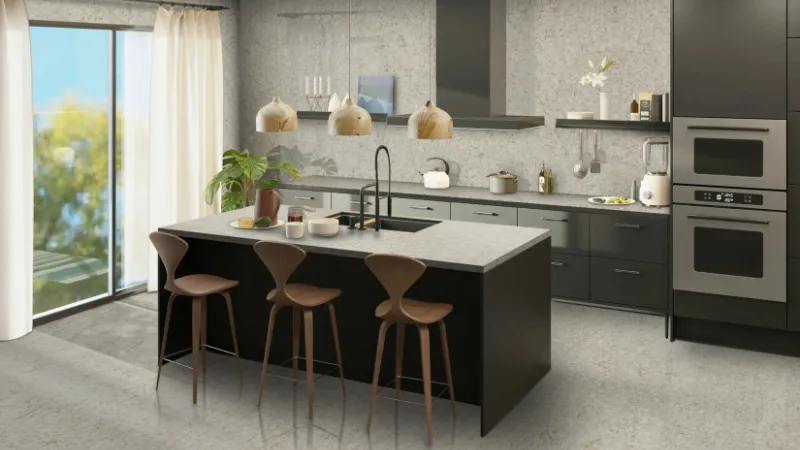
The kitchen remains the most demanding surface environment in any residential or commercial space. Heat, moisture, impact, and chemical exposure make surface selection a functional decision before it is ever an aesthetic one.
Quartz kitchen countertops dominate premium residential and commercial kitchen specifications because they combine the look of stone with low maintenance requirements. Non-porous by nature, they resist staining without periodic sealing and maintain their surface integrity under heavy daily use.
Kitchen islands in high-use environments — whether in a private residence or a restaurant — benefit from surfaces with consistent slab dimensions, allowing for single-piece installations that eliminate seams where bacteria and staining can accumulate.
For those who prefer natural stone in kitchen applications, leathered or honed granite provides a working surface with strong practical performance and a sophisticated matte finish.
Bathrooms demand surfaces that combine moisture resistance with visual refinement. This is where the intersection of function and luxury design is most clearly expressed.
Vanity surfaces in quality bathrooms are increasingly specified in marble or engineered stone, often extended continuously from the countertop into an integrated backsplash. The visual continuity this creates is simple to achieve with large-format slabs and has a significant impact on the perceived quality of the space.
Wall cladding in wet areas — showers, feature bath surrounds — requires careful material selection. Porosity must be assessed. Joints must be sealed correctly. The wrong natural stone in a shower environment will absorb moisture, discolour, and eventually fail structurally.
Engineered surfaces specifically manufactured for wet-area wall cladding offer a reliable alternative where natural stone is the aesthetic goal but moisture resistance is a non-negotiable requirement.
A stone feature wall does something no painted surface, wallpaper, or timber panel fully achieves: it brings geological scale into an interior space.
In residential design, book-matched marble panels create a symmetrical statement that functions as both architecture and art. In commercial settings — hotel lobbies, corporate reception areas, retail flagship stores — a stone feature wall signals material investment in a way that is immediately legible to the visitor.
The key to a successful stone feature wall is installation quality. The slab must be properly fixed, joints must be consistent, and the finish must be protected correctly. A poorly executed installation undermines the material itself.
The commercial sector is where stone surface performance is tested most rigorously. Hotels, retail environments, corporate offices, and public infrastructure all subject surfaces to traffic volumes and cleaning regimens that domestic use never approaches.
In hospitality design, stone is used to establish brand positioning. A five-star hotel lobby floored in travertine or marble communicates quality at the point of arrival — before the guest interacts with a single staff member.
In retail, stone surfaces in display areas and circulation zones create a sense of permanence and quality that is increasingly difficult to fake with cheaper alternatives.
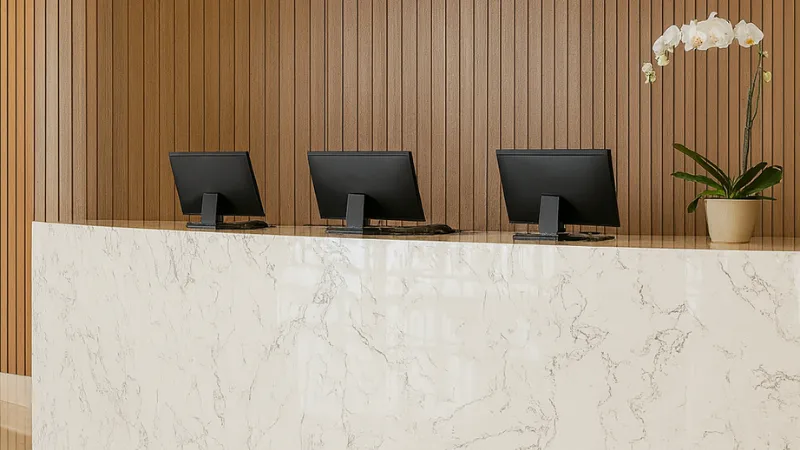
In office environments, particularly reception areas, breakout spaces, and client-facing zones, stone countertops and wall panels have become standard in premium corporate fit-outs.
Several directions are shaping how architects and designers are specifying stone surfaces right now:
Seamless and slab-continuity installations. The preference for uninterrupted surface runs — countertop flowing into backsplash, floor continuing into wall cladding — is driving demand for large-format slabs and thinner, more flexible material formats.
Reduced pattern variation. While dramatic veining remains popular for statement applications, there is increasing demand in contemporary commercial and residential design for low-variation stone — surfaces with subtle movement and consistent tonal fields.
Raw and natural finishes. Honed, leathered, and brushed finishes are now specified more frequently than polished in contemporary projects. They read as more current, are easier to maintain in daily use, and create a quieter material presence that works well in minimalist interiors.
Material honesty. A growing reaction against surfaces that simulate natural materials is driving renewed interest in genuine stone. When a client or designer specifies marble, they increasingly mean marble — not a ceramic tile printed to resemble it.
Sustainability in sourcing. Procurement teams and sustainability-focused practices are giving increasing weight to chain-of-custody documentation, responsible quarrying practices, and local sourcing where viable.
There is no universally correct stone surface. There is only the right surface for a specific brief, budget, performance requirement, and aesthetic objective.
Use this framework when beginning any surface specification:
1. Define the primary performance requirement. Is this surface primarily decorative, structural, or a balance of both? A feature wall panel has different requirements from a commercial kitchen worktop or a hotel lobby floor.
2. Assess traffic and use intensity. Light domestic use allows for more delicate, higher-maintenance surfaces. High-traffic commercial environments require harder, lower-porosity materials.
3. Establish realistic maintenance expectations. Who will maintain this surface, how frequently, and with what resources? Natural stone requires periodic professional attention. Some engineered surfaces do not. Mismatching material maintenance requirements with operational reality is one of the most common and costly specifying errors.
4. Set your aesthetic objectives clearly. Consider: tonal range, pattern variation, finish type, edge profile, and how the surface will interact with the light conditions in the space — both natural and artificial.
5. Align material selection with budget across the full lifecycle. Upfront material cost is only part of the picture. Factor in installation complexity, ongoing maintenance cost, and expected service life. A more expensive surface that lasts 40 years and requires minimal intervention will frequently outperform a cheaper material that requires replacement after 10.
To explore additional ways to elevate interior aesthetics without major remodeling, read How to Make Your Home Look Elegant Without Renovating.
Specifying on appearance alone. A slab that looks extraordinary in a showroom under artificial lighting may perform poorly under the specific light conditions and use patterns of the intended space. Always assess material performance alongside visual appeal.
Underestimating maintenance requirements. Natural marble in a high-traffic commercial kitchen is a maintenance liability unless the team is equipped and committed to managing it. Surface beauty should never override operational reality.
Overlooking installation complexity. Some materials — particularly large-format book-matched slabs, thin panels, and certain natural stones — require specialist installation. Failure to cost this correctly or engage the right contractor leads to poor outcomes regardless of material quality.
Treating upfront cost as the primary variable. The cheapest option at the point of purchase is rarely the most economical over a ten- or fifteen-year horizon. Lifecycle cost analysis changes the commercial calculation significantly.
Failing to request batch consistency documentation. For large or multi-phase projects, confirming that material from different production batches will match is essential. Colour and veining variation between batches can create visible inconsistencies that are nearly impossible to correct post-installation.
Architects, developers, and procurement managers are not simply buying material. They are buying a supply relationship that needs to perform across complex projects with tight tolerances.
The qualities that distinguish premium surface suppliers in professional procurement decisions:
Product consistency at scale. The ability to supply matching material across large orders and multiple project phases without visible batch variation.
Inventory reliability. Confirmed stock availability before and throughout the project lifecycle. Material going out of production mid-build is a commercially damaging event.
Technical support capability. Suppliers who can provide installation guidance, specification sheets, maintenance documentation, and technical representation during complex projects add genuine value beyond the material itself.
Customisation and fabrication flexibility. Custom edge profiles, non-standard slab formats, and colour-matched products require supplier capability that not all can provide. For high-specification projects, this matters.
Large-project readiness. The ability to coordinate delivery phasing, provide sample approvals, and maintain communication across long project timelines distinguishes professional supply partners from transactional vendors.
What are high-quality stone surfaces? High-quality stone surfaces are materials — natural or engineered — that meet consistent standards of structural integrity, surface finish precision, and long-term performance. They are distinguished by material consistency, manufacturing quality, and their ability to maintain their appearance and function over extended service lives.
Which stone surface is best for modern interiors? There is no single best material. Engineered quartz is widely specified for its low maintenance and consistent appearance. Marble remains the premium choice for luxury and statement applications. Terrazzo is increasingly specified in contemporary commercial and hospitality design. The right material depends entirely on the specific application, performance requirements, and aesthetic objectives of the project.
Are engineered stone surfaces durable? Yes. High-quality engineered stone surfaces — particularly quartz composites — are among the most durable interior surface materials available. They offer near-zero porosity, strong scratch resistance, and consistent performance across a wide range of applications. Their primary advantage over natural stone is uniformity of performance across batches and reduced maintenance requirements.
How do I choose the right interior stone material? Define your performance requirements first. Assess traffic, maintenance capacity, and moisture exposure. Set your aesthetic objectives with reference to actual site conditions. Then align material selection with lifecycle cost rather than upfront price alone. When in doubt, engage a specialist supplier who can provide technical guidance alongside material samples.
High-quality stone surfaces are not simply finishing materials. They are architectural decisions with long-term consequences for how a space performs, how it is perceived, and what it costs to maintain.
Approached correctly, surface selection is one of the highest-leverage design decisions in any interior project. A poorly specified surface undermines everything around it. A well-specified one elevates the entire space — and does so for decades.
The professionals who consistently make excellent surface decisions are those who combine aesthetic sensibility with functional rigour: who understand that beauty and performance are not in tension, and that the best material for a project is the one that serves both requirements equally well.
Working with a supplier who understands this — who can provide consistent quality, reliable inventory, and genuine technical support — is not a luxury. It is the baseline for delivering work that holds up over time

 24 September, 2026
Festive Home Makeovers: Refreshing Kitchens & Interiors with Stone
 20 September, 2026
 17 September, 2026
CNC Precision Cutting: How Technology Improves Edge & Inlay Work
 13 September, 2026
NSF & Food Safety Certifications: What They Mean for Quartz Surfaces
 12 September, 2026
Whatsapp Chatx
Hi! Click one of our representatives below to chat on WhatsApp or send us email to sales@paradigmquartz.in
 |
Contact Us +91 99440 00900 |