
02
APR
2026
Designers often choose engineered quartz for its consistent appearance, low-maintenance surface, predictable specifications, and wide range of colours and patterns. Natural stone remains a strong choice for projects that value unique veining, geological character, and material authenticity. Neither option is universally better. The right choice depends on the application, maintenance expectations, heat exposure, design brief, and procurement requirements. Understanding these differences helps designers specify surfaces that look right and perform well over time.
Modern interiors demand more than attractive surfaces. Designers must balance appearance with durability, maintenance, availability, and long-term project requirements.
Engineered stone is a broad category of manufactured surfaces. Engineered quartz typically combines natural quartz particles with polymer resins and pigments, while terrazzo may use marble, glass, or other aggregates in a cementitious or resin binder. Their properties vary by composition and manufacturing process.
Natural stone, including marble, granite, quartzite, and limestone, is quarried and cut into slabs. Its colours, mineral patterns, and geological features make every slab distinctive.
These differences influence how each material performs and where it works best.
Consistency matters when designing hotel rooms, retail chains, office floors, or multi-unit residential developments.
Natural stone varies from slab to slab. This variation creates character, but matching the same appearance across multiple areas or future renovation phases can be difficult.
Engineered quartz offers more control over colour and pattern through manufacturing. Designers can select a defined finish and establish clearer visual expectations for larger projects.
However, consistency is not automatic. Designers should review production samples, confirm batch availability, and agree on acceptable variation before procurement.
Engineered quartz surfaces are generally low-porosity and do not require routine sealing. Their surfaces are relatively easy to clean, making them practical for kitchens, vanity tops, reception counters, and other frequently used interior spaces.
Natural stone requires a more material-specific approach. Marble can be vulnerable to scratching and acid etching, while some natural stones may benefit from sealing to reduce staining. Not every granite requires sealing, as the Natural Stone Institute explains.
For designers, the key question is how much ongoing care the client is prepared to undertake. Engineered quartz often suits clients who prioritise straightforward maintenance, while natural stone can be equally appropriate when its care requirements are understood.
Engineered quartz is available in solid colours, subtle textures, marble-inspired veining, and decorative aggregate patterns.
This flexibility helps designers coordinate countertops, islands, vanities, and reception desks with cabinetry, flooring, lighting, and brand colours.
Natural stone offers something different: patterns formed by geological processes that cannot be reproduced exactly. Dramatic marble veining and distinctive quartzite slabs can become the focal point of a space.
The choice comes down to the design objective: controlled coordination or one-of-a-kind natural character.
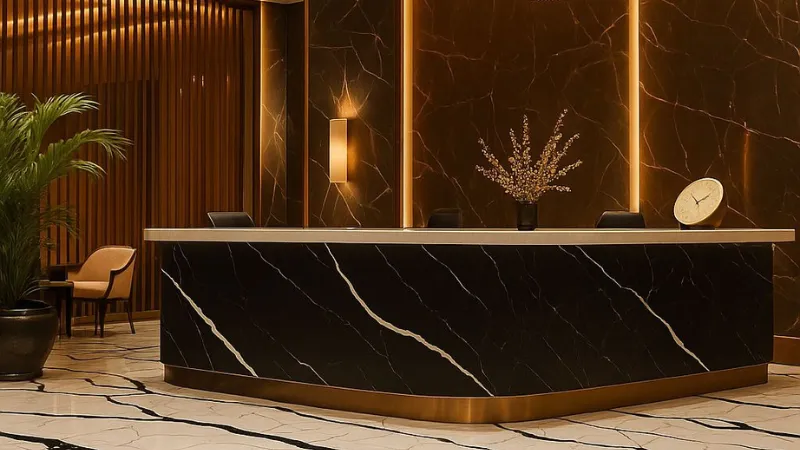
Contemporary interiors often use expansive islands, long counters, and minimalist reception desks. Large-format engineered quartz slabs can help reduce the number of joints required for these designs.
Fewer joints may improve visual continuity and simplify cleaning around seams. Actual seam placement depends on slab dimensions, layout, cutouts, transport limitations, and fabrication requirements.
Natural stone can also deliver impressive large-format installations, provided the selected slabs and installation system suit the application. Neither material guarantees a completely seamless result.
For developers and contractors, material decisions affect budgets, schedules, and site coordination.
Engineered quartz can offer clearer product specifications and repeatable designs, making it easier to plan standardised interiors across several properties or locations.
Natural stone sourcing may involve greater variation in appearance and availability, particularly for rare varieties or specific quarry selections.
Neither option guarantees stable prices or uninterrupted supply. Before placing bulk orders, buyers should confirm stock, lead times, batch consistency, replacement availability, and delivery arrangements.
A good material specification considers what natural stone does particularly well.
Unique character: No manufactured pattern fully reproduces the individuality of naturally formed marble, granite, or quartzite. This makes natural stone compelling for statement walls, luxury residences, and hospitality interiors.
Heat exposure: Granite and quartzite generally offer better tolerance of direct heat than resin-bound engineered quartz. Even so, hot cookware and sudden temperature changes can damage countertop surfaces, so protective measures remain advisable.
Material authenticity: Natural stone brings geological variation and a direct connection to its source. For projects where natural veining, quarry provenance, and material individuality are central to the design story, this can be a significant advantage.
Natural stone is not automatically high-maintenance or unsuitable for heavy use. Its suitability depends on the particular stone, finish, installation, and expected conditions.
Design consideration | Engineered quartz | Natural stone |
Appearance | More controlled colour and pattern | Naturally occurring variation |
Maintenance | Generally low maintenance; no routine sealing | Depends on stone type and finish |
Heat exposure | Requires care around hot objects | Granite and quartzite generally tolerate heat better |
Design selection | Broad range of manufactured colours and patterns | Distinctive natural patterns and mineral features |
Batch matching | Often easier, but batch variation still occurs | Matching future slabs may be challenging |
Procurement | Repeatable designs can simplify planning | Availability depends on the selected stone and source |
For designers, the best starting point is the intended use—not the material\'s popularity.
Consider engineered quartz when:
Consider natural stone when:
For outdoor installations, do not assume that standard engineered quartz is suitable. UV exposure can affect some resin-containing surfaces; check the selected manufacturer\'s application guidance. For example, Cosentino\'s Silestone maintenance guidance advises against outdoor use because UV rays can damage the surface.
Before specifying a surface, verify four things:
These checks help prevent a visually appealing specification from becoming a procurement or installation problem.
Not in every situation. Engineered quartz often suits projects requiring visual consistency and easy maintenance. Natural stone is an excellent choice when distinctive patterns and natural material character matter most.
No. Engineered quartz is manufactured from quartz particles, binders, and other ingredients. Quartzite is a natural stone formed through geological processes. Their appearance, care requirements, and performance differ.
Engineered quartz can work well for indoor reception counters, office interiors, and hospitality surfaces where consistent appearance and straightforward maintenance are priorities. The appropriate specification depends on the actual use, traffic, heat exposure, and product limitations.
It can provide a marble-inspired appearance with different maintenance characteristics. However, natural marble has distinctive veining and variation that manufactured surfaces cannot reproduce exactly.
Designers are not choosing engineered stone simply because it is modern. They are choosing it when controlled appearance, low maintenance, and repeatable specifications solve a project\'s practical needs.
Natural stone remains equally relevant for designs that celebrate unique patterns, geological character, and material authenticity.
The strongest specification is the one that matches the surface to the space, the client\'s expectations, and the project\'s long-term requirements. For architects, developers, and fabricators, evaluating those factors—and working with a supplier who can provide clear product information—makes material selection more reliable.

 24 September, 2026
Festive Home Makeovers: Refreshing Kitchens & Interiors with Stone
 20 September, 2026
 17 September, 2026
CNC Precision Cutting: How Technology Improves Edge & Inlay Work
 13 September, 2026
NSF & Food Safety Certifications: What They Mean for Quartz Surfaces
 12 September, 2026
Whatsapp Chatx
Hi! Click one of our representatives below to chat on WhatsApp or send us email to sales@paradigmquartz.in
 |
Contact Us +91 99440 00900 |