Super Jumbo Quartz Slabs for Five-Star Hotel Lobbies & Reception Counters

  • Home
  • Blogs
  • Super Jumbo Quartz Slabs for Five-Star Hotel Lobbies & Reception Counters
Super Jumbo Quartz Slabs for Five-Star Hotel Lobbies & Reception Counters

Walk into any five-star hotel and the first material you touch, lean on, or check in at is usually the reception counter. Before a guest sees the room, the restaurant, or the view, they experience the lobby — and the surfaces in that space carry a disproportionate amount of the brand's first impression. That's why lobby and reception design decisions get scrutinized far more closely than almost any other material choice in a hospitality project.

These spaces have to do several jobs at once. They need visual impact that photographs well and feels premium in person. They need to survive constant guest and staff contact without looking tired within a year. They need to be easy for housekeeping to maintain on a daily cycle. They need to reinforce a hotel's brand identity — whether that's minimalist, classic, or dramatic. And they need to be fabricated and installed in ways that are actually achievable on a real construction site, on a real schedule.

Super jumbo quartz slabs have become part of this conversation because larger slab formats let designers rethink how much of a counter or feature wall can be covered without interruption. This article looks at where that makes sense, where it doesn't, and what architects, developers, fabricators, and procurement teams should actually verify before specifying large-format quartz for a lobby or reception counter. Quartz is one option among several for these applications — not automatically the right one for every project — and the goal here is to help you evaluate it with clear eyes.

What Are Super Jumbo Quartz Slabs?

"Large-format" in engineered stone refers to slabs manufactured beyond the dimensions of standard-size slabs, giving designers more surface area to work with before a seam becomes necessary. Manufacturers use this extra size to cover bigger spans of countertop, wall cladding, or flooring with fewer joints, which is particularly useful in commercial and hospitality settings where visual scale matters.

Here's the part that gets glossed over in a lot of marketing material: there is no single, industry-wide definition of "jumbo" versus "super jumbo." Different manufacturers set different maximum dimensions, different standard thicknesses, and different weight limits for their large-format lines. A slab labeled "super jumbo" from one producer may not match the dimensions of a "super jumbo" slab from another.

This means the single most important early step in specifying large-format quartz is confirming the exact length, width, thickness, and weight of the specific product line under consideration — not assuming a generic size. Ask your supplier for the technical data sheet before finalizing any layout, budget, or fabrication plan.

Why Large-Format Slabs Matter in Five-Star Hotel Design

Luxury hospitality design tends to favor visual continuity — long, uninterrupted lines that read as calm and considered rather than busy or segmented. Large-format slabs support several design goals that come up repeatedly in five-star projects.

Fewer visible joints. Larger slab dimensions can reduce the number of seams needed across an appropriately designed counter or wall, which is often the primary reason architects specify them in the first place.

Large visual planes. A bigger single piece of material lets designers build broad surfaces that read as one continuous element, which supports a more architectural, less "assembled" look.

A more considered aesthetic. Fewer interruptions in a surface generally reads as more deliberate and higher-end, which fits the minimalist direction many five-star lobbies are designed around.

Pattern continuity. Depending on the specific product, veining and pattern movement can be easier to coordinate across a larger single piece than across multiple smaller slabs that need to be matched at the seam.

Brand identity. A distinctive stone surface — in colour, pattern, or finish — can become a recognizable part of a hotel's design language across a portfolio of properties.

None of this means quartz is the only material capable of these effects, or that large format automatically outperforms smaller-format material in every scenario. It means large-format quartz is one legitimate route toward these design goals, with its own set of trade-offs covered later in this article.

Super Jumbo Quartz for Hotel Lobby Applications

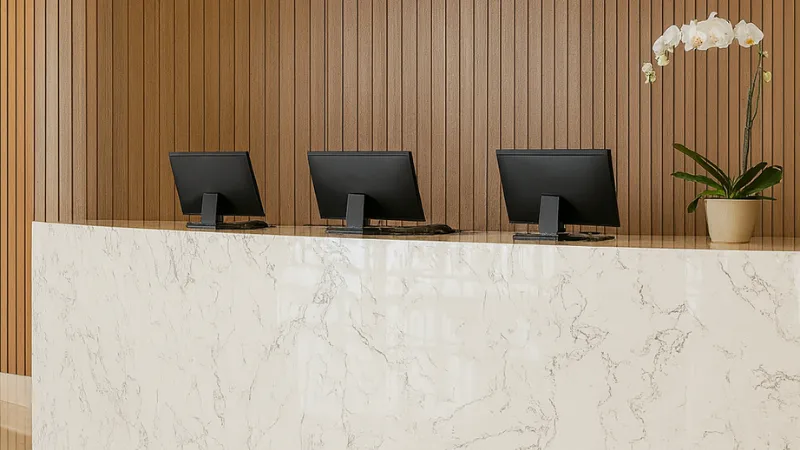
Reception desks. The front desk is the most heavily used surface in the lobby — guests lean on it, staff work at it for hours at a stretch, and it's visible in almost every arrival photo. It needs to look premium and hold up to constant contact, spills, and cleaning chemicals.

Concierge desks. Similar contact profile to the front desk, often with a slightly different footprint and a stronger design emphasis, since concierge areas are frequently positioned as a secondary architectural feature.

Lobby feature counters. Some hotels use a stone counter or ledge purely as a design statement rather than a working surface — these have more flexibility in slab orientation and pattern placement since they don't need to accommodate equipment or cash handling.

Hospitality display areas. Quartz can be built into branded architectural features — display niches, welcome desks, or signature walls — where the material becomes part of the overall design story rather than just a functional surface.

Backlit or decorative applications. Backlighting only works with quartz products specifically engineered for light transmission. Not every quartz slab is suitable for this — confirm with the manufacturer whether the specific product supports backlighting before designing around it.

Designing a Five-Star Reception Counter With Large Quartz Slabs

Counter geometry. Curves, returns, waterfall edges, and complex corner conditions all affect how much usable material a slab actually provides. A counter with multiple direction changes may require more careful slab layout than a simple straight run, even with a large-format piece.

Seam planning. Seam locations should be decided at the design stage, not left to be figured out during fabrication. Planning where a seam will fall — behind a POS terminal, at a corner return, along a natural break in the design — gives you far more control over how visible it ends up being.

Edge profiles. The edge detail chosen for the counter affects how substantial or refined the piece looks, and can also affect how the front-facing seam or joint reads visually.

Colour and pattern. Selection should be considered alongside flooring, wall finishes, lighting temperature, furniture tones, and brand palette — not chosen in isolation as a standalone material decision.

Slab orientation. The direction a slab is oriented can affect how veining or pattern movement reads across the counter, particularly on bookmatched or highly patterned products.

Seamless-Look Design: What Is Actually Possible?

This is worth being precise about, because it's the single most common point of miscommunication between designers and clients on large-format projects.

A truly seamless surface has no joints anywhere across its full length and width. A surface designed to minimize visible seams uses large-format material and careful planning to reduce the number and visibility of joints, without necessarily eliminating them entirely.

Super jumbo slabs can meaningfully reduce the number of seams in a suitably designed reception counter. They cannot guarantee a completely seam-free result on every layout. Whether a seam is needed — and where it falls — depends on:

  • the actual counter dimensions versus the actual slab dimensions
  • corner conditions, returns, and curves
  • cut-outs for sinks, equipment, or cable routing
  • structural support requirements under the counter
  • site access for moving and installing large pieces
  • fabrication tolerances of the specific fabricator

Setting this expectation clearly with clients and design teams early avoids disappointment later in the project.

For a deeper look at extra-large quartz formats and what "super jumbo" actually covers across manufacturers, see [Extra-Large Quartz Super Jumbo Slabs].

Quartz Performance in Hotel Reception Environments

Reception counters see constant guest contact, staff use, cleaning chemical exposure, and occasional impact from luggage or equipment. Designers and operators should evaluate quartz against several performance factors:

  • stain resistance under everyday hospitality use
  • scratch resistance from keys, luggage hardware, and daily wear
  • how easily the surface can be cleaned as part of routine housekeeping
  • how the surface finish holds up visually over time
  • resistance to impact from dropped objects or equipment
  • exposure to heat sources near the counter
  • exposure to common cleaning chemicals used in hospitality settings

Actual performance varies by manufacturer and product line, so these characteristics shouldn't be treated as universal. Quartz is not scratch-proof, stain-proof, heat-proof, indestructible, or maintenance-free — it is generally durable and low-maintenance relative to many alternatives, but "generally durable" is not the same as invulnerable. Where heat exposure near the counter is a real concern — for instance, near equipment or in high-traffic food and beverage adjacencies — check the specific manufacturer's technical documentation for temperature limits rather than assuming a universal threshold.

Choosing the Right Finish for a Luxury Hotel Lobby

Finish affects more than appearance. It influences how light reflects across the surface, how texture reads to the touch, how visible fingerprints and smudges are on a high-contact counter, and how easily the surface can be cleaned on a daily basis.

Polished finishes tend to maximize light reflection and can make veining and pattern read more dramatically, which suits statement reception counters. Matte or honed-style finishes reduce glare and can soften fingerprint visibility, which some operators prefer for high-touch surfaces. Which finish suits a given project depends on the lobby's lighting design, the hotel's operational cleaning schedule, and the overall design direction — there isn't a universally correct choice.

Colour & Pattern Selection for Five-Star Hotels

White and light neutrals support bright, open, spacious-feeling lobbies and photograph well in natural and artificial light alike.

Grey tones suit contemporary luxury interiors that want a more restrained, architectural palette.

Dramatic veining works well as a statement piece on a reception desk meant to be a design focal point.

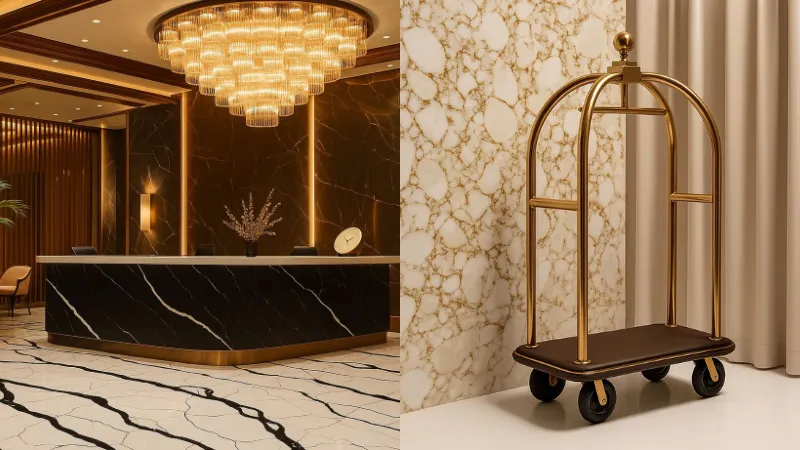
Dark quartz supports bolder, more dramatic hospitality environments, often paired with brass or warm lighting accents.

Subtle, understated patterns suit projects aiming for quiet luxury rather than a visually loud material moment.

Selection should account for the lighting design, the scale of the counter, the materials surrounding it, the hotel's brand positioning, and — practically — how visible everyday marks and smudges will be on that particular colour and finish combination. No single colour or pattern family is universally best; the right choice depends on the specific project.

Fabrication Challenges With Super Jumbo Quartz

Large-format material raises the technical bar for fabrication. Cutting a super jumbo slab accurately, forming clean edge profiles, executing precise cut-outs, and managing corners on a piece this size all require equipment and experience beyond what's needed for standard-size slabs.

Handling and support matter throughout the process — large slabs need adequate support during cutting and transport to avoid stress fractures, and seam placement needs to be planned around where the slab can realistically be cut without compromising structural integrity. As slab size and design complexity increase together — more curves, more cut-outs, more corner returns — fabricator capability becomes an increasingly important variable in whether the finished piece matches the design intent. This is a case where the fabricator's track record with large-format material specifically, not just quartz in general, is worth verifying before committing to a design.

Transportation & Handling Considerations

Larger slabs require more careful logistics at every stage: packaging designed to protect the slab edges and face during transit, adequate support during transportation to prevent flexing, careful unloading with appropriate lifting equipment, safe on-site storage before installation, and confirmation that the site itself can actually accommodate a piece this size — doorways, corridors, elevators, and lift routes all need to be checked against the slab's actual dimensions before it arrives.

Weight capacities, packaging standards, and lifting requirements vary by manufacturer and by slab size, so these should be confirmed directly with the supplier and logistics provider rather than assumed. Personnel handling large-format material should be trained specifically for it — general stone handling experience doesn't automatically transfer to super jumbo formats.

For a full breakdown of factory inspection, packaging, and transport considerations for large-format quartz, see [Zero-Damage Stone Exports: Global Logistics at Scale].

Design Before Procurement

Architects and procurement teams coordinating early — before slabs are ordered — tends to prevent the most common and expensive problems on hospitality projects. Early coordination should cover slab dimensions and quantity, layout and pattern direction, seam positions, fabrication requirements, delivery scheduling, on-site storage, and installation sequencing.

Deciding these details after material has already been ordered often leads to waste, mismatched batches, or design compromises that could have been avoided with earlier planning.

Common Mistakes When Specifying Super Jumbo Quartz for Hotels

Choosing slabs without checking exact dimensions. This happens when teams assume "super jumbo" means the same thing across manufacturers. It can result in a design that doesn't actually fit the intended slab, discovered only at fabrication. Prevent it by requesting a technical data sheet before finalizing any layout.

Ignoring site access. Teams sometimes design around a slab size without checking whether it can physically reach the installation point. This can mean a finished piece that can't be delivered without disassembly or damage. Prevent it by walking the delivery route and measuring doorways, corridors, and lifts early.

Treating "super jumbo" as a universal size. As covered above, this leads to budget and layout assumptions based on the wrong dimensions. Prevent it by sourcing dimensions from the specific product, not the category name.

Planning seams too late. When seam location is decided during fabrication rather than design, the result can be a seam falling somewhere highly visible. Prevent it by finalizing seam placement as part of the counter drawings.

Ignoring pattern direction. This can produce visually mismatched veining across a counter or feature wall. Prevent it by confirming slab orientation with the fabricator before cutting.

Underestimating fabrication complexity. Complex geometry combined with large-format material can exceed a fabricator's practical capability. Prevent it by verifying the fabricator's specific experience with large-format quartz, not just quartz generally.

Failing to coordinate transportation. Late transportation planning can delay a project or damage material in transit. Prevent it by confirming logistics requirements alongside the design, not after ordering.

Selecting based only on appearance. Choosing a slab purely on colour or pattern without confirming technical suitability can create performance or fabrication issues later. Prevent it by reviewing the technical specification alongside the aesthetic one.

What Hotel Architects & Procurement Teams Should Ask Suppliers

  • What are the exact slab dimensions for this product line?
  • What thicknesses are available?
  • What is the slab weight?
  • What finishes are available for this product?
  • How consistent is colour and pattern across production batches?
  • How much batch-to-batch variation should be expected?
  • What technical documentation is available (data sheets, care guidance)?
  • What handling requirements apply to this slab size?
  • What packaging is used for transport?
  • Can the supplier support project-scale quantities on this project's timeline?
  • What is the expected lead time from order to delivery?
  • Can matching material be supplied later if replacement is needed?
  • What fabrication support does the supplier offer or recommend?
  • What installation guidance is provided for this product?

Each of these questions matters because hospitality projects run on tight schedules and can't easily absorb a mismatched batch, an unexpected lead time, or a slab that arrives without adequate technical documentation.

For quartz applications beyond the lobby — reception desks, conference tables, and executive offices in commercial settings — see [Quartz for Commercial Reception Desks & Office Interiors].

Supplier Capability for Five-Star Hotel Projects

A strong B2B supplier for a hospitality project should be able to demonstrate consistent manufacturing quality, genuine project-scale production capacity, reliable slab availability, quality control processes, complete technical documentation, appropriate packaging, dependable logistics, active project coordination, a workable sample approval process, and a plan for replacement material if something is damaged or needs to be matched later.

Hotel projects generally demand more from a supplier than selecting one attractive slab — the relationship needs to hold up across an entire project timeline, including the possibility of changes, delays, or replacement needs.

Large-Format Quartz vs. Design Complexity

Larger slabs can support larger, more ambitious visual compositions — but slab size and design complexity interact rather than existing independently. A curved reception desk with multiple returns may still require more than one piece even with super jumbo material, simply because of how the geometry falls relative to the slab's dimensions. Cut-outs for equipment or cabling reduce the usable area of any given slab, regardless of its overall size. And even with generous slab dimensions, where the seam falls remains a design decision that has to be made deliberately rather than left to chance.

Practical Specification Checklist

Design

  • Confirm slab dimensions
  • Confirm colour
  • Confirm finish
  • Plan pattern direction
  • Plan seam locations

Technical

  • Confirm thickness
  • Confirm product specifications
  • Confirm support requirements
  • Confirm heat exposure requirements

Fabrication

  • Confirm fabricator capability with large-format material
  • Confirm edge details
  • Confirm cut-outs
  • Confirm tolerances

Logistics

  • Confirm packaging
  • Confirm transport method
  • Confirm site access
  • Confirm unloading plan
  • Confirm on-site storage

Procurement

  • Confirm quantity
  • Confirm availability
  • Confirm batch consistency
  • Confirm lead time
  • Confirm replacement strategy

FAQ

What are super jumbo quartz slabs?

They're engineered quartz slabs manufactured in dimensions larger than standard-size slabs, giving designers more surface area before a seam becomes necessary. Exact dimensions vary by manufacturer.

Are super jumbo quartz slabs suitable for hotel lobbies?

They can be, particularly for reception counters and feature surfaces where visual continuity matters. Suitability depends on the specific product, the counter design, and site conditions.

Can large quartz slabs reduce visible seams?

Yes, in appropriately designed layouts. They don't guarantee a completely seam-free result, since geometry, cut-outs, and fabrication limits still affect seam placement.

Can quartz be used for hotel reception counters?

Yes, quartz is commonly used for reception counters due to its combination of appearance options and relative durability, though it should be evaluated against the specific project's performance requirements alongside other materials.

What should architects consider when specifying jumbo quartz?

Whatsapp Chatx

Hi! Click one of our representatives below to chat on WhatsApp or send us email to sales@paradigmquartz.in

user Contact Us
+91 99440 00900
Visualizer