
01
NOV
2026
Cement-based and epoxy terrazzo combine decorative aggregates with different binding materials, resulting in distinct installation requirements and performance characteristics. Cement-based terrazzo offers traditional mineral aesthetics and includes systems suitable for certain exterior applications. Epoxy terrazzo provides greater matrix colour control, thinner installations, and design flexibility, making it popular for contemporary interiors. The right choice depends on the project location, substrate condition, structural requirements, design intent, maintenance expectations, and available installation expertise.
Terrazzo is valued for its ability to combine decorative aggregates, distinctive patterns, and durable architectural surfaces. However, choosing the aggregate is only part of the specification. The binder holding those aggregates together also influences the material\'s appearance, thickness, installation process, and suitability for different environments.
Two major categories dominate modern terrazzo specifications: cement-based terrazzo and epoxy terrazzo.
Although both create polished composite surfaces, they are not interchangeable. Architects and developers need to understand how their characteristics differ before selecting a system for residential, commercial, or institutional projects.
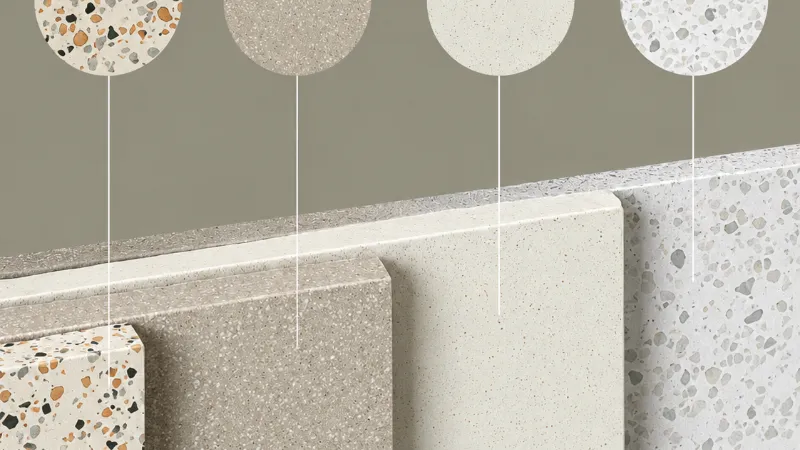
Terrazzo consists of decorative aggregates, such as marble, granite, glass, or other suitable materials, embedded in a binding matrix. The surface is cured, ground, and finished to expose the aggregates and create the desired appearance.
The primary difference is the binder:
There is also an important distinction within cement-based terrazzo itself. Systems include sand-cushion, bonded, monolithic, and polymer-modified cement terrazzo. Each has different thickness, substrate, and installation requirements.
Comparison factor | Cement-Based Terrazzo | Epoxy Terrazzo |
Binder | Cementitious matrix | Epoxy resin matrix |
Appearance | Traditional mineral character | Greater matrix colour control |
Thickness | Varies by system; some require substantial build-up | Generally a thinner topping |
Weight | Depends on the complete system and underbed | Generally lighter |
Design flexibility | Pigmented matrices and decorative aggregates | Extensive matrix colours and aggregate combinations |
Chemical resistance | Depends on composition and protective treatment | Generally offers better chemical resistance |
Exterior suitability | Specific systems can be designed for exterior use | Generally intended for interior applications |
Substrate requirements | Vary by system | Requires a flat, properly prepared substrate |
Installation | Can involve substantial preparation and curing | Often has a shorter installation-to-finishing cycle |
Neither system is universally better. The right specification depends on the intended application and site conditions.
Cement-based terrazzo has a long history in architectural flooring. Its cementitious matrix provides a mineral appearance that works well with natural aggregates such as marble and granite.
Traditional aesthetic: Cement-based matrices create a distinctive appearance that complements natural stone aggregates and architectural detailing.
Exterior applications: Certain cement-based systems, particularly appropriately specified rustic terrazzo, can be used outdoors. Their suitability depends on the finish, exposure conditions, drainage, and installation design.
Variety of system options: Architects can specify different cement-based systems according to the available floor depth, substrate, and project requirements.
Suitable for different architectural applications: Depending on the system, cement terrazzo can be used for floors, stairs, and other architectural surfaces.
Some cement-based systems require greater floor build-up, which can create challenges in renovation projects or buildings with limited floor-height allowances.
The cement matrix also needs appropriate curing and installation conditions. Inadequate substrate preparation, uncontrolled movement, or poorly coordinated construction joints can contribute to cracking.
The matrix colour may also show more variation than a carefully controlled resin-based system.
Epoxy terrazzo uses a resin-based binder to hold the decorative aggregates together. Its thinner installation profile and broad matrix colour options have made it a popular choice for contemporary commercial and institutional interiors.
Greater colour flexibility: Epoxy matrices can be produced in a broad range of colours, allowing designers to coordinate the floor with branding, furniture, architectural finishes, and interior palettes.
Thinner installation: Epoxy terrazzo is commonly specified as a relatively thin topping, making it useful where additional floor height is restricted.
Lower weight: Compared with thicker cement-based systems, epoxy terrazzo generally adds less weight to the structure.
Chemical resistance: Properly formulated epoxy systems offer good resistance to many chemicals and staining substances. Actual resistance depends on the resin formulation and exposure conditions.
Design precision: Designers can create detailed colour combinations, aggregate distributions, decorative bands, and geometric patterns.
Epoxy terrazzo is generally intended for interior use. Exposure to ultraviolet radiation and temperature variations can affect the resin matrix, so it should not automatically be specified for exterior applications.
It also requires a properly prepared substrate. An uneven or unsuitable base can affect the finished appearance and contribute to installation problems.
The material and application must be evaluated for substrate moisture conditions, bonding requirements, and compatibility with the selected resin system.
Both cement-based and epoxy terrazzo can provide durable surfaces when correctly specified, installed, and maintained. Their performance differences become more important when the project involves heavy foot traffic, chemical exposure, outdoor conditions, or demanding maintenance schedules.
Terrazzo\'s durability depends on several factors, including binder quality, aggregate selection, surface thickness, installation workmanship, and substrate stability.
Epoxy terrazzo offers a resilient resin matrix and good resistance to many common stains and chemicals. Cement-based terrazzo provides a hard-wearing surface but may require more attention to moisture protection and surface treatment.
Neither system is immune to cracking, particularly when underlying substrate movement and construction joints are not properly addressed.
Both systems benefit from regular cleaning with suitable, non-aggressive products.
Epoxy terrazzo typically has a less absorbent matrix and may require less protective treatment. Cement-based terrazzo generally benefits from an appropriate sealer to help reduce absorption and staining.
The finished surface, aggregate composition, and manufacturer\'s maintenance instructions should determine the cleaning and resealing schedule.
Epoxy terrazzo generally allows a thinner and quicker pour-to-grind process than traditional cement systems.
Cement-based installations may involve additional underbeds, reinforcing, curing stages, and floor-height coordination, depending on the system.
Actual project schedules depend on site preparation, environmental conditions, system specifications, and the installer.
The choice becomes easier when the application and construction constraints are considered together.
Project requirement | System to evaluate |
Contemporary office interiors | Epoxy terrazzo |
Hotels and commercial lobbies | Either, depending on design and site conditions |
Interior renovation with limited floor height | Epoxy terrazzo |
Outdoor architectural flooring | Suitable exterior-grade cement terrazzo |
Custom corporate colour schemes | Epoxy terrazzo |
Traditional stone-inspired flooring | Cement-based terrazzo |
Multi-storey commercial buildings | Lightweight epoxy systems may be advantageous |
These are starting points, not fixed rules. A specialist terrazzo contractor should assess the complete installation conditions before final specification.
For a broader comparison of terrazzo with another natural surface material, explore Terrazzo vs. Marble: Best Investment for Your Home.
Project teams evaluating different manufacturing and installation approaches can also read Precast vs Poured-in-Place Terrazzo: Which Is Right for Your Project?.
Before choosing a terrazzo system, consider the following:
These decisions should be coordinated during the design and specification stage rather than left until installation begins.
Not universally. Epoxy terrazzo offers thinner installation, extensive colour options, and good chemical resistance. Cement-based terrazzo offers different system options, traditional aesthetics, and appropriately specified exterior applications.
Certain cement-based systems are designed for exterior applications. Epoxy terrazzo is generally less suitable for outdoor exposure because of UV sensitivity and thermal movement considerations. Always confirm the system\'s intended application.
Often, but not in every case. Traditional cement-based systems may require substantial underbeds, while epoxy terrazzo is typically installed as a thinner topping. Some cement-based systems are also available in thinner configurations.
Epoxy terrazzo generally has lower absorption and may require less protective treatment. Cement-based terrazzo typically benefits from sealing. Both require regular cleaning and appropriate maintenance.
Both can incorporate similar decorative aggregates and achieve polished finishes. However, matrix appearance, colour consistency, and overall visual character can differ. Sample approval is important when a specific appearance is required.
Cement-based and epoxy terrazzo offer different advantages, and selecting between them requires more than comparing appearance or initial cost.
Cement-based terrazzo is worth considering for traditional aesthetics and suitable exterior systems, while epoxy terrazzo offers greater matrix colour flexibility, a thinner installation profile, and strong performance in many interior applications.
For architects, designers, and developers, the most reliable decision comes from evaluating the binder, aggregate, substrate, installation conditions, and intended use together.
Planning a residential or commercial surface project? Connect with Paradigm Surfaces to explore terrazzo design possibilities and discuss material considerations for your application.

Whatsapp Chatx
Hi! Click one of our representatives below to chat on WhatsApp or send us email to sales@paradigmquartz.in
 |
Contact Us +91 99440 00900 |

 13 November, 2026