
27
AUG
2026
Terrazzo is often specified for its surface qualities — pattern, aggregate, colour, finish. But the performance of a terrazzo installation is decided long before any of that is visible. It's decided by two factors that rarely make it into design mood boards: thickness and substrate.
Get these wrong, and even a well-fabricated terrazzo system can crack, delaminate, or fail to hold its joints. Get them right, and the same material performs for decades. This guide is written for architects, contractors, developers, and procurement teams who need to understand how terrazzo thickness and substrate decisions get made — not a single number to copy into a spec sheet.
There is no universal terrazzo thickness. There is no single substrate that works for every terrazzo system. Both depend on the terrazzo system selected, the installation method, the binder type, the application, expected loading, and the condition of the base itself. This article walks through that decision chain.
Terrazzo thickness isn't an isolated spec — it's the output of several interconnected decisions.
Different terrazzo systems — cementitious, epoxy, precast, poured-in-place — are engineered with different structural logics. A system's binder, aggregate loading, and reinforcement method all influence how thin or thick it can safely be poured or cast. Thickness should always be confirmed against the specific system's product documentation rather than assumed from general industry familiarity.
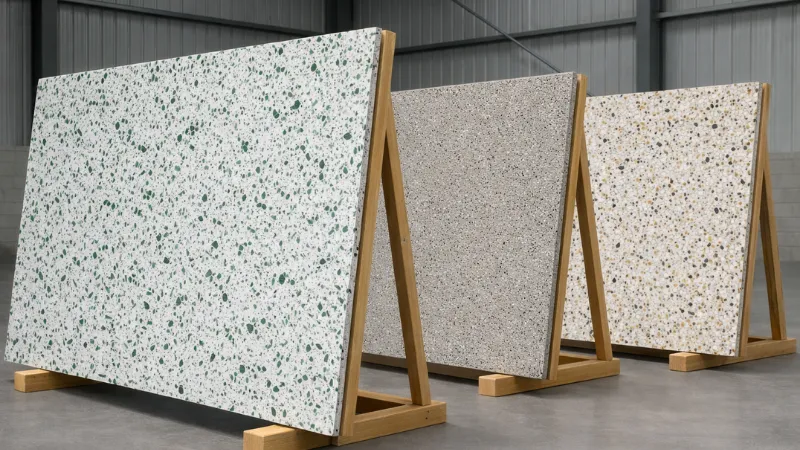
Poured-in-place terrazzo is built up in layers directly on site, over a prepared substrate, so its thickness is tied to that substrate's condition and the underlayment or structural topping used beneath it. Precast terrazzo, by contrast, is manufactured as panels or slabs under factory-controlled conditions, so its thickness is set during fabrication and is a function of panel size, structural support, and handling requirements rather than site conditions.
Cementitious terrazzo and epoxy terrazzo behave differently in terms of cure time, flexibility, and how they bond to a substrate. These differences affect what thickness a manufacturer will specify for a given system — a matter that should be verified in product technical data sheets, not generalised across binder types.
A terrazzo floor, a terrazzo wall panel, a terrazzo stair tread, and a terrazzo countertop are not interchangeable use cases. Each application places different structural and support demands on the material, which is why thickness recommendations for one application shouldn't be assumed to apply to another.
Pedestrian corridors, retail floors, hospitality lobbies, and areas with equipment movement or concentrated point loads all place different demands on a terrazzo system. Expected traffic and loading are core inputs into thickness and substrate decisions, not an afterthought considered post-installation.
For precast terrazzo, larger panel or slab formats introduce their own handling, support, and installation considerations. A larger panel may need to be engineered differently than a smaller one even within the same product line, which is one reason thickness is confirmed at the system level rather than treated as fixed across a manufacturer's full range.
The substrate is the underlying surface or structural layer that the terrazzo system is installed onto or supported by. It might be a structural concrete slab, a prepared underlayment, or another base approved for the specific terrazzo system being used.
Not every terrazzo system is compatible with every substrate. A system engineered for a structural concrete slab isn't automatically appropriate over a timber subfloor, an existing tiled floor, or a lightweight underlayment — compatibility needs to be confirmed against the manufacturer's installation requirements for that specific product.
Before any terrazzo system goes down, the substrate is assessed against several criteria.
The base needs to be appropriate for the loading conditions and the terrazzo system being installed over it. A substrate that can't support the intended traffic or use will compromise the terrazzo above it regardless of how well the terrazzo itself is specified.
An uneven substrate creates uneven terrazzo — inconsistent thickness across the floor, pooling during pour-in-place installation, and inconsistent support for precast panels. Flatness tolerances should be checked against the requirements of the system being installed.
Dust, oil, loose particles, and construction debris on the substrate surface interfere with bonding. Substrate preparation typically includes thorough cleaning before any terrazzo system, primer, or adhesive is applied.
Moisture in the substrate can matter significantly for certain terrazzo systems and their associated binders or adhesives. Acceptable moisture levels vary by system and should be confirmed against manufacturer requirements rather than assumed to be a fixed threshold across all terrazzo products.
The substrate and the terrazzo system need to be chemically and mechanically compatible — this includes the primer or bonding agent used, where applicable. Compatibility should be verified with the supplier before installation, not assumed based on general practice.
Existing cracks or movement in the substrate can transfer directly into the terrazzo surface above it if not properly addressed. This is one of the more consequential substrate issues, and it's covered in more detail below.
A practical substrate preparation sequence typically includes:
Each of these steps should follow the terrazzo manufacturer's documented installation requirements for the specific product being used, rather than a generic preparation checklist applied uniformly across systems.
Substrate movement is one of the more overlooked causes of terrazzo failure, and it deserves particular attention during specification.
Buildings move. Thermal expansion and contraction, structural settlement, concrete shrinkage, and differential movement between building elements all place stress on whatever is installed above the substrate. If that movement isn't accounted for, it transfers directly into the terrazzo system — showing up as cracking, joint separation, or surface irregularities over time.
This is why terrazzo specification isn't just a surface-level material decision. Movement behaviour in the substrate needs to be understood and coordinated with the terrazzo system's joint design from the outset, rather than addressed reactively after installation.
Control joints, movement joints, and construction joints all serve to manage stress and movement within a terrazzo installation. Joint layout should be coordinated with:
There's no universal joint spacing that applies across every terrazzo system and project — spacing should be determined based on the specific system's requirements and verified with the manufacturer or a qualified installer.
Choosing between precast and poured-in-place terrazzo has direct implications for both thickness and substrate strategy.
Precast terrazzo is manufactured under factory-controlled conditions as panels or slabs. This allows tighter dimensional consistency, but introduces its own considerations around panel/slab dimensions, installation methods, joint detailing between panels, and handling and transport logistics.
Poured-in-place terrazzo is installed and finished on site. This means substrate preparation, in-situ curing conditions, and field finishing quality have a direct bearing on the final result, and pattern continuity is achieved through on-site work rather than factory production.
Neither system is universally "better" — the right choice depends on project timeline, design intent, site conditions, and the substrate available. For a full comparison of installation methods and project-fit considerations, see our detailed guide, Precast vs Poured-in-Place Terrazzo: Which Is Right for Your Project?
Thickness selection should be evaluated differently depending on where the terrazzo is being installed.
|
Application |
Primary Considerations |
|
Commercial flooring |
Traffic volume, loading, long-term maintenance demands |
|
Residential flooring |
Normal household use, design intent, budget |
|
Hospitality |
High foot traffic combined with aesthetic continuity across large areas |
|
Stairs |
Additional structural detailing, nosing, and safety considerations |
|
Walls |
Different support and attachment requirements than floor systems |
|
Countertops/architectural surfaces |
Application-specific thickness and support requirements |
There is no single thickness that serves all of these applications equally — each should be assessed against its own structural and use-case demands.
A practical decision framework for project teams evaluating terrazzo should account for:
Working through this list before finalising thickness or substrate decisions helps avoid rework later in the project.
Choosing thickness before selecting the system. Thickness is a consequence of the system chosen — not an independent input. Locking in a thickness before confirming the system risks specifying something the manufacturer won't support.
Ignoring existing substrate problems. Terrazzo cannot conceal major substrate defects. Cracks, unevenness, and structural issues in the base will typically surface through the terrazzo above it.
Failing to consider moisture. For moisture-sensitive systems, skipping proper evaluation can compromise bonding and long-term performance.
Ignoring movement. Substrate and building movement that isn't accounted for in joint design is one of the more common causes of visible cracking.
Treating all terrazzo systems the same. Cementitious and epoxy systems, precast and poured-in-place methods, all carry different requirements. Generic terrazzo knowledge doesn't substitute for system-specific documentation.
Using generic installation advice. Manufacturer-specific specifications should always take precedence over general industry assumptions.
Poor coordination between trades. Flooring contractors, structural engineers, MEP teams, and architects all influence how well a terrazzo installation performs — a disconnect between any of them can create substrate or detailing conflicts late in the project.
Before specifying a terrazzo system, it's worth putting these questions directly to the supplier:
Each of these questions closes a gap that, left unanswered, tends to surface as a problem during or after installation.
A professional terrazzo supplier should be able to provide, where applicable:
Requirements vary by product and by project, so this documentation should be requested and reviewed before finalising a specification — not assumed to exist as a standard package across every supplier.
Terrazzo performs best when it's considered during early project planning rather than after the substrate is already built. Early coordination between the architect, structural engineer, flooring contractor, terrazzo supplier, installer, and project manager helps surface incompatibilities — between the chosen system and the planned substrate, for instance — while they're still inexpensive to resolve.
Waiting until the base is already constructed narrows the available terrazzo options and increases the risk of rework, delays, incompatible substrates, detailing conflicts, and material waste.
Before material selection
Before substrate preparation
Before installation
Before handover
What thickness should terrazzo flooring be? There's no single answer — thickness depends on the terrazzo system, installation method (precast or poured-in-place), application, and substrate conditions. It should be confirmed against the specific product's technical documentation.
Does terrazzo require a concrete substrate? Concrete is a common substrate for terrazzo, but not every system requires it, and not every concrete substrate is automatically suitable. Compatibility should be confirmed with the terrazzo system's manufacturer.
What makes a good terrazzo substrate? Structural stability, flatness, cleanliness, appropriate moisture conditions, bonding compatibility, and controlled movement are the core characteristics evaluated before installation.
Can terrazzo be installed over an existing floor? This depends entirely on the terrazzo system and the condition and type of the existing floor. It requires evaluation against the manufacturer's substrate requirements rather than a general assumption either way.
Why does substrate preparation matter? An unprepared or incompatible substrate can cause cracking, poor bonding, uneven surfaces, and joint failures — problems that are difficult and costly to correct once the terrazzo is installed.

 24 September, 2026
Festive Home Makeovers: Refreshing Kitchens & Interiors with Stone
 20 September, 2026
 17 September, 2026
CNC Precision Cutting: How Technology Improves Edge & Inlay Work
 13 September, 2026
NSF & Food Safety Certifications: What They Mean for Quartz Surfaces
 12 September, 2026
Whatsapp Chatx
Hi! Click one of our representatives below to chat on WhatsApp or send us email to sales@paradigmquartz.in
 |
Contact Us +91 99440 00900 |