
30
AUG
2026
Choosing a stone surface for this environment is not simply a question of which material looks best in a rendering. It's a question of how that material performs under repeated cleaning, how it responds to spills and heat, how it holds up to daily impact, and how easily it fits into a restaurant's actual operating rhythm. Performance, hygiene, maintenance, design, and operational continuity all have to be weighed together.
This guide is written for architects, restaurant designers, QSR operators, hospitality developers, contractors, fabricators, and procurement teams evaluating quartz, granite, marble, and terrazzo for food-service environments. No single stone is universally "best" — the right choice depends on where it's going, what it will be exposed to, and how the space will be maintained.
Compared with a typical residential kitchen or office lobby, restaurant and QSR surfaces face a distinct combination of conditions.
High traffic. Customer counters, ordering stations, and dining surfaces see continuous contact throughout service hours, not just a few times a day. That volume of use accelerates wear on finishes and edges.
Frequent cleaning. Restaurant surfaces are cleaned far more often than most commercial applications — sometimes between every transaction. This means the surface's compatibility with routine cleaning products and methods matters as much as its raw durability.
Spills and staining. Food, beverages, oils, and sauces are a daily reality. Stain resistance is not a fixed property of "stone" as a category — it varies by material, finish, sealant status, and how long a spill sits before it's addressed.
Heat exposure. Areas near serving lines, beverage stations, and cooking zones can expose surfaces to elevated temperatures. Actual exposure levels and the manufacturer's stated temperature limits for a specific product both need to be checked before specification — general assumptions about a material category aren't enough.
Impact and abrasion. Trays, carts, utensils, and equipment moving across a surface all day create a different wear pattern than typical residential or office use.
Different zones in a food-service space carry different requirements, so material decisions should be made zone by zone rather than for the project as a whole.
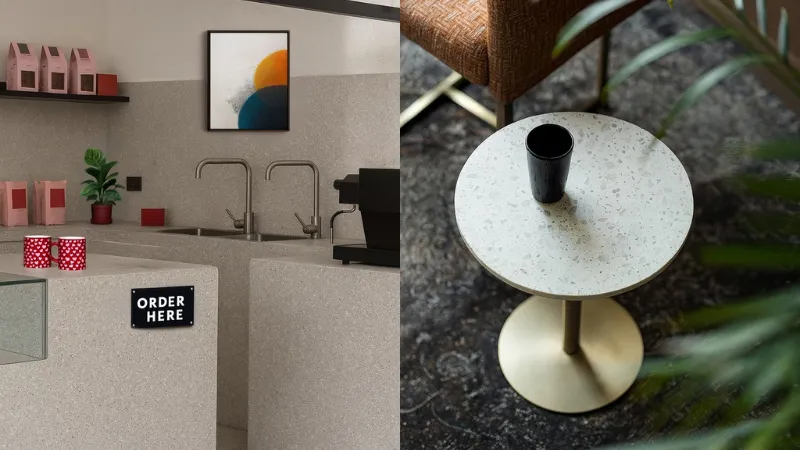
Customer-service counters. These are highly visible, brand-defining surfaces that also see constant contact and cleaning. Appearance, durability, and ease of maintenance all matter here.
Cashier and ordering counters. High-contact zones where a consistent, presentable finish needs to hold up under repeated wiping and occasional impact from trays or devices.
Bar and beverage counters. Frequent exposure to moisture, ice, and spilled drinks makes cleaning compatibility and moisture behaviour important considerations.
Dining areas. Tables, banquette surrounds, and feature counters need to balance everyday wear with the aesthetic experience guests actually see up close.
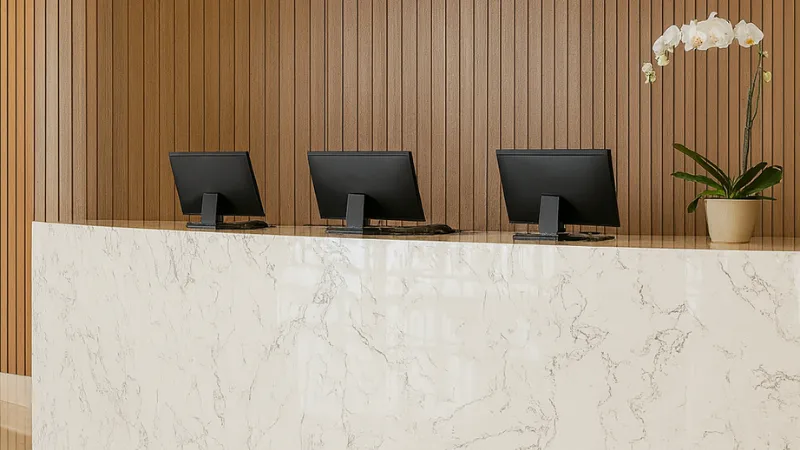
Reception and entry areas. First-impression zones where design continuity with the rest of the space often outweighs heavy-use performance requirements.
Wall features. Decorative applications where fabrication quality and visual impact are the priority, with lighter performance demands than horizontal work surfaces.
Back-of-house areas. Operational zones with their own cleaning, durability, and, in food-preparation areas, additional regulatory and hygiene considerations. Not every stone suitable for a customer-facing counter is automatically suitable for back-of-house food-contact use — that has to be evaluated for the specific application.
A useful evaluation framework looks at multiple factors together rather than optimising for one:
No single characteristic should drive the decision on its own. A highly stain-resistant surface that can't be sourced again for a future repair, for instance, creates its own operational problem down the line.
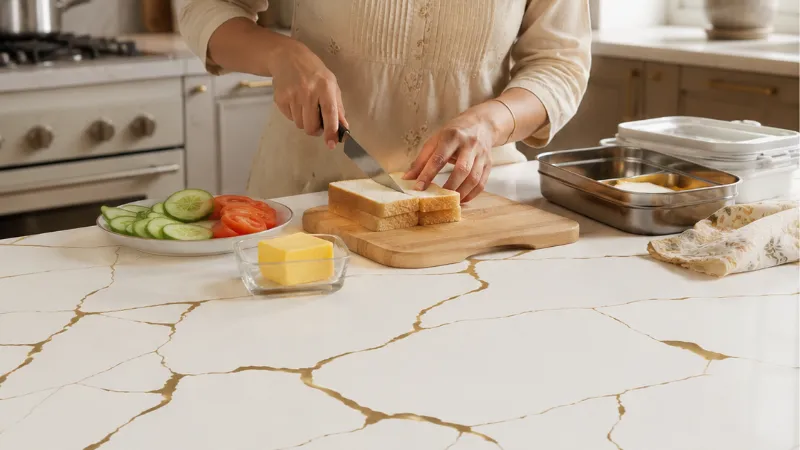
Engineered quartz is frequently considered for customer-facing counters, ordering stations, and other commercial areas where a consistent, repeatable appearance across multiple slabs — or multiple locations — is valuable, alongside a wide design range and generally straightforward routine cleaning.
That said, quartz is not heat-proof, and manufacturer-stated temperature limits vary by product. Areas near hot equipment, chafing dishes, or direct heat sources need to be checked against documented limits rather than assumed safe. Stain and scratch resistance also vary between quartz products depending on resin content, finish, and manufacturing process — these aren't universal properties of "quartz" as a category, and product-specific technical data should guide the decision.
Natural granite is used in some restaurant settings for counters, service areas, and feature surfaces where its pattern variation and long-term durability under heavy use fit the design intent.
Granite characteristics — hardness, porosity, and stain behaviour — vary by variety and finish, so performance shouldn't be generalised across "granite" as a single material. A honed and a polished finish of the same variety, for example, can behave differently in grip, visible wear, and cleaning response. Each variety-finish combination should be evaluated for the specific application.
Marble appears in restaurant design most often in reception areas, decorative feature surfaces, and higher-end hospitality settings where its aesthetic qualities align with the brand's design intent.
Marble is porous and can be prone to staining and etching from acidic substances common in food-service environments — citrus, wine, vinegar-based sauces — so its use in high-spill, high-traffic food-contact zones needs careful thought about finish, sealing, and maintenance. Marble is not automatically the easiest surface to maintain in a restaurant, though in customer-facing but lower-contact areas — reception desks, decorative walls — its maintenance demands are easier to manage than on a heavily used service counter.
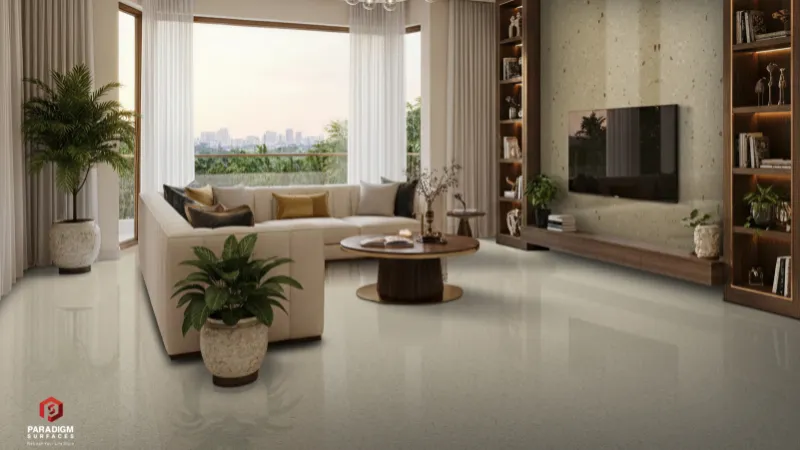
Terrazzo is worth considering for flooring, wall applications, and decorative zones in restaurant interiors, particularly where a restaurant wants visual continuity across a large footprint or a distinctive, brand-specific look through custom aggregate selection.
In food-service settings, terrazzo's jointless (poured-in-place) or tightly fitted (precast) installation can support cleaning in high-traffic dining and circulation areas, though the choice between the two systems should be driven by schedule, substrate conditions, and design requirements rather than a blanket preference. As with the other materials here, terrazzo's performance depends on the specific mix, finish, and installation quality — not the category alone.
Hygiene in a restaurant environment is a system, not a single material property. A few factors determine how cleanable and hygienic a stone surface actually is in use:
Surface condition. A properly finished, undamaged, and well-maintained surface is easier to clean effectively than one with chips, worn sealant, or degraded finish, regardless of the underlying material.
Joints and transitions. Poorly detailed joints, seams, or transitions between materials can trap debris and moisture, making routine cleaning less effective even on an otherwise durable surface.
Cleaning compatibility. Cleaning products and methods need to match the specific material and finish. A chemical that's safe on one stone or finish can damage another, so cleaning protocols should be confirmed with the supplier or fabricator rather than assumed.
Spill response. Prompt cleaning of spills — particularly acidic or oil-based substances — matters more in food-service environments than in most other commercial settings, simply because of how frequently spills occur.
Maintenance. Even durable, dense materials require appropriate ongoing care; no stone surface is maintenance-free.
Food-contact applications. Surfaces used directly for food preparation or food contact may be subject to additional project-specific, regulatory, or operational requirements beyond general commercial use. These requirements vary by jurisdiction and project type and should be confirmed directly rather than assumed from general material claims.
It's important to be precise here: cleanability and hygienic surface design are not the same thing as verified antimicrobial performance. A surface can be easy to clean and support good hygiene outcomes through its finish, joint detailing, and maintenance without being inherently antibacterial, self-sanitizing, or infection-proof. Claims of verified antimicrobial performance apply only to specific tested and certified products — they shouldn't be assumed for a stone category as a whole. For a broader look at how surface hygiene is actually evaluated in Indian food environments, see Why Bacteria-Free Surfaces Matter in Indian Kitchens Today.
Hygiene expectations also shift depending on the type of facility. A useful comparison for understanding how requirements change between sectors is Terrazzo for Educational & Healthcare Facilities: Hygiene Meets Design, which looks at how material performance considerations differ between food-service, healthcare, and educational environments — each with its own traffic patterns, cleaning protocols, and regulatory context.
Performance requirements don't have to come at the cost of design impact. Stone surfaces contribute to brand identity in several ways:
Colour. Sets the tone for a space — warm neutrals for a comfortable dining atmosphere, bold or saturated tones for a fast-paced QSR brand.
Veining. Natural veining in marble and some granites can create a premium visual effect in feature areas, particularly reception zones and accent walls.
Aggregate. In terrazzo, aggregate type, size, and colour create a distinctive, hard-to-replicate look that can become part of a brand's visual signature across locations.
Finish. Polished, honed, or textured finishes affect not just appearance but also tactile character, cleaning behaviour, and how clean a surface visually reads to customers even between deep cleans.
Pattern and zoning. Changes in material, colour, or pattern can be used to define different customer zones — separating ordering areas from dining areas, for instance — without relying on physical partitions.
Multi-location restaurant brands face a different set of constraints than a single independent restaurant. Consistency requirements include:
These considerations matter more for chains and multi-site rollouts than for a one-off interior, where slight variation between slabs may even be a desirable design feature.
Maintenance should be part of the material decision, not an afterthought once installation is complete. A realistic plan covers:
Requirements differ by material, finish, location, traffic level, and cleaning chemicals in use — a plan written for one restaurant's marble reception desk won't necessarily apply to another's granite service counter. No stone surface should be marketed as "maintenance-free."
Choosing only for appearance. A visually striking material that doesn't hold up to the space's actual traffic and cleaning demands creates ongoing operational problems.
Ignoring heat exposure. Assuming a material category is heat-resistant without checking the specific product's documented limits against the actual conditions in that zone.
Ignoring cleaning procedures. Specifying a material without confirming it's compatible with the cleaning products and frequency the operation will actually use.
Assuming every stone is food-service suitable. Not every finish or product within a stone category is appropriate for direct food-contact or heavy food-preparation zones — this needs project-specific evaluation.
Choosing without considering replacement. Selecting a material or specific batch that may not be available again if a section needs repair or a new location needs to match.
Ignoring batch variation. Particularly relevant for natural stone, where slab-to-slab variation can affect consistency across a large project or a multi-location rollout.
Poor fabrication planning. Cut-outs, edge profiles, seams, and joints all affect how the finished surface performs and how easy it is to clean — these details need attention during specification, not as an afterthought during installation.
A practical supplier checklist for restaurant and QSR projects should cover:
Each of these questions matters because restaurant projects — especially multi-location ones — depend on a supplier's ability to deliver consistent material and support over the life of the project, not just for the initial installation.
The table below is a starting framework, not a fixed recommendation. Final selection should always be checked against the manufacturer's technical guidance for the specific product being considered.
|
Restaurant Zone |
Key Considerations |
|
Reception |
Appearance, durability, branding |
|
Ordering Counter |
Traffic, cleanability, appearance |
|
Beverage Area |
Moisture, spills, cleaning |
|
Dining Area |
Wear, aesthetics, maintenance |
|
Back-of-House |
Operational requirements, cleaning, durability |
|
Feature Wall |
Appearance, fabrication, maintenance |
|
High-Heat Area |
Product-specific temperature performance |
Large restaurant programs — multi-location rollouts, high surface-quantity projects, or fast-opening schedules — introduce considerations that don't apply to a single-site project: inventory planning against the rollout schedule, production consistency across large orders, quality control at the supplier's facility, packaging that protects material through transport, logistics and lead times for each phase, technical support throughout the project, and documentation for specification and compliance.
For programs at this scale, supplier capability — consistency, communication, logistics — can matter as much as the material choice itself.
What are the best stone surfaces for restaurants? There's no single best material — the right choice depends on the specific zone, its traffic and spill exposure, heat conditions, and the restaurant's maintenance capacity.
Are quartz surfaces suitable for QSRs? Quartz is commonly considered for customer-facing counters where consistent appearance and routine cleanability matter, but it is not heat-proof, and product-specific temperature limits should be checked for any area near heat sources.
Is granite suitable for restaurant countertops? Granite can be suitable for counters and service areas, but performance varies by variety and finish, so each option should be evaluated individually rather than assumed based on the category.
Is marble a good choice for restaurant interiors? Marble can work well in reception and decorative applications where design intent aligns with its characteristics, but its susceptibility to staining and etching makes it a less straightforward choice for high-spill, high-traffic food-contact zones.
Can terrazzo be used in restaurants? Yes, terrazzo is used in flooring, walls, and decorative zones in restaurant interiors, with the choice between precast and poured systems depending on project schedule and substrate conditions.
Which stone surface is easiest to maintain? Maintenance ease depends on the specific product, finish, and how it's used — no stone is maintenance-free, and claims to that effect should be treated with caution.
Are stone surfaces hygienic for restaurants? Stone surfaces can support good hygiene outcomes through proper finish, joint detailing, and maintenance, but this is a matter of cleanability and hygienic design — not the same as verified antimicrobial or self-sanitizing performance, which applies only to specific tested and certified products.
Are quartz countertops heat-proof? No. Quartz has documented temperature limits that vary by product, and areas near heat sources should be checked against the specific manufacturer's guidance.
What should restaurants ask stone suppliers before purchasing? Availability, technical documentation, cleaning guidance, heat limitations, fabrication support, replacement handling, and project-scale supply capacity are all worth confirming before specification.
 20 September, 2026
 17 September, 2026
CNC Precision Cutting: How Technology Improves Edge & Inlay Work
 13 September, 2026
NSF & Food Safety Certifications: What They Mean for Quartz Surfaces
 12 September, 2026
 05 September, 2026
Marble in Temple & Religious Architecture: Tradition Meets Craft

Whatsapp Chatx
Hi! Click one of our representatives below to chat on WhatsApp or send us email to sales@paradigmquartz.in
 |
Contact Us +91 99440 00900 |
